The tradition & historical record
6 min read · 2 sourcesAfrican textiles are textiles from the various peoples, cultures, and locations of the African continent. These are produced in many distinctive styles; using varied fabrics, dyeing methods, manufacturing techniques, and technologies; and for myriad ritual, decorative, and functional ends. These textiles hold cultural significance and also are important historical documents of African design. Textiles were historically produced and used in every major region of Africa; however, archaeological finds of historic textiles in Africa are frequently described as "exceptional" due to the frequent degradation of such organic artifacts in tropical, temperate, and even semi-arid environments. Nonetheless, textiles of notable antiquity have been found in Africa, including a flax fragment found at the site of Upper K, Fayyum region, Egypt, which has been dated to the neolithic period of Ancient Egyptian history, also called the Pre-dynastic period; a cotton textile fragment at a site near Aksum, Ethiopia, dating to the late fifth or early sixth centuries AD; and a wool textile fragment found at the site of Kissi, Burkina Faso, dating to the early sixth century AD. 1
History
Some of the oldest surviving African textiles were discovered at the archaeological site of Kissi in northern Burkina Faso. They are made of wool or fine "short" animal hair including dried skin for integrity. Some fragments have also survived from the thirteenth century Benin City in Nigeria. Historically textiles were used as a form of currency since the fourteenth century in West Africa and Central Africa. Below is an overview of some of the common techniques and textile materials used in various African regions and countries. 1
Textile weaving
Stripweaving, a centuries-old textile manufacturing technique of creating cloth by weaving strips together, is characteristic of weaving in West Africa, who credit Mande weavers and in particular the Tellem people as the first to master the art of weaving complex weft patterns into strips. Findings from caves at Bandiagara Escarpment in Mali propose its use from as far back as the 11th century. Stripwoven cloths are made up of narrow strips that are cut into desired lengths and sewn together. From Mali, the technique spread across West Africa to Ivory Coast, Ghana, and Nigeria. Raffia fiber from dried stripped leaves of raffia palm was commonly used in West Africa and Central Africa for raffia cloth since it is widely available in countries with grasslands like Cameroon, Ghana, and Nigeria. Cotton fibers from the kapok tree has been extensively used by the Dagomba to produce long strips of fibre to make the Ghanaian smock. Other fiber materials included undyed wild silk used in Nigeria for embroidery and weaving, as well as barkcloth from fig trees used to make clothes for ceremonial occasions in Uganda, Cameroon, and the Congo. Over time most of these fibers were replaced with cotton. Textiles were woven on horizontal or vertical looms with variations depending on the region. 1
Horizontal looms: include single heddle looms, double heddle frame looms with foot treadles, and horizontal pit-treadle looms. However, there are many variations, for example, the Yoruba. In Nigeria use single heddle looms with extra string heddles but Kuba raffia weavers set the heddles at 45 degrees. Double heddle frames are used by Asante silk weavers, Ewe and Cameroonian cotton weavers, and the Djerma weavers in Niger and Burkina Faso. 1
West Africa
Asante Kente: The Asante were the dominant people of West Africa's Gold Coast, present-day Ghana. Controlling the only source of gold available, the Asante traded with other African states and later with Europeans after contact with the Portuguese in the 15th century. With their wealth and a rich source of gold, they made all forms of jewelry, amulets, and talismans from the gold. In the 18th century, the Asante acquired knowledge of the strip weaving technique from Bondoukou through trade that is seen in the present-day Ivory Coast. The Asante became respected for strip-weaving Kente cloths in cotton and silk in the weaving village of Bonwire. The term Kente means basket and refers to the checkerboard pattern of the cloths. The cotton for early Kente was locally grown, but the silk was imported since silk moths are not indigenous to Ghana. In present day, Kente is found worn across the population; however, its use is still concentrated among high society members and the wealthy. This stems from its long history of association with Asante royalty, who had also used it to denote their spiritual power, documented through later findings in their shrines to deities. Kyekye of the Bondoukou people: Kyekye is a fabric originating from the Bondoukou people of Ivory Coast, and is often woven in a geometric pattern with blue indigo dye serving as the primary color scheme. The kyekye also predates the Akan Kente fabric, influencing its subsequent development. Ewe Kente: Kente cloth is also worn by the Ewe, located in Ghana and Togo and Benin Republic. The Ewe, a Gbe speaking group who originated from Nigeria, had a tradition of horizontal loom weaving, adopted the double heddle frame loom style of Kente cloth weaving from the Asante with some important differences. 1
East Africa
Ethiopian Cotton: With the exception of Ethiopia, textile weaving is less common in East Africa. Cotton grows abundantly in Ethiopia and Sudan, with Sudan being one of the first cotton weaving locations in the world. Ethiopia has conditions that are good for growing cotton thus cotton was then locally grown and woven into cotton fabric on horizontal pit-looms mainly used by those with high social status. Embroidery is done by hand traditionally, and is originally the job of the men. Ugandan barkcloth: barkcloth in Uganda is traditionally made with the ficus natalensis plant and is harvested during the wet season. Afterwards, it is beaten laboriously until it develops a soft texture, in which then the fabric can be woven to satisfy the desired purpose. 1
Central Africa
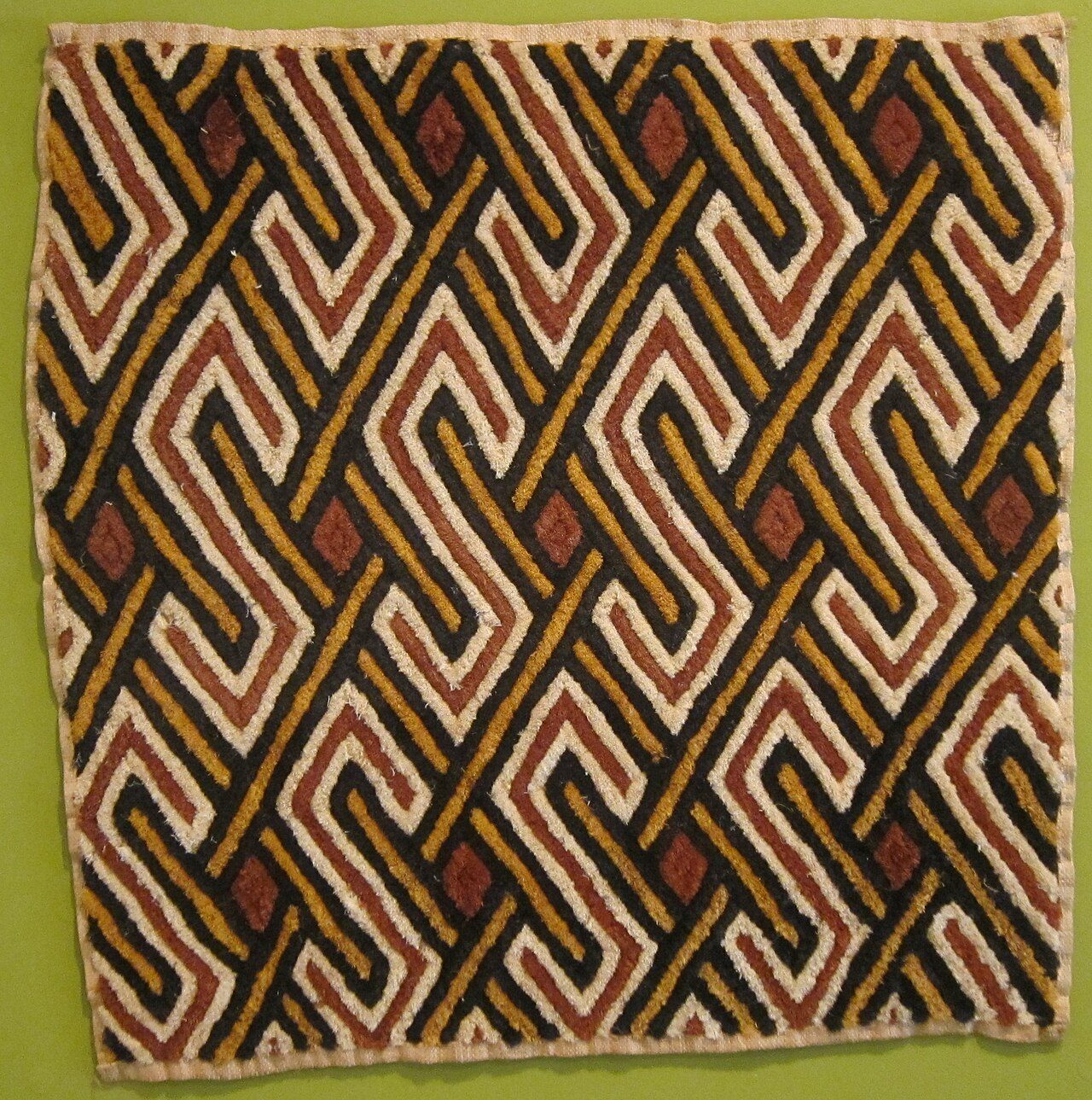
Kuba raffia: The Kuba of Central Africa have one of the widest range of textile skills in Africa including weaving cloth from leaves of raffia palm as well as embroidery, applique, cut-pile and resist dyeing techniques. The Kuba kingdom's need for traditional textiles for ceremonies has sustained their traditional cloth and weaving techniques since the height of the kingdom between the 17th and 19th century until today. Unlike in other regions in Africa where over time locally grown and homespun materials were replaced by mill spun and synthetic fabrics, the Kuba raffia looms could not be adapted for weaving cotton or other fibers; thus helping to retain traditional skills. raffia is one of the most important indigenous fibres used in Central Africa including Cameroon, Republic of Congo and the Democratic Republic of Congo. It grows in abundance and sustainably in the swampy lands. 1
The text above is adapted from the Wikipedia article “African textiles”, available under the Creative Commons Attribution-ShareAlike 4.0 licence. 1
African textiles is textiles originating in and around continental Africa or through the African diaspora, according to the structured record cited below. This entry was generated automatically from that record and has not yet been reviewed by a person familiar with the tradition. 2
The source record links this tradition to 2 external registers, which can be verified through the citation. 2