The tradition & historical record
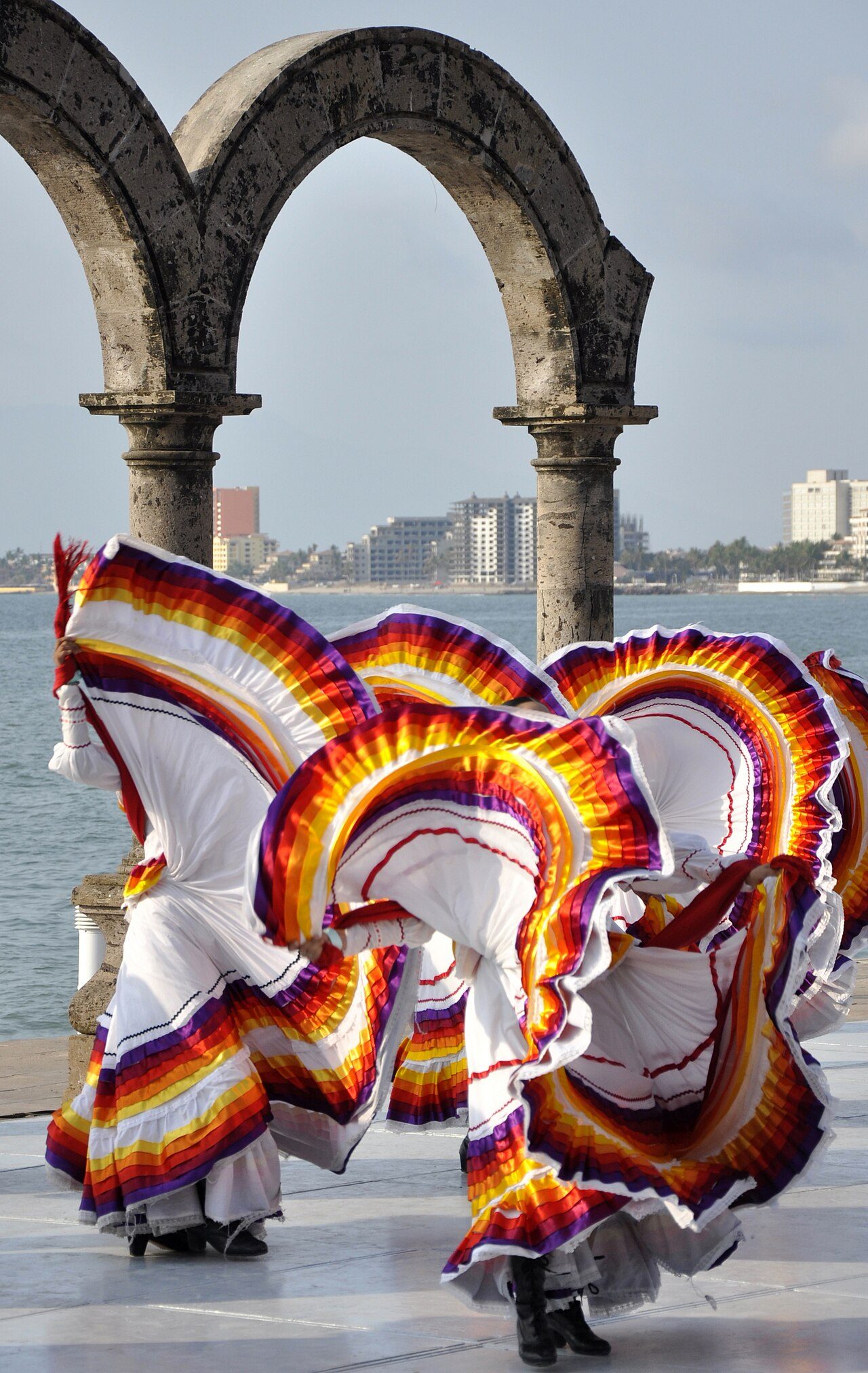
6 min read · 2 sourcesFolk dance of Mexico, commonly known as baile folklorico or Mexican ballet folk dance, is a term used to collectively describe traditional Mexican folk dances. Ballet folklórico is not just one type of dance; it encompasses each region's traditional dance that has been influenced by their local folklore and has been entwined with ballet characteristics to be made into a theatrical production. Each dance represents a different region in Mexico illustrated through their different zapateado, footwork, having differing stomps or heel toe points, and choreography that imitates animals from their region such as horses, iguanas, and vultures. 1
History
Mexico's modern folk dance tradition is a blending of elements from its Indigenous, African, and European heritage. Before the arrival of the Spanish, indigenous dance developed with strong ties to the religious practices. For the Aztecs, there were two levels of dance, those for the elite, and those for the common people, such as Netotilitzli. After the Conquest, the Spanish initially worked to eradicate indigenous dances, considering them “too pagan” and succeeded with a number of forms, especially those associated with the priest and ruling classes. However, they were unable to eradicate the more popular forms, especially in the rural and more inaccessible regions of New Spain. Instead, evangelizers worked to adapt dances to Christianity, giving them new meanings. For this reason, most of these dances have suffered at least some modification since the pre Hispanic era. 1
Dance evolved drastically from 1520 to 1750, mostly among the indigenous, African, and mestizo descendants. One of the first adaptations was allowing the indigenous to continue dances with religious aspects but in homage to the Virgin Mary or other Catholic personage. One of the first areas to begin innovation was Tlaxcala, were dances to reenact the Conquest are traced. In addition, a number of European dances, music and instruments were introduced including Moros y cristianos (a mock battle between Moors and Christians brought to the central states), Los Archos, Las Escadas, Los Machetes, El Paloteo, Las Cintas and Los Doce Pares. Other European dances include La Zambra, La Zarabanda, La Contradanza, seguidillas, fandangos, huapangos, jotas, boleros, zambras and zapateados. In some cases, these dances were modified or given entirely new choreography in Mexico. 1
Diversity
Mexican folk dance is an uneven synthesis of different cultural traditions. Its historical roots is the synthesis of indigenous, European and African cultural influences but it continues to evolves with influences from modern pop culture. It is not one particular style but rather a collection of various regional and ethnic traditions. Dance traditions vary widely over Mexico's expanse. In some areas, such as the Isthmus of Tehuantepec and the Yucatan Peninsula, the pre Hispanic elements have almost completely disappeared. In others, such as Totonacapan (in the states of Veracruz and Puebla), among the Nahuas of Guerrero and State of Mexico, the Huastecs of San Luis Potosí and areas in the northwest of the country, indigenous elements have been strongly maintained. Those considered native or indigenous include Los Voladores, Los Quetzales, and the Deer Dance. Dances that survive relatively intact are in areas that were remote from colonial authorities. However, their “purity” is under debate. Most of the ancient dances have been modified in various ways, although most of these are superficial with the basic movements remaining intact from the pre Hispanic period. The aspect to change most has been costuming. The materials used to produce dance costumes, adapting to new materials and the loss of old ones. The use of hides and feathers is the oldest of costuming traditions, but today costumes can be made of synthetic fabrics and other modern elements. One common substitution is the use of mirrors on costumes to replace polished stones. 1
Instruments used to accompany the dancers have changed to include those from Europe, but pre Hispanic ones, especially drums and flutes, are still used. 1
Ballet Folklórico de México
Mexico's best known folk dance troupe is the Ballet Folklórico de México, which was founded by dancer Amalia Hernández in 1952. The troupe consists of forty dancers, a mariachi band and sixteen other musicians. Counting support staff such as costume and set designers, the organization involves over 600 people. The group began with eight dancers with sporadic performances until they were invited to perform on television for a program called Función de Gala. Since 1959, it has performed regularly at the Palacio de Bellas Artes in Mexico City. In 1970 was named the official folk dance company of Mexico. Amalia Hernández was a pioneer in ballet folklórico, she experimented with traditional Mexican dances that were originally created for religious purposes. Hernandez infused Mexican folk legends with ballet influences such as pointed toes, exaggerated movements, and highly choreographed routines. Hernandez was able to shift the dances from their original religious purposes, not meant to be watched, into the theatrical production that ballet folklórico is known for today. Hernandez has become a cultural ambassador for Mexico through her work with the dance troupe, choreographing more than forty different ballets covering sixty regions of Mexico. It wasn't until her death in 2000 at the age of 84, that the troupe gained a new director her grandson Salvador López. The repertoire maintains the traditional dances although somewhat updated with the choreography of López. Dances include the Jarabe tapatío, the Deer Dance and the Aztecs/Concheros. It also has “new” dances such as Adelitas, which honors the women of the Mexican Revolution. The group has performed over 15,000 times in sixty counties and 300 cities in Europe, Asia and Latin America. 1
Querétaro
The Concheros dance is also known as Apaches, Indios and Chichimecas. It is a ritual dance that likely developed after 1522 as a means of preserving some elements of pre Hispanic culture. Members of these dance troupes are part of formal societies and unlike some other groups admit women. These troupes perform at annual festival mostly in honor of patron saints—especially in the Villa de Guadalupe, Amecameca, Chalma and Los Remedios. These are located north, east, south, and west of Mexico City, a remnant of the importance of the cardinal directions to indigenous people. Dancers dress in indigenous style garb that can include loincloths, feathered headdresses body paint and more. They are accompanied by indigenous drums, flutes and small lutes made from armadillo shells (showing European influence). The symbolism and most of the steps are indigenous. 1
Mexico City
The Chinelos dance is derived from Carnival celebrations in what are now the south of Mexico City, Morelos and the State of Mexico. 1
The text above is adapted from the Wikipedia article “Mexican folk dance”, available under the Creative Commons Attribution-ShareAlike 4.0 licence. 1
Mexican folk dance is type of dance, according to the structured record cited below. This entry was generated automatically from that record and has not yet been reviewed by a person familiar with the tradition. 2
The source record links this tradition to 7 external registers, which can be verified through the citation. 2