The tradition & historical record
6 min read · 2 sourcesModern western square dance (also called western square dance, contemporary western square dance, modern American square dance or modern square dance) is one of two American types of square dancing, along with traditional square dance. As a dance form, modern western square dance grew out of traditional square dance in the American West. The term western square dance, for some, is synonymous with "cowboy dance" or traditional western square dance. Therefore, this article uses the term "modern western square dance" to describe the contemporary non-historical dance which grew out of the traditional dance. Square dancing was the national folk dance of the United States in 1982 and 1983. Modern western square dance, like traditional square dance, is directed by a caller. In modern western square dance the caller strings together a sequence of individual square dance calls to make a figure or sequence. These calls are the building blocks of the choreography that is danced by the individuals – square dancers – in the squares. There are eight people (four pairs of males and females, traditionally) in each square; at a dance there may be many squares. Generally speaking, each of these squares dances independently of each other, with the exception of specialty or "gimmick" dances, where there might be some crossover of dancers from one square to another. While traditional square dance uses live music, modern western square dancing is usually played from recordings. 1
Learning modern western square dance
Dancers learn the individual calls at sponsored square dance clubs classes, taught by square dance callers. Clubs also sponsor special social and dance evenings, as well as open square dances. The individual calls are categorized as belonging to a particular dance program, or level of difficulty. Each dance program has a list of defined dance steps, which is associated with it. These lists of dance steps are managed, and universally recognized. Callerlab, the International Association of Square Dance Callers, the largest international square dance association, manages the most universally accepted and recognized lists. There are four main levels, some of which are divided into sublevels: Mainstream, Plus, Advanced (2 sublevels), and Challenge (5 sublevels, the top two levels of which are not managed). In general, the first three levels are more physically active than the challenge level (often referred to as challenge square dance). Challenge square dance is more cerebral, and focuses on problem solving. At the basic square dance levels, the dancer is introduced to many square dance calls. A few of the most fundamental and well-known calls are "do-si-do", "promenade", and "right and left grand". Among other things, the dancer is additionally trained to move smoothly and rhythmically, to appreciate timing, to execute the steps from many different positions and in many different formations, and to cooperate effectively with the others in their square so that they get the most out of their dance experience. Starting at the advanced level, the square dancer is introduced to square dance concepts, an addition to a call which modifies it in some way. Concepts often generalize more basic notions of square dancing and are an important aspect of challenge square dance. 1
Dancing modern western square dance
Each dance round, called a tip, typically consists of two dances. The first dance part is known as a hash call, which is characterized by its unstructured and often puzzling dance choreography. The music is usually instrumental and the calls are typically not sung, but rather rhythmically spoken. The second dance part of a square dance tip is a singing call. The dance instructions are sung as well as the lyrics during the long duration calls. The music are often popular songs and the calls are timed to fit. During a singing call the female dancers temporarily switch partners in a counter-clockwise order around the square until they return to their original partners. The caller restores the original order of the square both at the end of the hash and the singing call. The duration time of a tip may vary, but is usually between ten and twenty minutes. Between tips, dancers are generally encouraged to find other dance partners and form new squares for the next tip. 1
Dress code
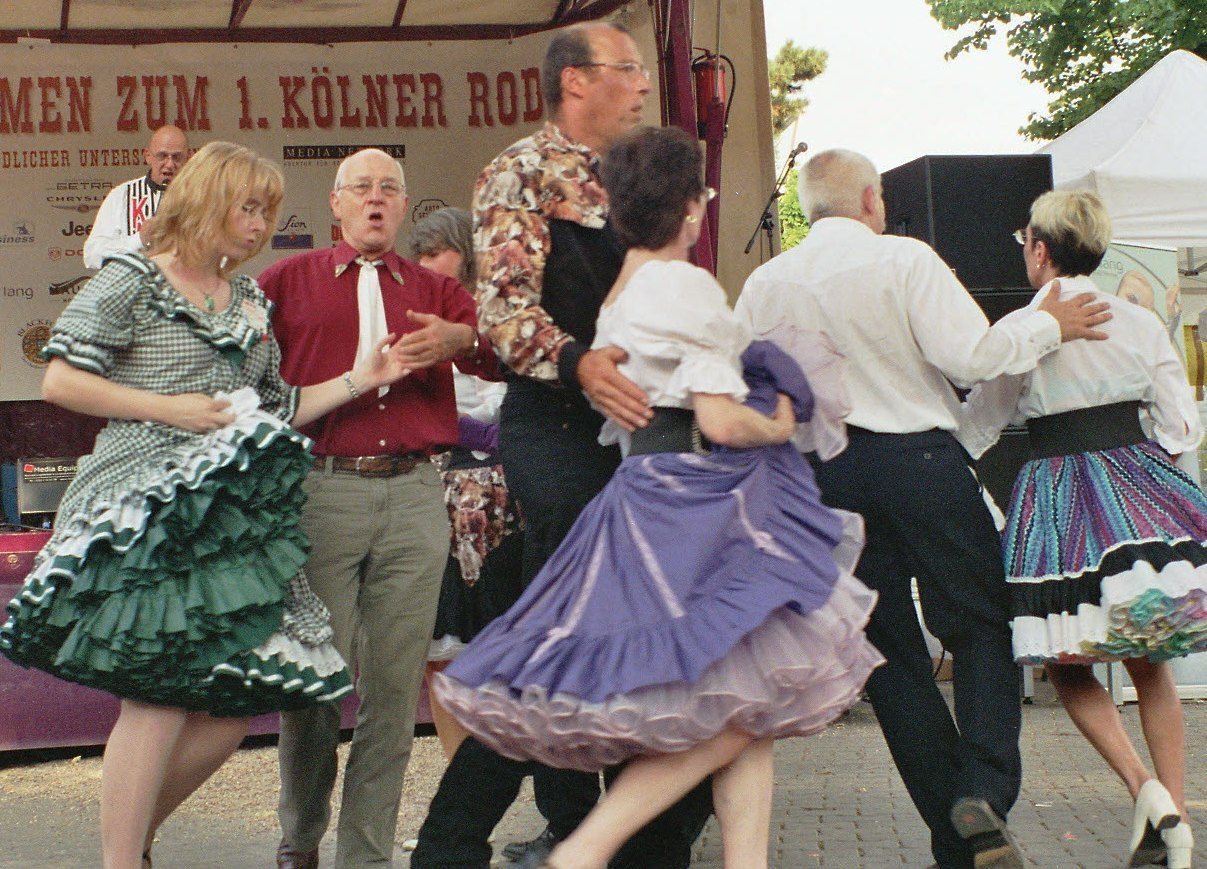
Modern western square dance has developed a "look" that has become known as "square dance attire". This style of dress developed when square dancing's popularity in the United States increased after World War II, and began soaring during the 1950s and early 1960s. Several factors may have helped influence the look that has become known as "square dance attire". These include the visibility and popularity of square dance performers such as Lloyd "Pappy" Shaw‘s traveling troupe of "teenage cowboy square dancers"; the way square dancing and the west were portrayed in western movies and early television; and the popular clothing styles of those times, for example poodle skirts. 1
At the non-challenge levels, particularly in North America, of modern western square dancing participants are often expected to wear western-style square dance outfits, or "square dance attire", especially at large dances. Over the years, there has been much discussion within square dancing circles about relaxing the dress code, and this has led to the adoption of alternative less restrictive attire designations— "proper" attire and "casual" attire. Clubs that sponsor dances are free to select a less restrictive dress code and are encouraged to advertise the dress code that is appropriate for their dance. Some clubs drop the "traditional" dress code requirement for classes and for their summer dances, and some, like challenge groups, gay square dance clubs and youth square dance clubs, have never had a dress code. 1
Flourishes, sound effects, and games
There are many additions to or variations from standard square dancing, which have gained headway over the years. These are not universally recognized, and they are not all equally accepted or considered acceptable under all circumstances, or in all areas. Some of these are of local nature, and others are more widely known. These variations fall into the following basic categories: 1
Flourishes
Flourishes are movements either in addition to or replacing the standard movement as defined. There are certain accepted flourishes in most communities, which may be limited to a club or geographic region, or be common among members of a group such as youth square dancers or gay square dancers. Common flourishes include replacing the dosado with a "highland fling" move, or twirling at the end of a promenade. Flourishes which are very common in a geographic area may be known informally as "regional styling differences". Flourishes are usually omitted with those just learning to dance, as they may obscure the standard movement. 1
The text above is adapted from the Wikipedia article “Modern Western square dance”, available under the Creative Commons Attribution-ShareAlike 4.0 licence. 1
Modern Western square dance is one of two American types of square dancing, according to the structured record cited below. This entry was generated automatically from that record and has not yet been reviewed by a person familiar with the tradition. 2
The source record links this tradition to 1 external register, which can be verified through the citation. 2