The tradition & historical record
7 min read · 2 sourcesThe Aeneid (, ih-NEE-id; Latin: Aeneis [ae̯ˈneːɪs]) is a Latin epic poem that tells the legendary story of Aeneas, a Trojan who fled the fall of Troy and travelled to Italy, where he became the ancestor of the Romans. Written by the Roman poet Virgil between 29 and 19 BC, the Aeneid comprises 9,896 lines in dactylic hexameter. The first six of its twelve books tell the story of Aeneas' wanderings from Troy to Italy, and the latter six tell of the Trojans' ultimately victorious war upon the Latins, under whose name Aeneas and his Trojan followers are destined to be subsumed. The hero Aeneas was already known to Graeco-Roman legend and myth, having been a character in the Iliad. Virgil took the disconnected tales of Aeneas' wanderings, his vague association with the foundation of Rome, and his description as a personage of no fixed characteristics other than a scrupulous pietas, and fashioned the Aeneid into a compelling founding myth or national epic that tied Rome to the legends of Troy, explained the Punic Wars, glorified traditional Roman virtues, and legitimised the Julio-Claudian dynasty as descendants of the founders, heroes, and gods of Rome and Troy. The Aeneid is widely regarded as Virgil's masterpiece and one of the greatest works of Latin literature. 1
Mythology and origins
Although the definitive story of Aeneas escaping the fallen Troy and finding a new home in Italy, thus eventually becoming the ancestor of the Romans, was codified by Virgil, the myth of Aeneas' post-Troy adventures predates him by centuries. As Greek settlements began to expand starting in the sixth century BC, Greek colonists would often try to connect their new homes, and the native people they found there, to their pre-existing mythology; the Odyssey containing Odysseus's travels in many far away lands already provided such a link. Aeneas's story reflects not just Roman, but rather a combination of various Greek, Etruscan, Latin and Roman elements. Troy provided for a very suitable narrative for the Greek colonists in Magna Graecia and Sicily who wished to link their new homelands with themselves, and the Etruscans, who would have adopted the story of Aeneas in Italy first, and quickly became associated with him. Greek vases as early as the sixth century BC provide evidence for these early Greek mythological accounts of Aeneas founding a new home in Etruria predating Virgil by a wide margin, and he was known to have been worshipped in Lavinium, the city he founded. The discovery of thirteen large altars in Lavinium indicates early Greek influence, dating to the sixth through fourth century BC. In the following centuries, the Romans would come in contact with Greek colonies, conquer them and subsume the legend of Aeneas into their own mythological narratives. 1
Story
The Aeneid can be divided into halves based on the disparate subject matter of Books 1–6 (Aeneas' journey to Latium in Italy), commonly associated with Homer's Odyssey, and Books 7–12 (the war in Latium), mirroring the Iliad. These two halves are commonly regarded as reflecting Virgil's ambition to rival Homer by treating both the Odyssey's wandering theme and the Iliad's warfare themes. This is, however, a rough correspondence. 1
Theme
Virgil begins his poem with a statement of his theme (Arma virumque cano ..., "Of arms and the man I sing ...") and an invocation to the Muse, falling some seven lines after the poem's inception (Musa, mihi causas memora ..., "O Muse, recount to me the causes ..."). He then explains the reason for the principal conflict in the story: the resentment held by the goddess Juno against the Trojan people. This is consistent with her role throughout the Homeric epics. 1
Book 1: Storm and refuge
In the manner of Homeric epic, the story begins in medias res (into the middle of things), with the Trojan fleet in the eastern Mediterranean, heading in the direction of Italy. The fleet, led by Aeneas, is on a voyage to find a second home. It has been foretold that in Italy he will give rise to a race both noble and courageous, a race which will become known to all nations. Juno is wrathful, because she had not been chosen in the judgement of Paris, and because her favourite city, Carthage, will be destroyed by Aeneas' descendants. Also, Ganymede, a Trojan prince, was chosen to be the cupbearer to her husband, Jupiter—replacing Juno's daughter, Hebe. Juno proceeds to Aeolus, King of the Winds, and asks that he release the winds to stir up a storm in exchange for a bribe (Deiopea, the loveliest of all her sea nymphs, as a wife). Aeolus agrees to carry out Juno's orders (line 77, "My task is / To fulfill your commands"); the storm then devastates the fleet. 1
Neptune takes notice: although he himself is no friend of the Trojans, he is infuriated by Juno's intrusion into his domain, and stills the winds and calms the waters, after making sure that the winds would not bother the Trojans again, lest they be punished more harshly than they were this time. The fleet takes shelter on the coast of Africa, where Aeneas rouses the spirits of his men, reassuring them that they have been through worse situations before. There, Aeneas' mother, Venus, in the form of a huntress very similar to the goddess Diana, encourages him and recounts to him the history of Carthage. Eventually, Aeneas ventures into the city, and in the temple of Juno he seeks and gains the favour of Dido, queen of the city. 1
Book 2: Trojan Horse and sack of Troy
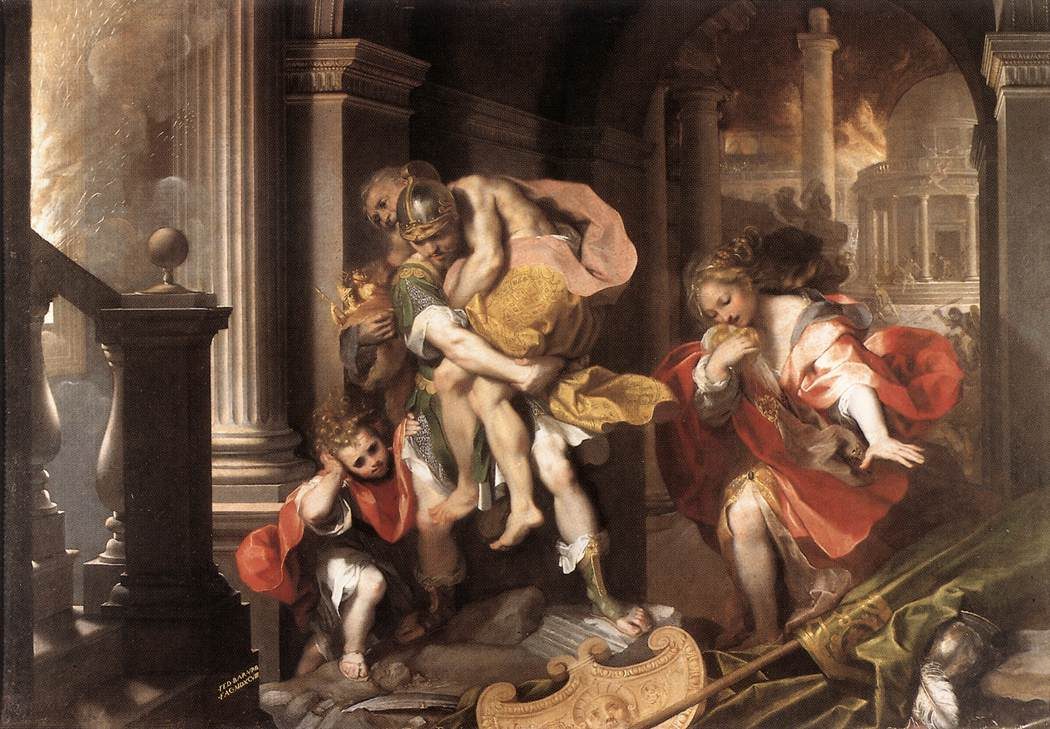
In books 2 and 3, Aeneas recounts to Dido the events that occasioned the Trojans' arrival. Cunning Ulysses devised a way for Greek warriors to gain entry into the walled city of Troy by hiding in a large wooden horse. The Greeks pretended to sail away, leaving a warrior, Sinon, to mislead the Trojans into believing that the horse was an offering and that if it were taken into the city, the Trojans would be able to conquer Greece. The Trojan priest Laocoön saw through the Greek plot and urged the horse's destruction, but his protests fell on deaf ears, so he hurled his spear at the horse. Then, in what would be seen by the Trojans as punishment from the gods, two serpents emerged from the sea and devoured Laocoön, along with his two sons. The Trojans then took the horse inside the fortified walls, and after nightfall the armed Greeks emerged from it, opening the city's gates to allow the returned Greek army to slaughter the Trojans. In a dream, Hector, the fallen Trojan prince, advised Aeneas to flee with his family. Aeneas awoke and saw with horror what was happening to his beloved city. At first he tried to fight the enemy, but soon he lost his comrades and was left alone to fend off the Greeks. He witnessed the murder of Priam by Achilles' son Pyrrhus. His mother, Venus, interrupted him when he was about to murder Helen, and led him back to his house. Aeneas tells of his escape with his son, Ascanius, his wife Creusa, and his father, Anchises, after the occurrence of various omens (Ascanius' head catching fire without his being harmed, a clap of thunder and a shooting star). 1
The text above is adapted from the Wikipedia article “Aeneid”, available under the Creative Commons Attribution-ShareAlike 4.0 licence. 1
Aeneid is epic poem by Virgil, according to the structured record cited below. This entry was generated automatically from that record and has not yet been reviewed by a person familiar with the tradition. 2
The source record links this tradition to 63 external registers, which can be verified through the citation. 2