The tradition & historical record
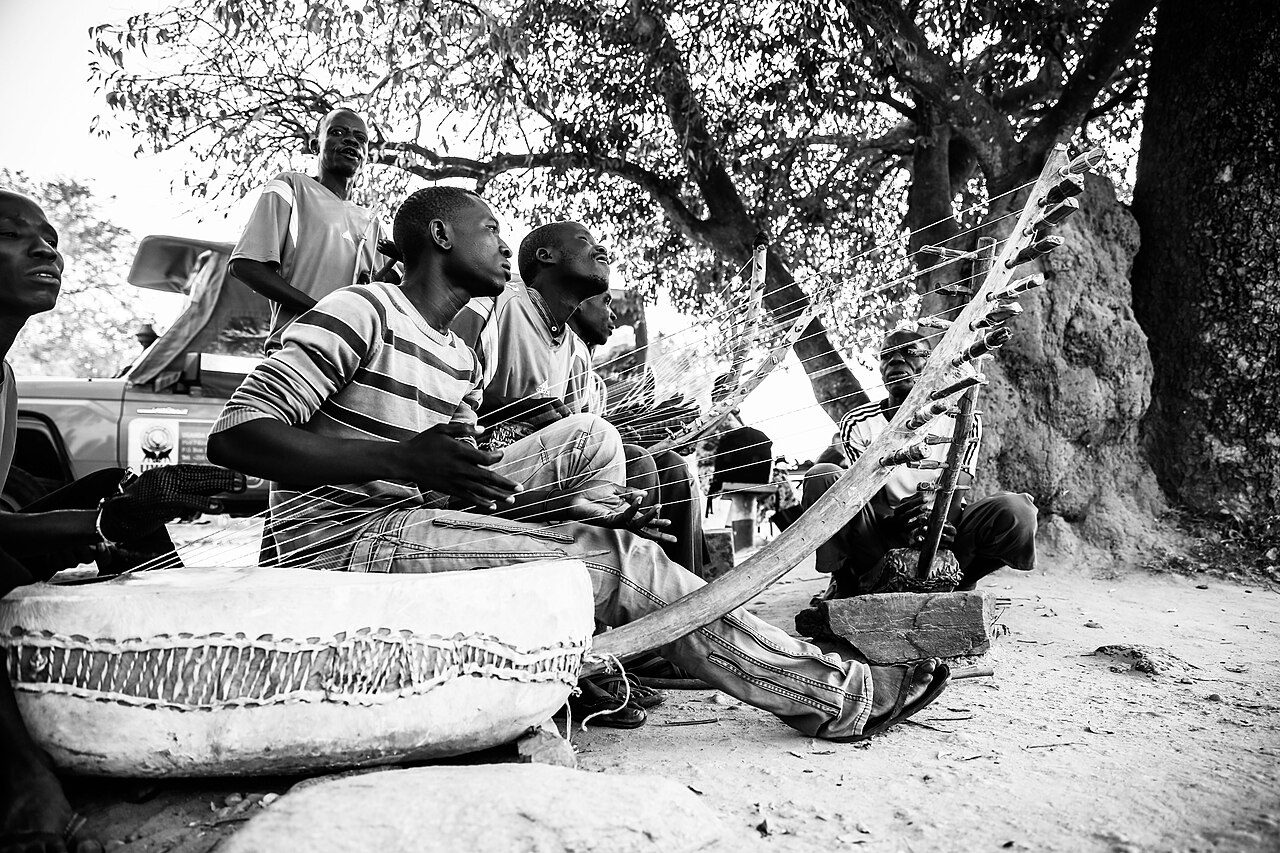
5 min read · 2 sourcesAfrican harps, particularly arched or "bow" harps, are found in several Sub-Saharan African music traditions, particularly in the north-east. Used from early times in Africa, they resemble the form of harps in ancient Egypt with a vaulted body of wood, parchment faced, and a neck, perpendicular to the resonant face, on which the strings are wound. 1
Ancient Egyptian harps
The oldest depictions of harps without a forepillar can be seen adjacent to the Near East, in the wall paintings of ancient Egyptian tombs in the Nile Valley, which date from as early as 3000 BCE. These murals show an instrument that closely resembles the hunter's bow, without the pillar that we find in modern harps. 1
The oldest depictions of harps in Africa date back to the 4th Dynasty of Egypt (around 2500 BC). They represent the already fully developed type of bowed harp with a short spade or shovel-shaped resonance box, which presumably dates back to the 1st dynasty (beginning of the 3rd millennium) and is an independent Egyptian development. Curt Sachs (1928) recognizes the musical bow as the starting point in the gently curved arch of the man-high ancient Egyptian harp, whose attached resonating body was adapted to the lower end of the string carrier and from whose ceiling instead of one string several strings now appear in one plane up to the upper area of the support rod. Towards the end of the Second Intermediate Period (around 1600 BC), new forms of harp appeared, above all the naviforme large bow harp, a head-high standing harp with a long, slender body that only gradually merges into the string carrier. In the Theban tomb TT367, which is dated to the reign of Amenophis II (second half of the 15th century BC), there is also a transportable, smaller, deep-arched harp of the singers (shoulder harp) and, for the first time, a small angular harp. The latter supplanted the ancient Egyptian bowed harps, which continued to exist at best in folk music or in surrounding areas. The Egyptian angular harp later made its way to West Africa, where it survived in the form of the Mauritanian ardin. 1
Ardin
The ardin is a type of angular harp played in Mauritania. It has a resonating body made of calabash, with 10 to 16 strings and metal rings affixed to the top of the neck, and a skin belly. It is played by female griots. The neck sits loosely in the calabash bowl, held in place by the strings. The skin belly can be drummed while the strings are being plucked. The strings act as jingles. 1
Adungu
See Adungu The a'dungu, also called the ekidongo or ennenga, is a stringed musical instrument of the Alur people of northwestern Uganda. It is an arched harp of varying dimensions, ranging from seven to ten string or more. The instrument is made of a hollowed-out slab of wood, which is covered by two pieces of leather, woven together in the center. The upper piece of leather functions as a soundboard, and a wooden rib supports it, serving also as a structure to secure the strings to the soundboard. A curved wooden neck, containing a tuning peg for each .note, is inserted into the end of the instrument's body. The strings run diagonally from the tuning pegs in the neck to the rib in the center of the body. Tuning is not standardized, and players will usually tune by ear to each other shortly before a performance. The a'dungus are not in a particular key, and the tonality can be adapted to the preferences of the performers. 1
Enanga
The ennanga, nanga, nnanga or enanga is a type of arched harp played by the Ganda people of Uganda. The sound box is made of a single piece of wood and roughly hemispherical. The top of the box is a stretched resonant membrane made of antelope skin, tied to a piece of hide at the bottom of the box. The neck is attached to the inside of the box, exits through a small round opening on the membrane, and curves upward for about 60 to 70 cm. Seven or eight strings are attached to a piece of wood inside the box, and extend through the skin to tuning pegs inserted along the neck. Sometimes small metallic rattling pieces are attached to the pegs, to color the sound. It is usually used to accompany men's singing. 1
Abalanga (harpists) are skilled performers and composers who work within a very structured paradigm to ensure that no two abalanga performances are the same. 1
Kundi
The kundi is the five-string harp of the Azande and related people of Central Africa. It is an instrument traditionally played by young men and boys. A similar type of harp played by the Nzakara people. The instruments are well known for their ornately carved heads. The instrument has generally fallen from popularity, though in 1993 some older players were recorded on the album Central African Republic: music of the former Bandia courts. 1
The text above is adapted from the Wikipedia article “African harp”, available under the Creative Commons Attribution-ShareAlike 4.0 licence. 1
African harp is plucked string instrument found in several Sub-Saharan African music traditions, consisting of a parchment faced vaulted body of wood and a neck, perpendicular to the resonant face, on which the strings are wound, according to the structured record cited below. This entry was generated automatically from that record and has not yet been reviewed by a person familiar with the tradition. 2
The source record links this tradition to 1 external register, which can be verified through the citation. 2