The tradition & historical record
6 min read · 2 sourcesThe agung, also transliterated as agong, is a set of two wide-rimmed, vertically suspended gongs used by the Maguindanao, Maranao, Sama-Bajau and Tausug people of the Philippines as a supportive instrument in kulintang ensembles. The agung is also ubiquitous among other groups found in Palawan, Panay, Mindoro, Mindanao, Sabah, Sulawesi, Sarawak and Kalimantan as an integral part of the agung orchestra. 1
Description
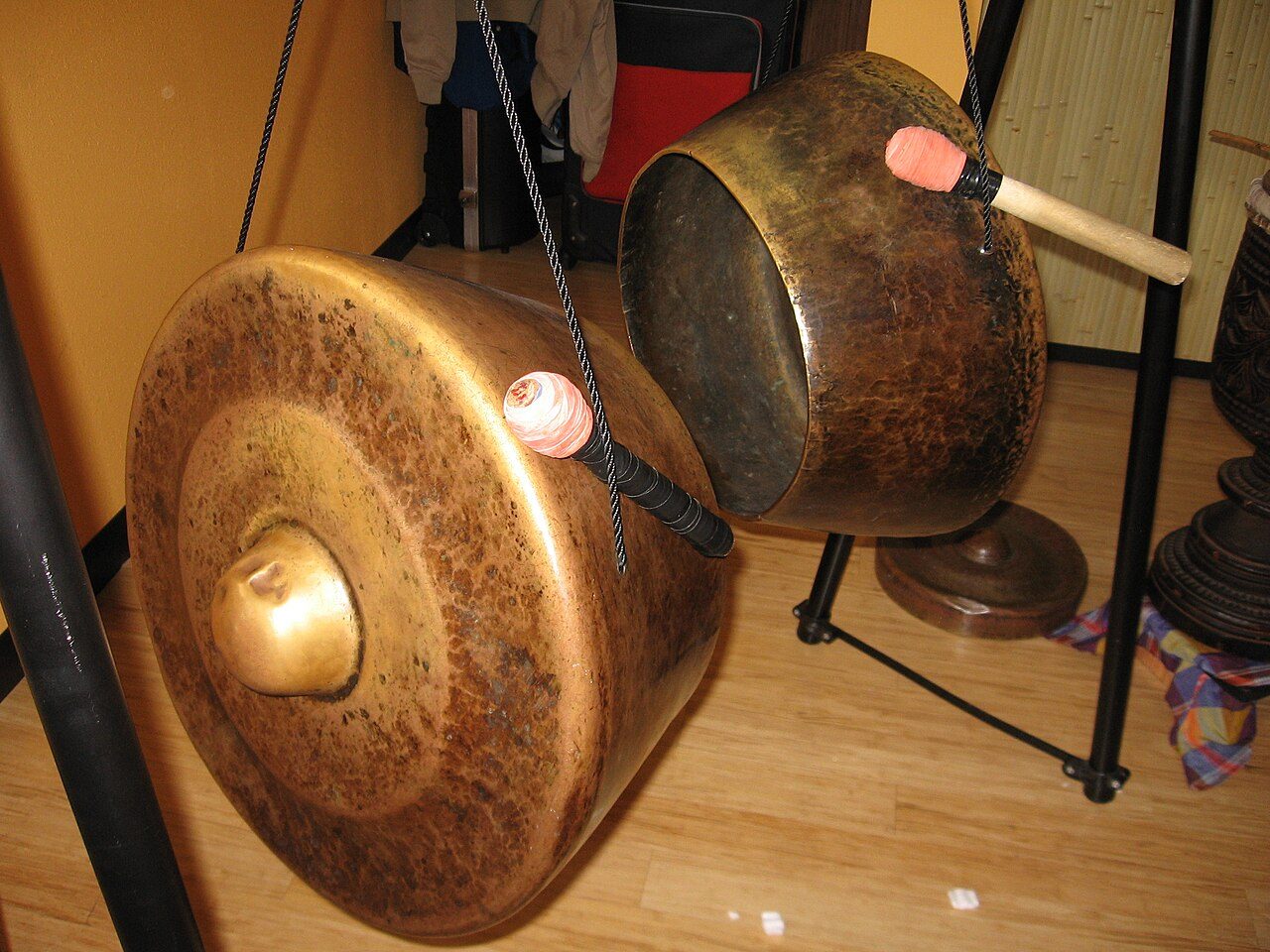
The agung is a large, heavy, wide-rimmed gong shaped like a kettle gong. of the agung produces a bass sound in the kulintang orchestra and weighs between 13 and 16 pounds, but it is possible to find agungs weigh as low as 5 pounds or as high as 20 or 30 pounds each, depending on the metal (bronze, brass or iron) used to produce them. Though their diameters are smaller than the gandingan's, at roughly 22 inches (560 mm) to 24 inches (610 mm) in length, they have a much deeper turned-in takilidan (rim) than the latter, with a width of 12 to 13 inches (330 mm) including the knob. They are hung vertically above the floor at or a bit below the waist line, suspended by ropes fastened to structures like strong tree limb, beam of a house, ceiling, or gong stand. The larger, lower pitched gong of the two is called the pangandungan by the Maguindanao and the p'nanggisa-an by the Maranao. Played on the musician's right, it provides the main part, which it predominantly played on the accents of the rhythmic structure. The smaller, higher pitched gong, the thicker of the two, is called the panentekan by the Maguindanao and the p'malsan or pumalsan by the Maranao. Found on the player's left, it is mainly played on the weaker double and triple beats of the rhythmic structure, in counterpoint to the pangandungan's part. 1
Origins
Scholars seem to agree that the origins of the agung are in Indonesia, noting that the word agung/agong is derived from the Malay agong and Indonesian/Javanese ageng. Further evidence of this comes from a British explorer, Thomas Forrest, who in the 1770s wrote Filipinos were "fond of musical gongs which came from Cheribon on Java and have round knobs on them". 1
Technique
The agung is usually performed while standing beside the instrument, holding the upper edge of its flange between the thumb and other fingers with the left hand while striking the knob with the right hand. The mallets, called balu, are made from short sticks about half a foot in length and padded with soft but tough material such as rubber at one end. Using these balus, players handle the agung similar to the way a brass tom-tom is played. A series of solid, fast decaying sounds are produced using dampening techniques. The desired effect is produced after striking the knob, by leaving one's hand or knee or the mallets themselves on it. When one player is using two gongs, the assistant holding the lower-pitched gong positions it at an angle and dampens its surface using their hands. Recently, new ways of handling the agung have emerged, including grasping a portion of the boss rather than the flange to dampen or using regular strokes upon the busel while striking the surrounding gong surface with the opposite, wooden end of the beater. The latter technique, called katinengka, is used by downriver musicians to produce metallic sounds during kulintang performances. Different combinations of players, gongs and mallets can be used for playing the agung: two players with each assigned their own gong or just one. When playing alone, the agung player could either play both gongs with the player holding the higher-pitched gongs face-to-face, with the lower one held at an angle by an assistant for stability, or just one gong. The latter style, common among downriver Maguindanaos in Simuay, who consider this style an old one, uses only the higher-pitch gong for it, unlike the lower-pitched gong, is considered the lead gong, therefore having primary importance. 1
Kulintang ensemble
The main use for the agung in Maguindanao and Maranao society is as a supportive/accompanying instrument of an orthodox kulintang ensemble. Using basic patterns and interlocking rhythms, a player would use the agung to complement the melody played by the kulintang. The patterns players use are normally considered freer than either the babendil or the dabakan; players could manipulate the patterns freely as long as they conform, reaffirm, reinforce and even generate the rhythmic mode of the piece. The length of the patterns themselves may vary depending on how they fit into the melodic improvisation. Rapid style is useful especially during exhibition of playing skills. Among both the Maguindanao and the Maranao, the agung embodies all that is masculine and thus the agung is traditionally considered a masculine instrument. To be considered a good player, one must possess strength, stamina (playing extremely fast tempos with no mistakes) and endurance. Players must also exhibit improvisation skills for different patterns to be considered as having quality musicianship—lest the audience considers the patterns played repetitions and mundane. Because of the highly skilled nature required for playing the agung, it is not uncommon to see agung players have friendly rivalries during a performance, using tricks in an attempt to throw others off-beat. For instance, if the p’nanggisa's elaborations are so elusive that the p’mals has a hard time ornamenting or if the reversed happens and the p’mals ornaments to the point the p’nanggisa's performance is engulfed, the player that cannot keep up is usually embarrassed, becoming the butt of jokes. 1
Interactions with the opposite sex
There was also a secondary motive for men, especially young males, for learning the agung: the ability to interact with young, unmarried women. Both Maranao and Maguindanao cultures traditionally adhere to Islamic customs which prohibit dating or causal conversation between the opposite sexes (unless married to or related to by blood) and therefore performances such as kulintang music provided the opportunity for such a connection. Among the Maguindanao, the rhythmic modes of duyog and sinulog a kamamatuan allowed agung players to serenade the young, unmarried women on the kulintang. Tidto, the other rhythmic mode, could also be used but players rarely use this for serenading since the kulintang player is usually an older woman. 1
The text above is adapted from the Wikipedia article “Agung”, available under the Creative Commons Attribution-ShareAlike 4.0 licence. 1
agung is Indonesian-Filipino traditional musical instrument, according to the structured record cited below. This entry was generated automatically from that record and has not yet been reviewed by a person familiar with the tradition. 2
The source record links this tradition to 4 external registers, which can be verified through the citation. 2