The tradition & historical record
4 min read · 2 sourcesAinu religion consists of the spiritual beliefs, ritual practices, and mythical stories of the Ainu people. It is broadly animist in nature, with special reverence for animal sacrifice traditionally. Today only a small minority of Ainu people practice traditional Ainu religion, with the majority following Buddhism. 1
Ainu creation myth
There is not a singular creation myth for the Ainu but various traditional accounts of creation. These stories share common characteristics with Japanese creation myths and earth diver creation stories commonly found in Central Asian and Native American cultures. The core of the creation myths involve Kotan-kar-kamuy creating the world, and then various other kamuy creating humans and providing them with the necessities to live. 1
Animism and kamuy
The Ainu are traditionally animists, believing that everything in nature has a kamuy (spirit or god) on the inside. The most important include: 1
Kamuy-huci, kamuy of the hearth Kim-un-kamuy, kamuy of bears and mountains Rep-un-kamuy, kamuy of the sea, fishing, and marine animals Kotan-kar-kamuy, regarded as the creator of the world in the Ainu religion Ae-oyna-kamuy, regarded as a cultural hero and the kamuy who taught the Ainu weaving, carving, fishing, hunting, gathering, architecture, medicine, and religious ritual. Ainu clans would establish agreements with local kamuy to allow the Ainu to use the land to support them and their communities. Ainu craftsmen, and the Ainu as a whole, traditionally believed that "anything made with deep sincerity was imbued with spirit and also became a [kamuy]". They also held the belief that ancestors and the power of the family could be invoked through certain patterns in art to protect them from malignant influences. 1
The Ainu people give thanks to the gods before eating and pray to Kamuy-huci in times of sickness. Kamuy-huci is also considered to be the Ainu people's most important female deity, thus cooking, which is associated closely with fire and the hearth, is a major symbol used in healing rites that occur right beside the hearth through shamans. Traditional Ainu belief holds that their spirits are immortal and that their spirits will be rewarded hereafter by ascending to kamuy mosir (Land of the Gods). The Ainu are part of a larger collective of indigenous people who practice "arctolatry", or bear worship. 1
Kamuy
Alongside kamuy that can be helpful and benevolent, there are kamuy associated with disasters and misfortune called wen-kamuy (evil kamuy). Additional kamuy include: 1
Legendary creature
Huri 1
Shamanism
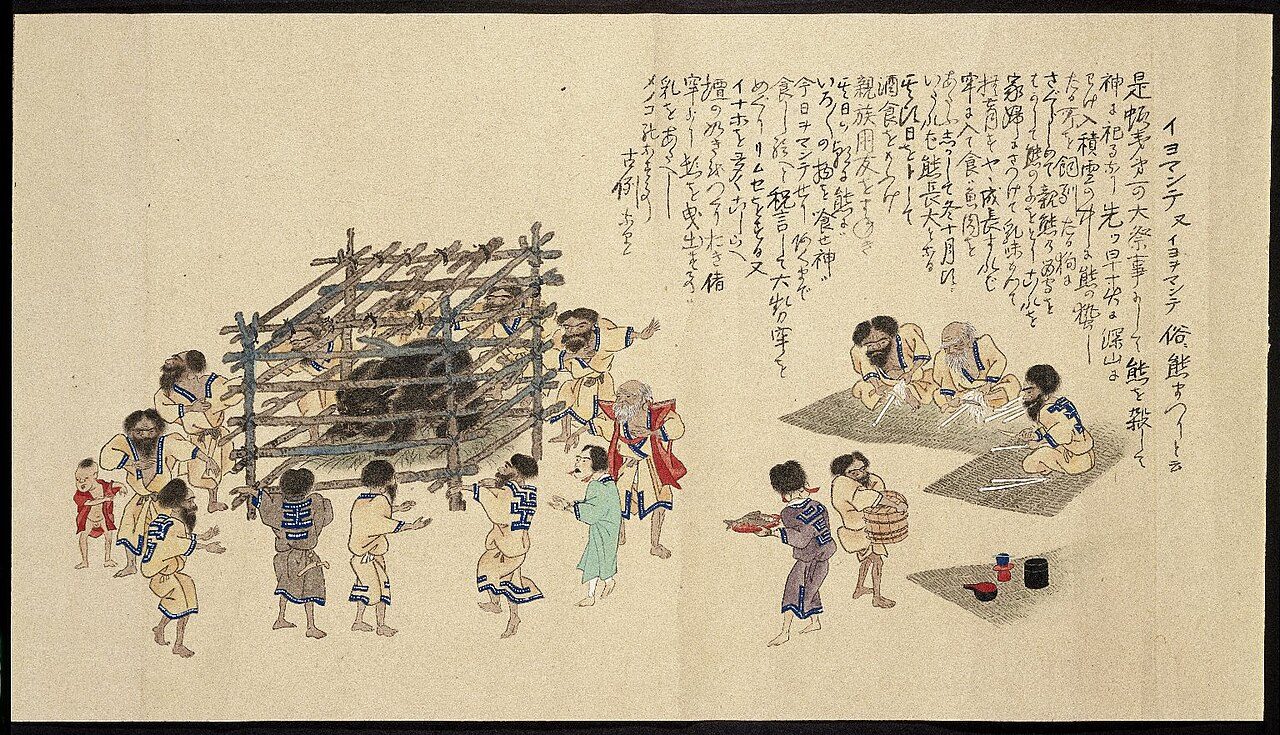
While Ainu religion has no priests by profession, it does include a variety of shamanistic practices, often overseen by the village chief who performs whatever religious ceremonies are necessary. Ceremonies mainly consist of making libations of sake, saying prayers, and offering willow sticks with wooden shavings attached to them. These sticks are called inau (singular) and nusa (plural). Shamanistic practices are observed among the Ainu, and can be broadly divided into Sakhalin-type and Hokkaido-type. The Sakhalin-type includes ritual physical exertion to induce an ecstatic state, known as imu. Whereas in the Hokkaido-type, ecstatic states are not induced through ritual physical exertion. After World War II in Hokkaido, many of the artefacts and processes to induce an ecstatic state for shamanistic practices were from Japanese and Buddhist culture, such as the use of Japanese drums and Buddhist sutras and prayer beads. In the 20th century imu was researched as a psychological condition, with Uchimura Yushi recording 110 cases of imu in his field work conducted in the 1930s. Later researchers have labelled imu as a "culture-bound syndrome", with research by Nozuma Suwa et al. in 1958 finding only four cases. As with the broad division of shamanistic practices, the symptoms and stimulus of imu were differentiated between Sakhalin-type and Hokkaido-type. 1
The text above is adapted from the Wikipedia article “Ainu religion”, available under the Creative Commons Attribution-ShareAlike 4.0 licence. 1
Ainu mythology and religion is recorded in open cultural data. The structured record cited below does not describe the practice, and this entry has not yet been reviewed by a person familiar with the tradition. 2
The source record links this tradition to 3 external registers, which can be verified through the citation. 2