The tradition & historical record
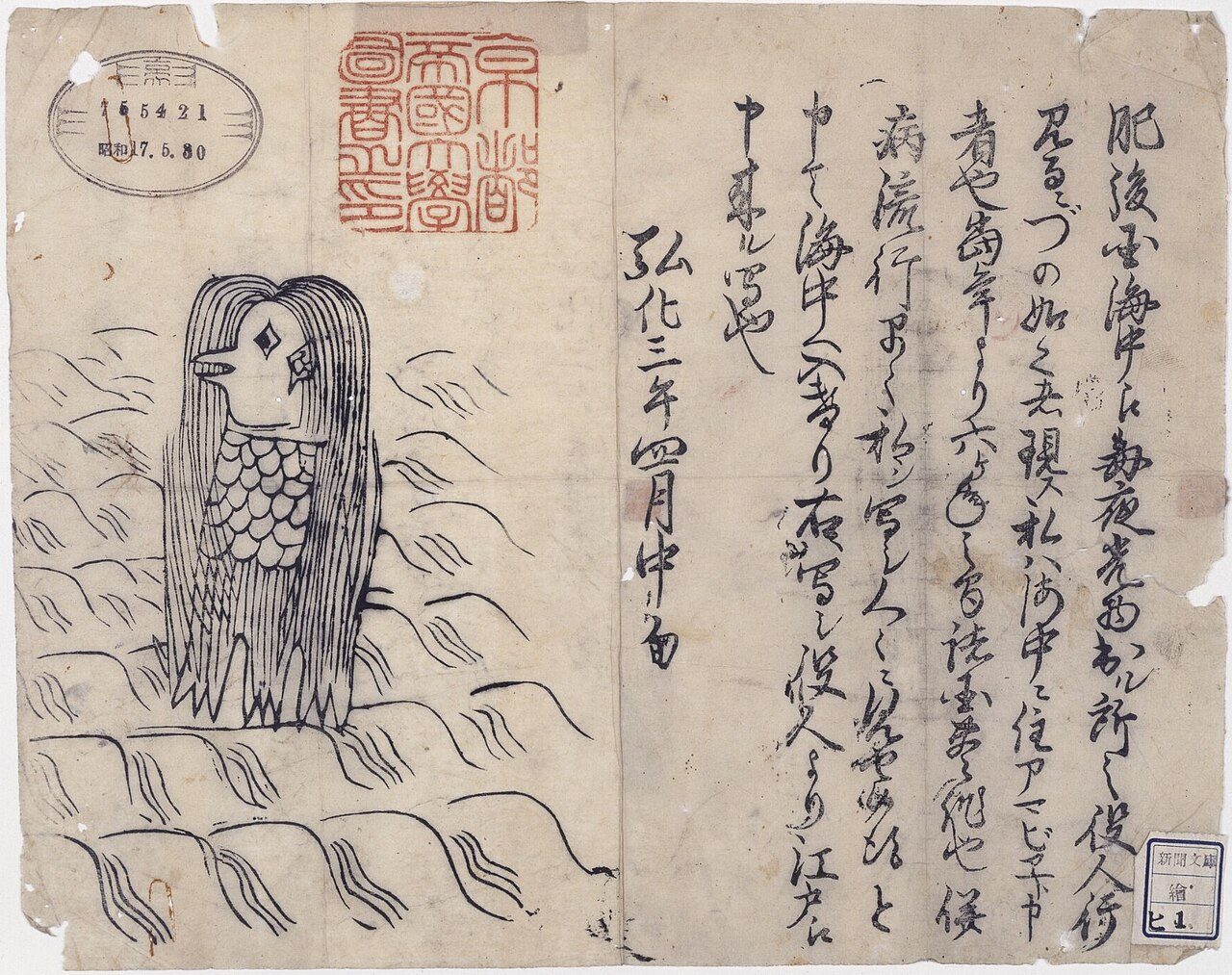
5 min read · 2 sourcesAmabie (アマビエ) is a legendary Japanese mermaid or merman with a bird beak-like mouth and three legs or tail-fins, who allegedly emerges from the sea, prophesies either an abundant harvest or an epidemic, and instructed people to make copies of its likeness to defend against illness. The amabie appears to be a variant or misspelling of the amabiko or amahiko (Japanese: アマビコ, アマヒコ, 海彦, 尼彦, 天日子, 天彦, あま彦), otherwise known as the amahiko-nyūdo (尼彦入道), also a prophetic beast depicted variously in different examples, being mostly as 3-legged or 4-legged, and said to bear ape-like (sometimes torso-less), daruma doll-like, or bird-like, or fish-like resemblance according to commentators. This information was typically disseminated in the form of illustrated woodblock print bulletins (kawaraban) or pamphlets (surimono) or hand-drawn copies. The amabie was depicted on a woodblock print marked with an 1846 date, which is located at Kyoto University Library and the only known documentation. Attestation to the amabiko predating amabie had not been known until the discovery of a hand-painted leaflet dated 1844. There are also other similar yogenjū (予言獣) that are not classed within the amabie/amabiko group, e.g., the arie (アリエ). 1
Legend
According to legend, an amabie appeared in Higo Province (Kumamoto Prefecture), around the middle of the fourth month, in the year Kōka-3 (mid-May 1846) in the Edo period. A glowing object had been spotted in the sea, almost on a nightly basis. The town's official went to the coast to investigate and witnessed the amabie. According to the sketch made by this official, it had long hair, a mouth like bird's bill, was covered in scales from the neck down and three-legged. Addressing the official, it identified itself as an amabie and told him that it lived in the open sea. It went on to deliver a prophecy: "Good harvest will continue for six years from the current year; if disease spreads, draw a picture of me and show the picture of me to those who fall ill." Afterward, it returned to the sea. The story was printed in the kawaraban (woodblock-printed bulletins), where its portrait was printed, and this is how the story disseminated in Japan. 1
Amabiko group
There is only one unique record of an amabie, whose meaning is uncertain. It has been conjectured that this amabie was simply a miscopying of "amabiko", a yōkai creature that can be considered identical. Like the amabie, the amabiko is a three-legged or multi-legged prophesizing creature which prescribes the display of its artistic likeness to defend against sickness or death. However, the appearance of the amabie is said to be rather mermaid-like (the three-leggedness allegedly stemming from a mermaid type called jinjahime), and for this reason one researcher concludes there is not enough of a close resemblance in physical appearance between the two. 1
Name variations
There are a dozen or more attestations of amabiko or amahiko (海彦; var. あま彦, 尼彦, 天彦) extant (counting the amabie), with the copies dated 1843 (Tenpō 14) perhaps being the oldest. 1
Locality of appearances
Four describe appearances in Higo Province, one report the Amabiko Nyūdo (尼彦入道; "the amahiko monk") in neighboring Hyuga Province (Miyazaki prefecture), another vaguely points to the western sea. Beyond those clustered in the south, two describe appearances in Echigo Province in the north. The two oldest accounts (1844, 1846) do not closely specify the locations, but several accounts name specific village or counties (gun) that turn out to be nonexistent fictitious place names. 1
Physical characteristics
The accompanying caption texts describes some as glowing (at night) or having ape-like voices, but description of physical appearance is rather scanty. The newspapers and commentators however provide iconographic analysis of the pictorials (hand-painted and prints). The majority of pictorial represent the amabiko/amabie as 3-legged (or odd-number legged), with a couple cases rather like an ordinary quadruped. 1
Torso-less ape-like version An amahiko/amabiko (海彦; ‘sea prince’), whose appearance in Echigo Province is documented on a leaflet dated 1844 (Tenpō 15). The hand-copied pamphlet illustration depicts a creature rather like an ape with three legs, the legs seemingly projecting directly from the head (without any neck or torso in-between). The body and face are covered profusely with short hair, except for it being bald-headed. The eyes and ears are human-like, with a pouty or protruding mouth. The creature appeared in the year 1844 and predicted doom to 70% of the Japanese population that year, which could be averted with its picture-amulet. 1
Amahiko-no-mikoto The Amahiko-no-mikoto (天日子尊; ‘His Highness Heaven Prince’) was spotted in a rice paddy in Yuzawa, Niigata, as reported by the Tokyo Nichinichi Shinbun from 1875. The crude newspaper illustration depicts a daruma doll-like or ape-like, hairless-looking four-legged creature. This example stands out since it was emerged not in the ocean but in a wet rice field. 1
The text above is adapted from the Wikipedia article “Amabie”, available under the Creative Commons Attribution-ShareAlike 4.0 licence. 1
Amabie is legendary Japanese mermaid or merman, according to the structured record cited below. This entry was generated automatically from that record and has not yet been reviewed by a person familiar with the tradition. 2
The source record links this tradition to 6 external registers, which can be verified through the citation. 2