The tradition & historical record
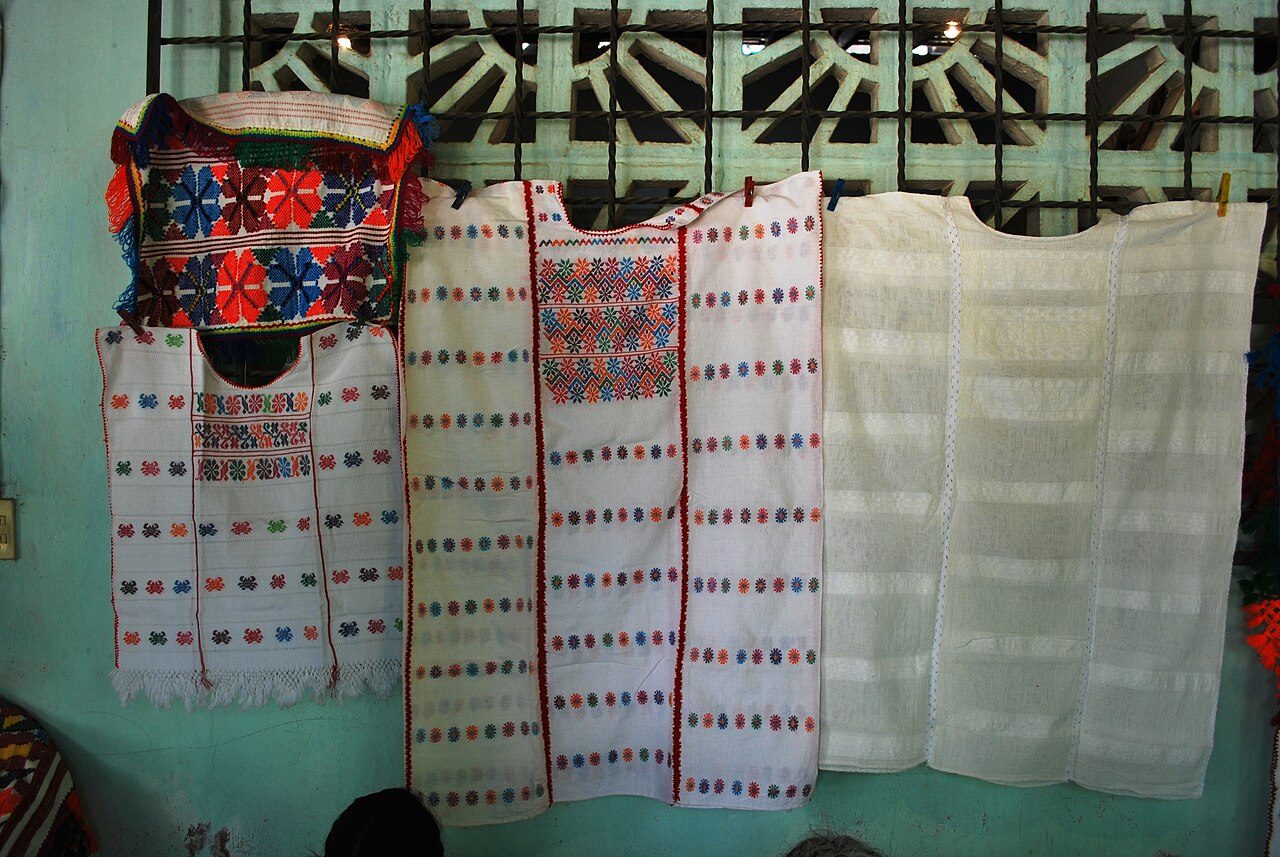
6 min read · 2 sourcesAmuzgo textiles are those created by the Amuzgo indigenous people who live in the Mexican states of Guerrero and Oaxaca. The history of this craft extends to the pre-Columbian period, which much preserved, as many Amuzgos, especially in Xochistlahuaca, still wear traditional clothing. However, the introduction of cheap commercial cloth has put the craft in danger as hand woven cloth with elaborate designs cannot compete as material for regular clothing. Since the 20th century, the Amuzgo weavers have mostly made cloth for family use, but they have also been developing specialty markets, such as to collectors and tourists for their product. One major player in this development is the Liaa’ Ljaa’ cooperative, which seeks to not only commercialize Amuzgo weaving but also preserve designs and traditional techniques, partnering with organizations such as the Universidad Autónoma Metropolitana (UAM) in Azcapotzalco. Most weavings are still done with traditional designs and techniques and with natural fibers, principally cotton, and dyes. 1
The Amuzgos
The Amuzgos live in the border region of southeastern Guerrero and southwestern Oaxaca, with about eighty percent in Guerrero. Most live in the municipalities of San Pedro Amuzgos, Putla and Santa María Ipalapa in Oaxaca and Xochistlahuaca and Ometepec in Guerrero. The region is hot with rugged terrain with tropical forest whose leaves drop during the dry season. It has various small rivers and streams. The Amuzgo practice subsistence agriculture based on corn, beans and chili peppers with some other cash crops such as sesame seed and tropical fruits. The region is not purely Amuzgo as Triquis, Tlapanecs, Mixtecs, Chatinos and Nahuas. One name the Amuzgo have for themselves is Tzjon non, especially in San Pedro Amuzgos, which means “people of the textiles.” There are about 35,000 speakers of the Amuzgo language. The religion is Catholicism with indigenous elements such as a belief in good and evil spirits which can cause or cure disease, rain or drought and more. The largest community of Amuzgos is in the municipality of Xochistlahuaca in Guerrero. Many houses are of adobe on narrow streets on steep hills. The Amuzgos here have maintained most of their culture in its food, family structure, language and religious beliefs. Since 1996, Xochistlahuaca has hosted a regional gathering of Amuzgos to promote regional social, political and economic development. The town also has a community museum which has a number of pre Hispanic pieces. The children receive primary school education in both Spanish and Amuzgo. Textiles are an important part of Amuzgo culture and economy, although other handcrafts such as ceramics. 1
Preservation and marketing
Most textiles made in Amuzgo homes is still for family use, especially huipils. However, the craft is in danger because machine made cloth is much cheaper, and as everyday clothing, traditional hand woven cloth cannot compete in the market outside the home. Starting in the latter 20th century, huipils and other traditional clothing for sale has been targeted to specialty markets such as to scholars like anthropologists, rich Mexican woman who wear them for civic holidays and to tourists from various parts of the world including those who travel to Xochistlahuaca to buy. Amuzgo textile production and efforts at preservation are strongest in Xochistlahuaca, with the oldest and most complex designs mostly known only to the oldest weavers in this municipality. The weavers of this town have made efforts to preserve these designs and pass them onto the younger generations. One major development in the preservation and promotion of Amuzgo textiles was the formation of the Liaa’ Ljaa’ cooperative in 1996. The name is from Amuzgo and means "materials of flowers". The cooperative today have fifty nine members representing fifty nine families, which totals about 160 people, only forty of which are men. This cooperative exists to avoid middlemen, selling more directly to the market for higher prices as well as promote efforts to preserve traditional designs and techniques using natural fibers and dyes. The group weaves elaborate huipils, blouses, skirts, rebozos, bedcovers, tablecloths and napkins, and works together to commercialize them. 1
Designs
The embroidery and weaving designs of Amuzgo textiles have significance and are passed down from generation to generation. The designs found on the cloth made in Xochistlahuaca is some of the most traditional. The patterns identify various Amuzgo communities as well as Amuzgo identity, with the designs considered to be a kind of “alphabet” by Amuzgo weavers. This use of design is part of this people’s cultural heritage along with the weaving process itself. Some of the designs can be traced back to images found on codices and pre Hispanic cultures. Most of the designs are based on the flora and fauna of the Costa Chica region of Guerrero, especially those near Xochistlahuaca. These include petate mat patterns, fretwork, suns, stars, mountains, rivers, dogs, horses, donkeys, turtles, water bugs, birds, double headed eagles and various flowers. There are mathematical formulas that create patterns such as “pata de perro” (a kind of leaf that grows along the Santa Catarina River), “flores de piedra” (stone flowers), curvas de cola de tortuga (turtle tail curls), “flores de pina” (pineapple flowers) and “patas de gato” (cats’ feet). These patterns can be found on huipils, blouses, skirts, napkins, rebozos and dresses. An S pattern represents the feminine and indirectly, the earth. Another common motif is the double headed eagle, which is based on a number of myths of the region. There are also newer designs which were created with the help of Beatriz Jimenez, a designer at UAM. 1
Process
Like many other indigenous communities, people learn to create handcrafts as young children, with most boys learning to weave hammocks and nets, but it is the girls that learn to make cloth on a backstrap loom, learning from their mothers and grandmothers. Most of the thread, the dyes and the tools used for weaving fabric are natural and include cotton, wood and even bird bones which function much like needles. White cotton is increasingly used but the most traditional variety is called “coyuche” which is naturally brown. The name comes from “coyote” as the color is similar to that to the animal. This variety of cotton is not used anywhere else in the world, but its use is less than the past and not used at all in many works. This cotton is grown by the Amuzgo themselves, along with other crops. Cotton fiber is also often mixed with the fiber of a local plant called cacaloxuchitl. Dyes are made from cochineal, branches from the nanche (Byrsonima crassifolia) and almond tree and hay. Generally, huipils made from cloth 45 cm wide take about four months to complete, working four hours a day. It sells for about 2,500 pesos. 1
Florentina López de Jesús
The best known Amuzgo weaver from Xochistlahuaca is Florentina López de Jesús. 1
The text above is adapted from the Wikipedia article “Amuzgo textiles”, available under the Creative Commons Attribution-ShareAlike 4.0 licence. 1
Amuzgo textiles is recorded in open cultural data. The structured record cited below does not describe the practice, and this entry has not yet been reviewed by a person familiar with the tradition. 2
The source record links this tradition to 1 external register, which can be verified through the citation. 2