The tradition & historical record
6 min read · 2 sourcesAnatolian animal carpets represent a special type of pile-woven carpet, woven in the geographical region of Anatolia during the Seljuq and early Ottoman period, corresponding to the 14th–16th century. Very few animal-style carpets still exist today, and most of them are in a fragmentary state. Animal carpets were frequently depicted by Western European painters of the 14th–16th century. By comparison of the few surviving carpets with their painted counterparts, these paintings helped to establish a timeline of their production, and support our knowledge about the early Turkish carpet. 1
Dragon and Phoenix carpet
A traditional Chinese motif, the fight between the fenghuang, or Chinese phoenix, and the dragon, is seen in an Anatolian carpet at the Pergamon Museum, Berlin. Radiocarbon dating confirmed that the "Dragon and Phoenix" carpet was woven in the mid 15th century, during the early Ottoman Empire. It is knotted with symmetric knots. The Chinese motif was probably introduced into Islamic art by the Mongols, or artists working for them, during the thirteenth century. The Dragon and Phoenix carpet lacks his original borders, and seems to be cut off at the right side. Its field is parted into two rectangular sections, each containing a yellow-ground octagon in which a Chinese dragon and a phoenix are opposed to each other in combat. Both animals are stylized in geometrical form. Their blue colours, outlined in red, contrasts well with the yellow ground of the octagon. The design of the upper octagon appears to be somewhat more compressed than the lower. The corners between the octagon and the rectangular field are filled in with red triangles and rows of white hooks on red ground, creating a reciprocal hook design. The rectangular fields are surrounded by a small guardian border showing a row of pearls in different colours. The main border has red floral tendrils composed of identical, S-like ornaments on a brown ground. The Phoenix and Dragon carpet was first described in 1881 by Julius Lessing, and Wilhelm von Bode in 1895. Since then the Dragon and Phoenix carpet has been referred to in many books on Oriental carpets. A similar fragment was discovered in Fustat, with dragon and phoenix depicted in combat on a yellow field. The animals in this fragment are depicted in red, and outlined in blue. 1
Marby rug
Another carpet showing two medallions with two birds besides a tree was found in the Swedish church of Marby in Jämtland province; it is now in the Swedish History Museum in Stockholm. The rug was radiocarbon dated to 1300–1420. More fragments of this type were found in Fostat, today a suburb of the city of Cairo. The Marby rug is divided into two rectangles, each containing an octagon with a tree and a pair of birds. The tree is mirrored along the horizontal middle axis of the octagon in a way which suggests its image is reflected in water. Both the Phoenix and Dragon, and the Marby rug, have additional rows of knots on their backsides. At a distance of every 6 cm, rows of loosely tied knots of red thread are woven in. Another carpet fragment from Fustat has similar additional knots. It has been suggested that these rows of knots mark the weaver's progress during a given time. On average, the additional knots are repeated every 15 rows in the Dragon and Phoenix rug. At an estimated original width of 1 m, about 3800 knots were woven between two rows of the additional red knots, consistent with the dimensions of the carpet and the number of knots a single weaver can tie in a carpet during a day.(Beselin 2011, p. 46–49) 1
Animal carpet at the Metropolitan Museum
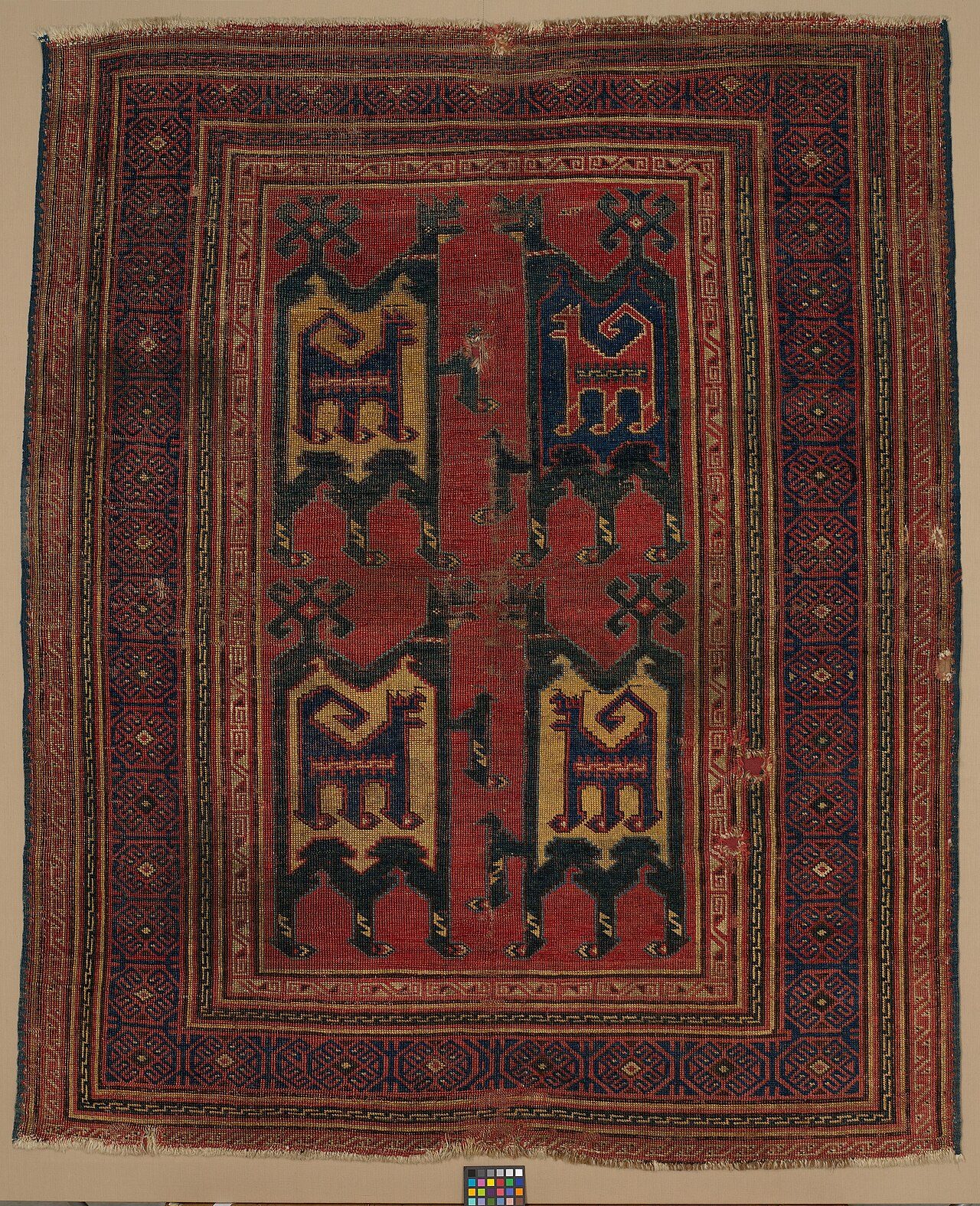
The "Dragon and Phoenix" and the "Marby" rugs were the only existing examples of Anatolian animal carpets known until 1988. Since then, seven more carpets of this type have been found. They survived in Tibetan monasteries and were removed by monks fleeing to Nepal during the Chinese cultural revolution. One of these carpets was acquired by the Metropolitan Museum of Art which parallels a painting by the Sienese artist Gregorio di Cecco: "The Marriage of the Virgin", 1423. It shows large confronted animals, each with a smaller animal inside. 1
Animal carpets from the Vakıflar Museum
The field of an animal carpet in the Vakıflar Museum, Istanbul (Inv. No. E-1) is divided into two rectangular compartments by a band similar to its borders. An octagon containing confronted animals is inscribed into each compartment. The winged animals face a stylized tree. They show a down-turned, snout-like head, to which antler-like extensions are attached, and their body is spotted. Overall, the animals more resemble fallow deer than birds, which are usually depicted on animal carpets. Deer and fallow deer are already depicted on the borders of the Pazyryk carpet, and are frequently seen on early textiles and other objects in Anatolia and Iran. Below each deer, and above the main animal, is a bird-like quadruped. Another animal carpet with a coarser design compared to the Vakıflar rug is at the Mevlana Museum in Konya (Balpınar, 1988, p. 62). 1
Animal carpet from the Pergamon Museum
Another carpet in the Pergamon Museum was dated to before 1500 AD. It shows four double-headed quadrupeds within a rectangular field surrounded by an eight-pointed star. The uppermost star is cut off. The stars are framed by smaller octagonal ornaments, two at their sides, one each at the top and bottom of each star. A smaller guardian border separates the field from the main border, which shows stylized leaves adorning S-shaped ornaments. Smaller triangular elements of the design and the outlines of the animals are woven in offset knotting. By its colours, the carpet has been localized to Central Anatolia. On the reverse of the carpet, additional wefts can be seen meandering over two warps after about every 22 regular wefts. The additional weft changes its colour from yellow to red, roughly at the middle of the carpet. It has been interpreted to show a day's work of two weavers working besides each other. If taken as such, the number of knots woven by each weaver would amount to roughly 2,500 knots per day. (Beselin 2011, p. 50–1) See: knot density. 1
The text above is adapted from the Wikipedia article “Early Anatolian animal carpets”, available under the Creative Commons Attribution-ShareAlike 4.0 licence. 1
Anatolian animal carpet is type of pile-woven carpet from 14th-16th century Anatolia, according to the structured record cited below. This entry was generated automatically from that record and has not yet been reviewed by a person familiar with the tradition. 2
The source record links this tradition to 1 external register, which can be verified through the citation. 2