The tradition & historical record
6 min read · 2 sourcesAncient Greek crafts (or the craftsmanship in Ancient Greece) was an important but largely undervalued, economic activity. It involved all activities of manufacturing transformation of raw materials, agricultural or not, both in the framework of the oikos and in workshops of size that gathered several tens of workers. The artisans or "craftsmen" constituted a minority population in the Greek city or Polis, but their presence in the sources is not disproved since it was seen to grow throughout Greek Antiquity. In Ancient Greece, there were craftsmen of different social strata. Although the metics and slaves were probably in the majority, there were also many free citizens in the workshops. They developed crafts such as musical instruments, sculptures, pottery, etc. Much of Ancient Greek craftsmanship was part of the domestic sphere. However, the situation gradually changed between the 8th and 4th centuries BC, with the increasing commercialization of the Greek economy. Thus, important tasks as weaving or baking bread were performed only by women before the 6th century BC. With the growth of trade, slave labor began to be used extensively in handicrafts. Only the best quality dyed cloth, and in particular Tyrian purple, was made in the workshops. 1
A tricky definition
"Craftsmanship" and also "craftsman" are delicate notions to define, insofar as they refer to relatively modern concepts, the definition of which is irrelevant for Ancient Greece. Historians of antiquity were in agreement in considering an artisan or craftsman an individual with special expertise and who produced material goods intended for marketing outside the agricultural sector. "The artisan could sell his own production, but he should not be confused with the merchant: he manufactures part or all of the product he markets." Within this framework, some historians add an additional selective criterion considering that craftsmanship was limited to the production of "finished" material goods, which would exclude the extraction of raw materials in quarries or mines, but such a restriction is not taken into account by other historians. The ancient Greeks did not usually distinguish the artist from the craftsman. As a result, some activities considered artistic in contemporary times were an integral part of craftsmanship in ancient Greece, insofar as they expressed themselves in the manufacture of a concrete object—no more so than activities "to which the ancients accorded the status of artistic production and the patronage of a Muse" (like music, poetry, etc.) 1
Diverse designations for a varied reality
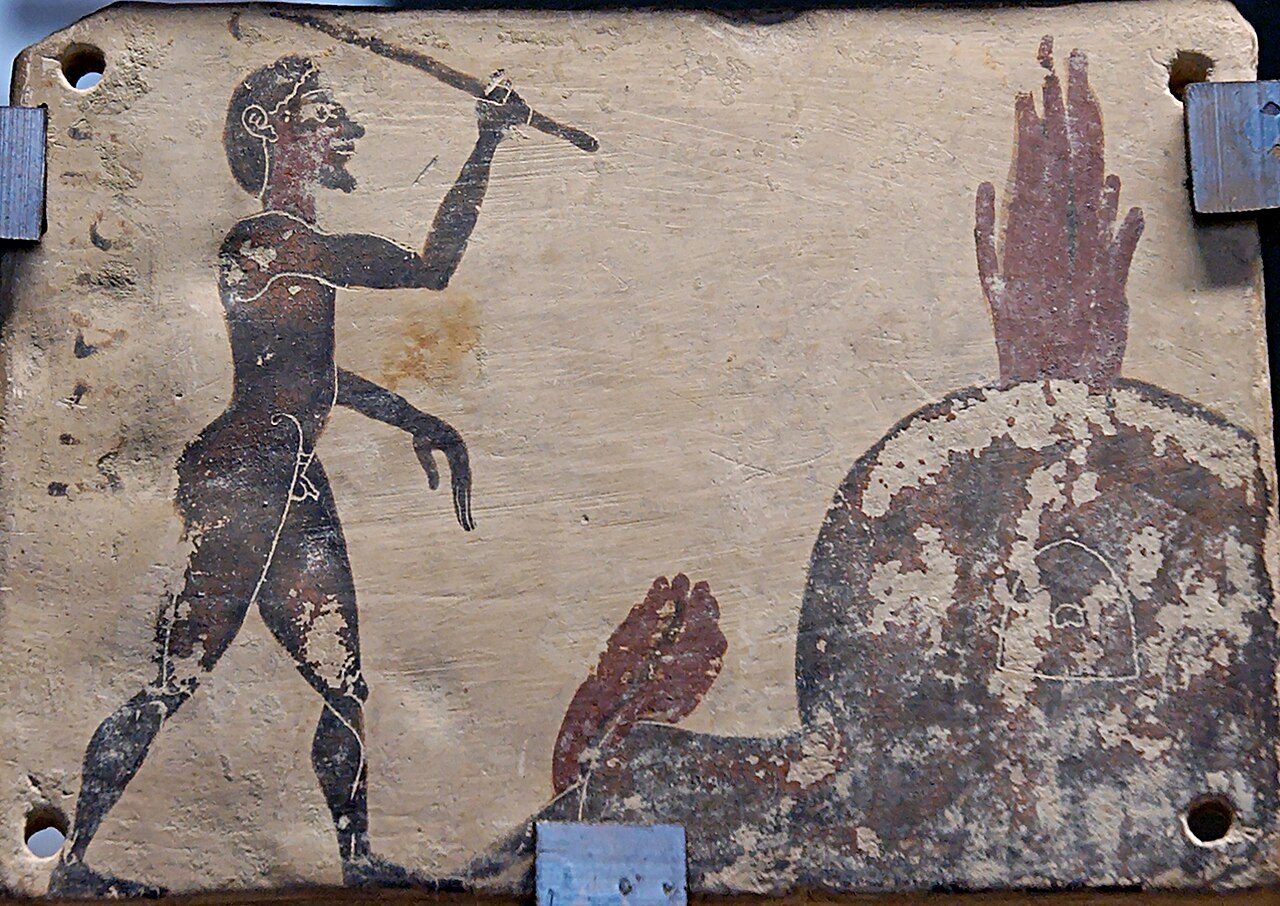
The fact that Ancient Greek does not have a term that encompasses the set of realities to which the contemporary concept of "craftsman" indicates both a lack of homogeneity in this world of craftsmanship and the great diversity of activities and status of those who depended on them. Artisans and craftmen are designated by various terms. If δημιουργός / demiourgós, which refers to the idea of creation, of making an object, remains rather neutral and general (it designates the potter as well as the aedo or the diviner), the pejorative character of the term βάναυσος / bánausos underlines the contempt of the Greeks for these manual workers (as opposed to the intellectual) who used the fire of their kiln (baunos) to manufacture ceramic or metal objects. The use of the word τεχνίτης / technítês refers to the mastery of a particular skill and goes far beyond the strict field of craftsmanship in that respect, since it also designates the virtuoso actor or soloist. 1
An activity deemed unworthy of a truly free man
The sources at our disposal regularly underline the bad image of craftsmen in Greek society, and justify it, as Xenophon: "the so-called manual trades are discredited and, logically, have a very bad reputation in our cities, since they harm the bodies of workers and officials, forcing them to remain seated and to spend the whole day in the shade, and some of them even to be always by the fire. And by effeminizing the bodies, the spirits are also weakened." They are considered unreliable when it comes to taking up arms to defend their city: "they have a bad reputation in dealing with their friends and as defenders of the fatherland. Even in some cities, especially in those which have a reputation for war, no citizen is allowed to engage in manual trades." Craft activity was considered incompatible with the ideals of autarky, which irrigated the mentality of the time and lead to privilege agriculture above any other productive activity. In fact, the free man was considered to be the one who does not depend on anyone but himself and his ability to exploit the land he owns, his oikos, for his survival. Living on his goods, he does not depend on the will of another, unlike the craftsman who, to survive, must have customers willing to buy what he produces. Aristotle said that "the condition of a free man is that of one who does not live under obligation to his neighbor." In this scheme, the farmer, free "by nature" is more worthy of the status of citizen than the craftsman. The accuracy of this opinion is illustrated by the ancient authors in the attitude of the craftsmen while they are citizens of a city. 1
A more nuanced reality
However, the strength of this aristocratic ideal, more or less infused in society as a whole, was not everywhere of the same order. If it was imposed in warlike or rural cities such as Sparta or Thebes—where obtaining citizenship was conditioned by the possession of goods, and where four years of exercising artisan functions condemned them to lose it—the cities more open to trade were much more liberal in recognizing the legitimacy of citizenship for those of their inhabitants who practiced craftsmanship. Thus, in Classical Greece, they would be almost 10,000 (out of a total of 30,000 or 40,000 citizens) in Athens, city where the craftsmanship was particularly developed. This significant proportion of artisans among the citizens of Athens is also underlined, in order to denigrate them, by Socrates: "For which of them are you ashamed of? Of the fullers, the shoemakers, the masons, the blacksmiths, the peasants, the merchants, or those who are peddling about the agora concerned with buying something cheap in order to sell it at a higher price? For it is all of them who compose the assembly." The proportion of citizens among the artisans was not negligible. According to the accounts of the Erechtheion, among the workers whose status is specified, there were 23% citizens, compared to 58% metics and 19% slaves. The real possibilities of enrichment by craftsmanship activity can certainly contribute to explain this discrepancy between discourse and reality. 1
An activity of slaves and metics
Most of the artisans belonged to the slave labor force. These slaves were employed by their owners in tasks of more or less importance according to their skills. Thus, while most of the slaves who worked in the Laurion mines, for example, were employed in less complex tasks, there were also slaves specialized in highly technical work, such as metallurgist, ceramist or sculptor. 1
The text above is adapted from the Wikipedia article “Ancient Greek crafts”, available under the Creative Commons Attribution-ShareAlike 4.0 licence. 1
Ancient Greek crafts is Handicrafts of Ancient Greece, according to the structured record cited below. This entry was generated automatically from that record and has not yet been reviewed by a person familiar with the tradition. 2
The source record links this tradition to 1 external register, which can be verified through the citation. 2