The tradition & historical record
6 min read · 2 sourcesPottery was produced in enormous quantities in ancient Rome, mostly for utilitarian purposes. It is found all over the former Roman Empire and beyond. Monte Testaccio is a huge waste mound in Rome made almost entirely of broken amphorae used for transporting and storing liquids and other products – in this case probably mostly Spanish olive oil, which was landed nearby, and was the main fuel for lighting, as well as its use in the kitchen and washing in the baths. It is usual to divide Roman domestic pottery broadly into coarse wares and fine wares, the former being the everyday pottery jars, dishes and bowls that were used for cooking or the storage and transport of foods and other goods, and in some cases also as tableware, and which were often made and bought locally. Fine wares were serving vessels or tableware used for more formal dining, and are usually of more decorative and elegant appearance. Some of the most important of these were made at specialised pottery workshops, and were often traded over substantial distances, not only within, but also between, different provinces of the Roman Empire. For example, dozens of different types of British coarse and fine wares were produced locally, yet many other classes of pottery were also imported from elsewhere in the Empire. 1
Terra sigillata or red-gloss wares
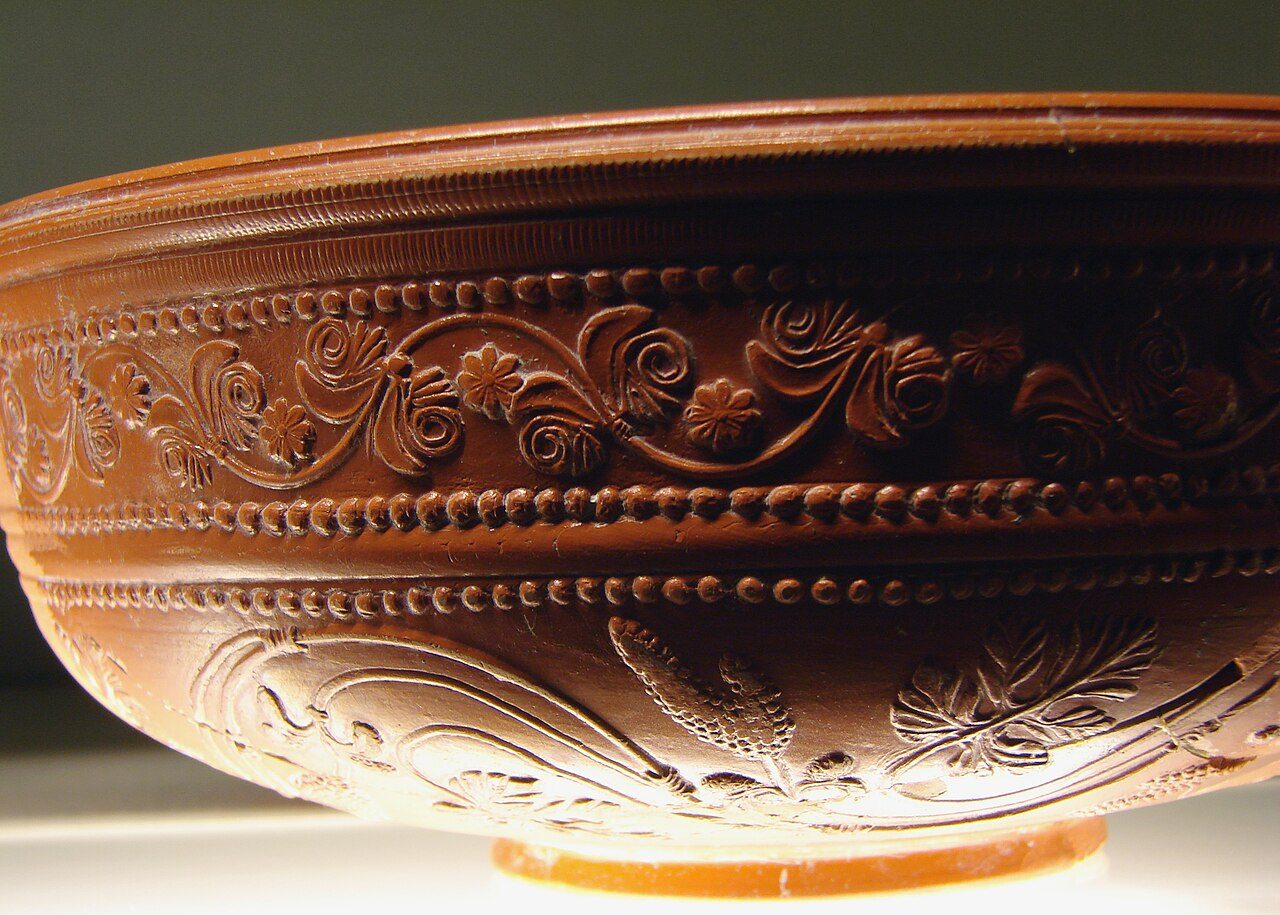
The designation 'fine wares' is used by archaeologists for Roman pottery intended for serving food and drink at table, as opposed to those designed for cooking and food preparation, storage, transport and other purposes. Although there were many types of fine pottery, for example drinking vessels in very delicate and thin-walled wares, and pottery finished with vitreous lead glazes, the major class is the Roman red-gloss ware of Italy and Gaul make, and widely traded, from the 1st century BC to the late 2nd century AD, and traditionally known as terra sigillata or samian ware. These vessels have fine, fairly hard and well-fired buff to pink fabrics, with a naturally glossy surface slip ranging in colour from light orange to quite a bright red. The variations in the colour and texture of both body fabric and slip, as well as the vessel-shapes and the designs on the decorated forms can enable a trained student to identify source, date and often individual workshop quite accurately. Arretine ware, made at Arezzo in Tuscany, was the pre-eminent type of fine pottery in the 1st century BC and early 1st century AD, and was succeeded by samian ware, manufactured in a number of centres in Gaul, modern France and Germany. However the definition of all these terms has varied and evolved over the many generations during which the material has been studied. Technically, red-gloss wares have much in common with earlier Greek painted pottery, but the decorated forms employ raised, relief decoration rather than painting. African Red Slip (ARS) ware belonged to the same tradition, and continued to be made much later than Italian and Gaulish sigillata, right through to the Islamic conquest. 1
Other fine wares
Some of the shapes of Arretine plain wares were quite closely copied in the later 1st century BC and early 1st century AD in a class of pottery made in north-east Gaul and known as Gallo-Belgic ware. Many of these plates and dishes in red-slipped (terra rubra) and black-slipped (terra nigra) fabrics bear potters' stamps. Other fine, thin-walled flagons, drinking beakers, bowls and dishes were made locally in most regions of the Roman Empire, including frontier provinces such as Britain: for example, Romano-British 'colour-coated' (slipped) wares made at Colchester and in the Nene Valley belong to that classification. Several of the pots to the right of the group photograph in the lead section of this article are Nene Valley wares, including the large black beaker decorated with a lively hunting scene of hounds and hares in the barbotine technique. Many decorative techniques were used to beautify pottery tableware, including the use of coloured slips, painting, and various textured surfaces. Painted decoration did not, however, continue the Greek and Etruscan traditions as a specialised technique used for elaborate luxury tablewares, though simpler painted designs do appear on many pottery types, both coarse and fine, throughout the Empire. The dividing lines between 'fine' and 'coarse' wares, or tablewares and cooking wares, become a little blurred in the case of some of the local, provincial products, because pottery is often multi-purpose. 1
Lead-glazed pottery was made in many regions of the Roman Empire, including Gaul, Italy and the eastern provinces. This type of vitreous glaze was most often used for small, decorative items of tableware, including mould-made cups with relief decoration, lamps and zoomorphic containers. 1
Cooking pots
Pottery was essential for cooking food in antiquity. Although metal utensils made of bronze or iron were widely available in the Roman period, simple, functional earthenware bowls, pans, casseroles and jars were an inexpensive and standard part of the equipment of every kitchen. From Britain to Egypt, from Spain to Syria, over the length and breadth of a vast Empire, local pre-Roman pottery traditions in simple cooking wares often continued without major changes for centuries. Roman cooking pots therefore have to be studied on a regional basis. As well as the ordinary bowls and pans used for cooking, ceramic utensils were made for many specialised uses, such as the small cheese-press illustrated to the left of the group photograph of Roman pottery from Britain above. The two black jars to the left behind the cheese-press in the same photograph are examples of Romano-British black-burnished ware, first made in south-west England in the late Iron Age, before the Roman conquest: this ware continued to be popular throughout the Roman period, and was made in greater quantities, and marketed more widely, under Roman influence. Other wares made in Roman Britain were Crambeck Ware, Huntcliff ware, and Nene Valley Colour Coated Ware, which was often decorated. 1
Mortaria
However, one vessel type used in food preparation was closely linked with the spread of Roman culture and Roman cuisine: the mortarium. This was a robust shallow bowl with a thick, out-curved rim that made it easy to handle, often a pouring lip, and an internal surface deliberately roughened with a coating of grit or coarse sand during manufacture. It was used with a pestle to purée or pulverise ingredients in order to prepare elaborate and carefully seasoned Roman dishes; the Roman culinary tradition made extensive use of herbs and spices. The mortarium was the Roman equivalent of the food-processor, and is a real indicator of 'romanisation'; In Britain, the first mortaria were being imported from Gaulish sources more than a generation before Britain became a Roman province in AD 43, indicating the growing influence of Roman culture in late Iron Age southern Britain, and perhaps the actual presence of immigrants from Gaul. 1
Description and function
Amphorae, or amphoras, were used during R… 1
The text above is adapted from the Wikipedia article “Ancient Roman pottery”, available under the Creative Commons Attribution-ShareAlike 4.0 licence. 1
Ancient Roman pottery is pottery produced within the Roman Republic and Roman Empire, according to the structured record cited below. This entry was generated automatically from that record and has not yet been reviewed by a person familiar with the tradition. 2
The source record links this tradition to 6 external registers, which can be verified through the citation. 2