The tradition & historical record
6 min read · 2 sourcesThe Andean textile tradition spanned from the Pre-Columbian to the Colonial era throughout the western coast of South America, but was mainly concentrated in what is now Peru. The arid desert conditions along the coast of Peru have allowed for the preservation of these dyed textiles, which can date to 6000 years old. Many of the surviving textile samples were from funerary bundles, however, these textiles also encompassed a variety of functions. These functions included the use of woven textiles for ceremonial clothing or cloth armor as well as knotted fibers for record-keeping. The textile arts were instrumental in political negotiations, and were used as diplomatic tools that were exchanged between groups. Textiles were also used to communicate wealth, social status, and regional affiliation with others. The cultural emphasis on the textile arts was often based on the believed spiritual and metaphysical qualities of the origins of materials used, as well as cosmological and symbolic messages within the visual appearance of the textiles. Traditionally, the thread used for textiles was spun from indigenous cotton plants, as well as alpaca and llama wool. 1
Lithic Period
The earliest known surviving textiles are samples of fiberwork found in Guitarrero Cave, Peru dating back to 8000 BCE. Early fiberwork by the Norte Chico civilization consisted of plant fibers that were intertwined and knotted to form baskets and other containers. Surviving examples of finely spun thread and simple cloths indicate that knowledge of spinning and weaving had already been well-established and developed in the area. Mummified human skeletons dating to this period were stuffed with plant fibers and wrapped in rope and cane, a preservation method invented in the Chilean Chinchoros area around 5000 BC. Existence of this technology demonstrates early knowledge of spinning naturally occurring fibers into cord. 1
Pre-Ceramic Era
Coastal civilizations were the first to create fishnets, and were the first to utilize the openwork tradition in knotted objects. The fishnets were created through twining, a non-loom technique similar to macramé. Knotting patterns depicting standing humans, parrots, snakes, and cats have been decoded from surviving fragments. 1
Initial Period
The introduction of camelid herding for their meat, fibrous hair, and ability to transport cargo was developed in response to remarkably inhospitable environmental conditions found in Andean highlands. As a result, alpacas and llamas were revered for their hardiness and ability to provide resources in both life and death. The scaly fibers produced by these animals were both flexible and dye-permeable, allowing them to be woven with cotton to produce sturdy threads and textiles. Chavín culture began to emerge around the late Initial Period (c. 900-500 BC). Surviving textiles found from looted burials feature brown dye painted on large, seamed panels of cloth. Textiles from the burials of Karwa are featured as ritual cult center objects, and depict explicitly feminine deities. The Chavín culture may have demonstrated the first extensive production of textiles for ritualistic and symbolic purposes. Paracas culture rapidly developed the textile industry into a time-intensive and labor-consuming practice. Embroidered and woven textiles became commonplace, 1
featuring consistent repetition and variation of motifs. Nonwoven fabric structures, such as headbands, were created through cross-knit looping. Paracas officials adopted the practice of wearing multiple garments in sets, including headbands, turbans, mantles, ponchos, tunics, skirts, and loincloths. The Moche wove textiles, mostly using wool from vicuña and alpaca. Although there are few surviving examples of this, descendants of the Moche people have strong weaving traditions. 1
Middle Horizon
The Middle Horizon is characterized by the supremacy of the Wari and Tiwanaku cultures over the central Andes. 1
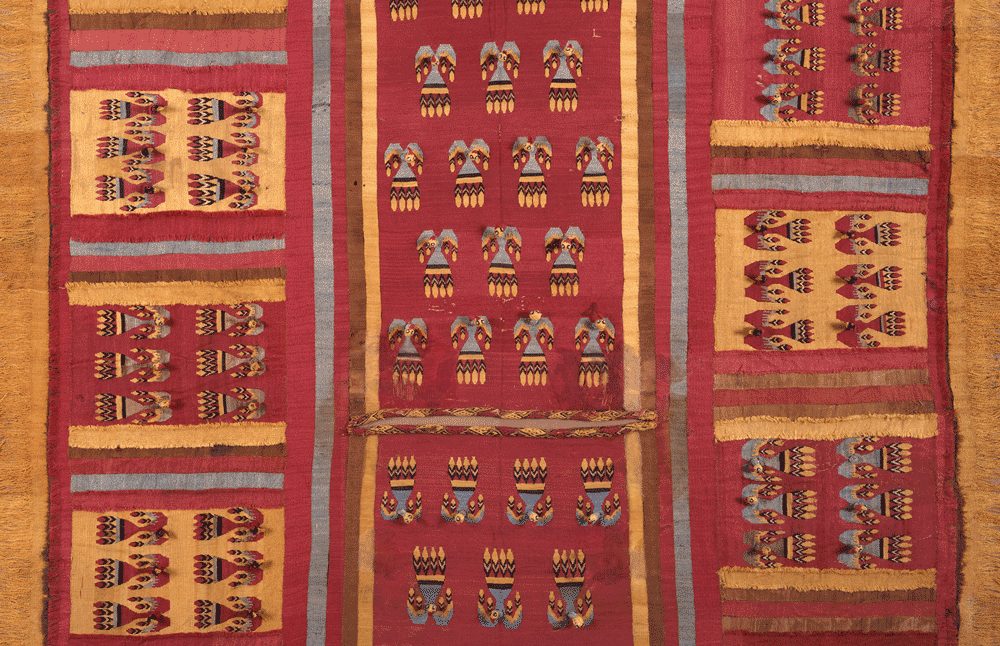
Wari, as the former capital city was called, is located 11 km (6.8 mi) north-east of the modern city of Ayacucho, Peru. This city was the center of a civilization that covered much of the highlands and coast of modern Peru.The discovery in early 2013 of an undisturbed royal tomb, El Castillo de Huarmey, offers new insight into the social and political influence of the Wari during this period. The variety and extent of the burial items accompanying the three royal women indicate a culture with significant material wealth and the power to dominate a significant part of northern coastal Peru for many decades.[4] The Wari are particularly known for their textiles, which were well-preserved in desert burials. The standardization of textile motifs serves as artistic evidence of state control over elite art production in the Wari state.[7] Surviving textiles include tapestries, hats and tunics for high-ranking officials. There are between six and nine miles of thread in each tunic, and they often feature highly abstracted versions of typical Andean artistic motifs, such as the Staff God. Wari fiber arts featured large-scale textiles created in state-sponsored workshops. Political messages of abundance and control were depicted using chaotic geometric imagery and camelid-like figures. Examples of surviving imagery (see image) feature multiple repeating motifs of highly geometric patterns, punctuated with highly expressive color palettes. Scholars have argued that the complexity of such designs broadcast the abilities and abundances of state-controlled resources. 1
Late Intermediate Period
Some of the main cultures during the late intermediate period were Lambayeque, Chimor, and Chancay, late Cajamarca, Chincha, late Chachapoya, Wanka, Chanka, Qolia, Lupaca, Yaro, Warko, and others Lambayeque emerged around the 750 AD, with its peak between 900 AD and 1100. The Lambayeque style of textiles often combined the styles of earlier cultures, like the Moche and the Wari, but added its own local iconography. This led to a unique style of textile art. These earlier influences from the Wari and Moche include emphasis on narratives. However, Lambayeque's local style included motifs such as sea birds and fish, as well as crescent-shaped headdresses. The Chancay tended to have many different styles in their textiles.These styles included openwork, painted, slit tapestry, and three-dimensional figures. The Chancay textiles tended to use soft colors, which contrasts with the Chimú, who used bright, vibrant colors. 1
The text above is adapted from the Wikipedia article “Andean textiles”, available under the Creative Commons Attribution-ShareAlike 4.0 licence. 1
Andean textiles is textile tradition indigenous to South America, according to the structured record cited below. This entry was generated automatically from that record and has not yet been reviewed by a person familiar with the tradition. 2
The source record links this tradition to 1 external register, which can be verified through the citation. 2