The tradition & historical record
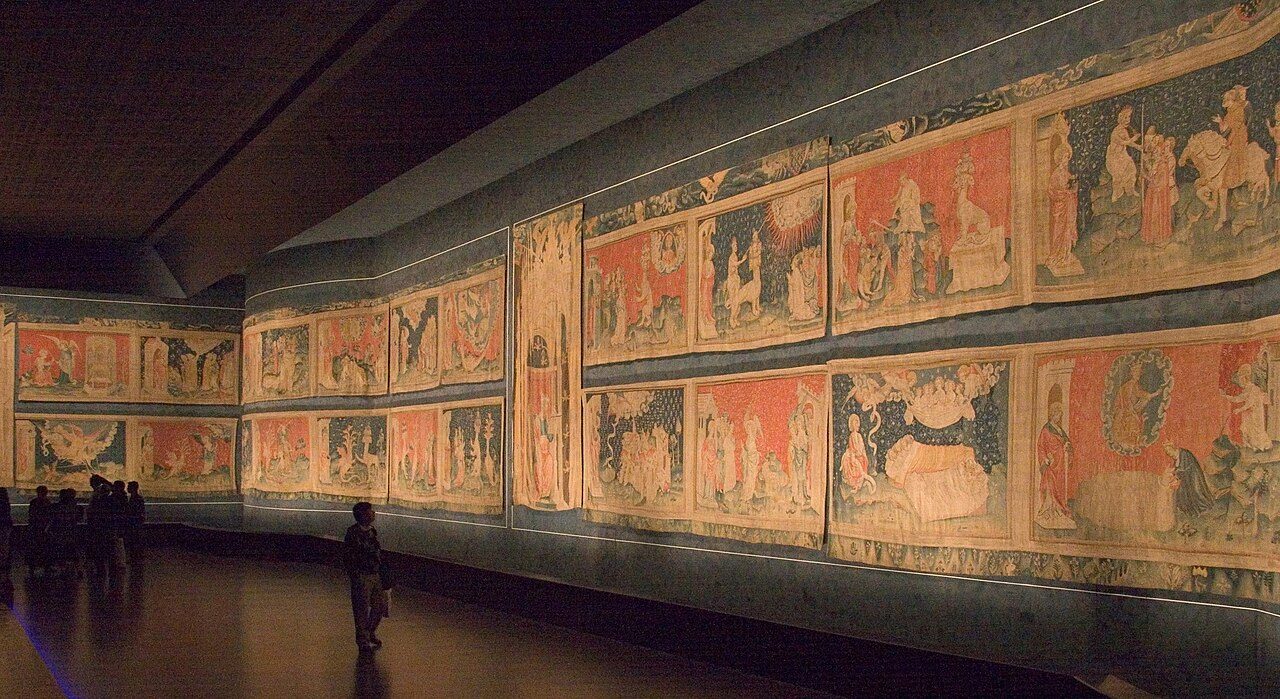
5 min read · 2 sourcesThe Apocalypse Tapestry is a large medieval set of tapestries commissioned by Louis I, Duke of Anjou, and woven in Paris between 1377 and 1382. It depicts the story of the Apocalypse from the Book of Revelation by Saint John the Divine in colourful images, spread over six tapestries that originally totalled 90 scenes, and were about six metres high, and 140 metres long in total. It is the most significant, and almost the only, survival from the first decades of the great period of tapestry, when the industry developed large workshops and represented the most effective art form for exhibiting the magnificence of royal patrons, not least because large tapestries were hugely expensive. The period began in about 1350, and lasted until at least the 17th century, as tapestry was gradually overtaken in importance by paintings. At this early point relatively few tapestries were made to designs specified by the patron, which seems clearly to have been the case here. The main weaving centres were ruled by the French and Burgundian branches of the House of Valois, who were extremely important patrons in the period. This began with the four sons of John II of France (d. 1362): Charles V of France, Louis of Anjou, John, Duke of Berry and Philip the Bold, Duke of Burgundy. Their respective inventories reveal they owned several hundred tapestries between them. 1
History
The Apocalypse Tapestry was commissioned by Louis I, Duke of Anjou, around 1373. Jean Bondol, a Flemish artist who was a court artist of Louis' brother Charles V of France, made designs or modellos for the set; these were probably rather small and later worked up into full-size cartoons for the weavers to follow. Bondol used an illuminated manuscript Apocalypse from the royal library as a partial model. The commission was arranged through the Paris merchant Nicholas Bataille, who in the past was often regarded as the head weaver, but is now thought of as only the middleman and perhaps the financier of the Paris workshop run by Robert Poinçon. It cost 6,000 francs. At this point Paris was still the leading tapestry-weaving centre, and Bataille supplied Louis with many tapestries from 1363 until the 1380s. The set was probably finally complete by 1380, or 1382. It was still unusual for a tapestry to be commissioned by a buyer to a specific design in this way. It is uncertain how Louis used the tapestry; it was probably intended to be displayed outside, supported by six wooden structures, possibly arranged so as to position the viewer near to the centre of the display, imitating a jousting field. The tapestry and its theme would have also helped to bolster the status of Louis' Valois dynasty, then involved in the Hundred Years' War with England. The tapestry shows the story of the Apocalypse from the Book of Revelation by Saint John the Divine. In the 14th century, the Apocalypse was a popular story, focusing on the heroic aspects of the last confrontation between good and evil and featuring battle scenes between angels and beasts. 1
Description and style
The tapestry was made in six sections, each 78-foot (24 m) wide by 20-foot (6.1 m) high, comprising 90 different scenes. Each scene had a red or blue background, alternating between the sections. They would have taken considerable effort to produce, with between 50 and 84 person-years of effort required by the weaving teams. Only 71 of the original 90 scenes survive. The tapestry is dominated by blue, red and ivory coloured threads, supported by orange and green colours, with gilt and silver woven into the wool and silk. These colours are now considerably faded on the front of the tapestry but were originally similar to the deep and vibrant hues seen on the back of the tapestry panels. Jean Bondol's design follows the Franco-Flemish school of tapestry design, with rich, realist, fluid images placed into a simple, clear structure through the course of the tapestry. As a result, the angels and monsters are depicted with considerable energy and colour, the impact reinforced by the sheer size of the tapestry, which allows them to be portrayed slightly larger than life-size. Various approaches are taken in the tapestry to interpreting the allegorical language used by St John in his original text; in particular, the tapestry takes an unusual approach to portraying the Fourth Horseman of the Apocalypse, Death. The depiction of Death in this tapestry follows the style then becoming popular in England: he is represented as a decaying corpse, rather than the more common 14th century portrayal of Death as a conventional, living person. 1
The text above is adapted from the Wikipedia article “Apocalypse Tapestry”, available under the Creative Commons Attribution-ShareAlike 4.0 licence. 1
Apocalypse Tapestry is tapestry series by Jan Bondol from Bruges in the Château d'Angers, according to the structured record cited below. This entry was generated automatically from that record and has not yet been reviewed by a person familiar with the tradition. 2
The source record links this tradition to 13 external registers, which can be verified through the citation. 2