The tradition & historical record
6 min read · 2 sourcesThe visual arts of the Indigenous peoples of the Americas encompasses the visual artistic practices of the Indigenous peoples of the Americas from ancient times to the present. These include works from South America and North America, which includes Central America and Greenland. The Siberian Yupiit, who have great cultural overlap with Native Alaskan Yupiit, are also included. Indigenous American visual arts include portable arts, such as painting, basketry, textiles, or photography, as well as monumental works, such as architecture, land art, public sculpture, or murals. Some Indigenous art forms coincide with Western art forms; however, some, such as porcupine quillwork or birchbark biting are unique to the Americas. Indigenous art of the Americas has been collected by Europeans since sustained contact in 1492 and joined collections in cabinets of curiosities and early museums. More conservative Western art museums have classified Indigenous art of the Americas within arts of Africa, Oceania, and the Americas, with precontact artwork classified as pre-Columbian art, a term that sometimes refers to only precontact art by Indigenous peoples of Latin America. Native scholars and allies are striving to have Indigenous art understood and interpreted from Indigenous perspectives. 1
Lithic and Archaic stage
The Lithic stage or Paleo-Indian period is defined as approximately 18,000 to 8,000 BCE. The period from around 8000 to 800 BCE is generally referred to as the Archaic period. While people of this time period worked in a wide range of materials, perishable materials, such as plant fibers or hides, had seldom been preserved through the millennia. Indigenous peoples created bannerstones, Projectile point, Lithic reduction styles, and pictographic cave paintings, some of which have survived in the present. Belonging in the lithic stage, the oldest known art in the Americas is a fossilized megafauna bone, possibly from a mammoth, carved with a profile of walking mammoth or mastodon that dates back to 11,000 BCE. The bone was found early in the 21st century near Vero Beach, Florida, in an area where human bones (Vero man) had been found in association with extinct pleistocene animals early in the 20th century. The bone is too mineralized to be dated, but the carving has been authenticated as having been made before the bone became mineralized. The anatomical correctness of the carving and the heavy mineralization of the bone indicate that the carving was made while mammoths and/or mastodons still lived in the area, more than 10,000 years ago. The oldest known painted object in North America is the Cooper Bison Skull from approximately 8,050 BCE. Lithic age art in South America includes Monte Alegre culture rock paintings created at Caverna da Pedra Pintada dating back to 9250 to 8550 BCE. Guitarrero Cave in Peru has the earliest known textiles in South America, dating to 8000 BCE. The southwestern United States and certain regions of the Andes have the highest concentration of pictographs (painted images) and Petroglyphs (carved images) from this period. 1
Arctic
The Yup'ik of Alaska have a long tradition of carving masks for use in shamanic rituals. Indigenous peoples of the Canadian arctic have produced objects that could be classified as art since the time of the Dorset culture. While the walrus ivory carvings of the Dorset were primarily ceremonial, the art of the Thule people who replaced them circa 1000 CE was more decorative in character. European contact dramatically changed Inuit art-making. In the late 19th century, Inuit artisans created souvenirs for the crews of whaling ships and explorers. Common examples include cribbage boards. Modern Inuit art began in the late 1940s, when with the encouragement of the Canadian government they began to produce prints and serpentine sculptures for sale in the south. In the mid-20th-century, Inuit printmaking emerged as a significant genre after James A. Houston created a printmaking studio in Kinngait in 1957. Greenlandic Inuit have a unique textile tradition integrating skin-sewing, furs, and appliqué of small pieces of brightly dyed marine mammal organs in mosaic designs, called avittat. Women create elaborate netted beadwork collars. They have strong mask-making tradition and also are known for an art form called tupilaq or an "evil spirit object." Traditional art making practices thrive in the Ammassalik. Sperm whale ivory remains a valued medium for carving. 1
Subarctic
Cultures of interior Alaska and Canada living south of the Arctic Circle are Subarctic peoples. While humans have lived in the region far longer, the oldest known surviving Subarctic art is a petroglyph site in northwest Ontario, dated to 5000 BCE. Caribou, and to a lesser extent moose, are major resources, providing hides, antlers, sinew, and other artistic materials. Porcupine quillwork embellishes hides and birchbark. After European contact with the influence of the Grey Nuns, moosehair tufting and floral glass beadwork became popular through the Subarctic. 1
Northwest Coast
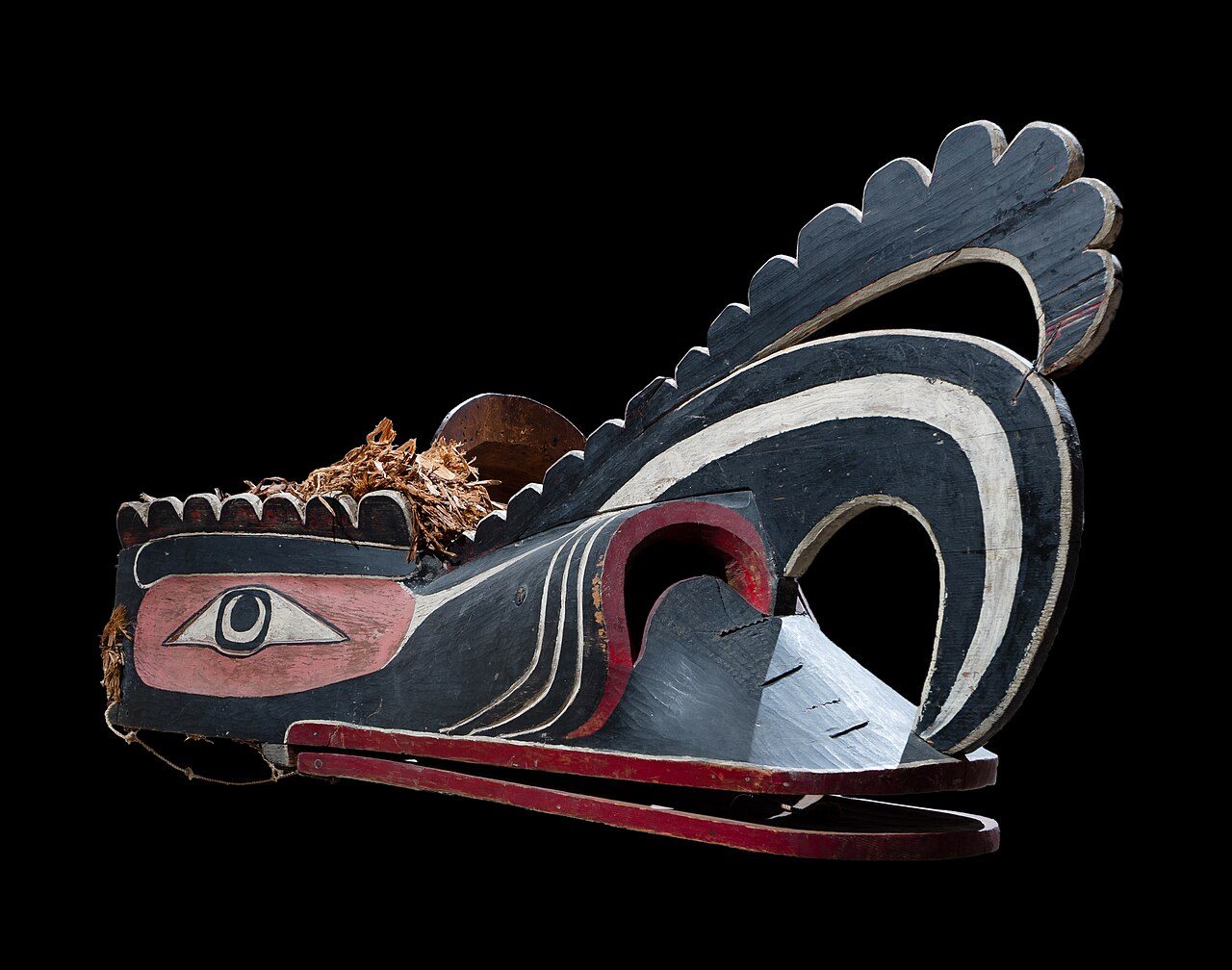
The art of the Haida, Tlingit, Heiltsuk, Tsimshian and other smaller tribes living in the coastal areas of Washington state, Oregon, and British Columbia, is characterized by an extremely complex stylistic vocabulary expressed mainly in the medium of woodcarving. Famous examples include totem poles, transformation masks, and canoes. In addition to woodwork, two dimensional painting and silver, gold and copper engraved jewelry became important after contact with Europeans. 1
Northeastern Woodlands
The Eastern Woodlands, or simply woodlands, cultures inhabited the regions of North America east of the Mississippi River at least since 2500 BCE. While there were many regionally distinct cultures, trade between them was common and they shared the practice of burying their dead in earthen mounds, which has preserved a large amount of their art. Because of this trait the cultures are collectively known as the Mound builders. The Woodland period (1000 BCE–1000 CE) is divided into early, middle, and late periods, and consisted of cultures that relied mostly on hunting and gathering for their subsistence. Ceramics made by the Deptford culture (2500 BCE–100 CE) are the earliest evidence of an artistic tradition in this region. The Adena culture are another well-known example of an early Woodland culture. They carved stone tablets with zoomorphic designs, created pottery, and fashioned costumes from animal hides and antlers for ceremonial rituals. Shellfish was a mainstay of their diet, and engraved shells have been found in their burial mounds. The Middle Woodland period was dominated by cultures of the Hopewell tradition (200–500). 1
The text above is adapted from the Wikipedia article “Visual arts of the Indigenous peoples of the Americas”, available under the Creative Commons Attribution-ShareAlike 4.0 licence. 1
art of Amerindian peoples is art created by Indigenous peoples from the Americas, according to the structured record cited below. This entry was generated automatically from that record and has not yet been reviewed by a person familiar with the tradition. 2
The source record links this tradition to 19 external registers, which can be verified through the citation. 2