The tradition & historical record
5 min read · 2 sourcesArt of the American Southwest is the visual arts of the Southwestern United States. This region encompasses Arizona, New Mexico, and parts of California, Colorado, Nevada, Texas, and Utah. These arts include architecture, ceramics, drawing, filmmaking, painting, photography, sculpture, printmaking, and other media, ranging from the ancient past to the contemporary arts of the present day. 1
Ancient Puebloan people
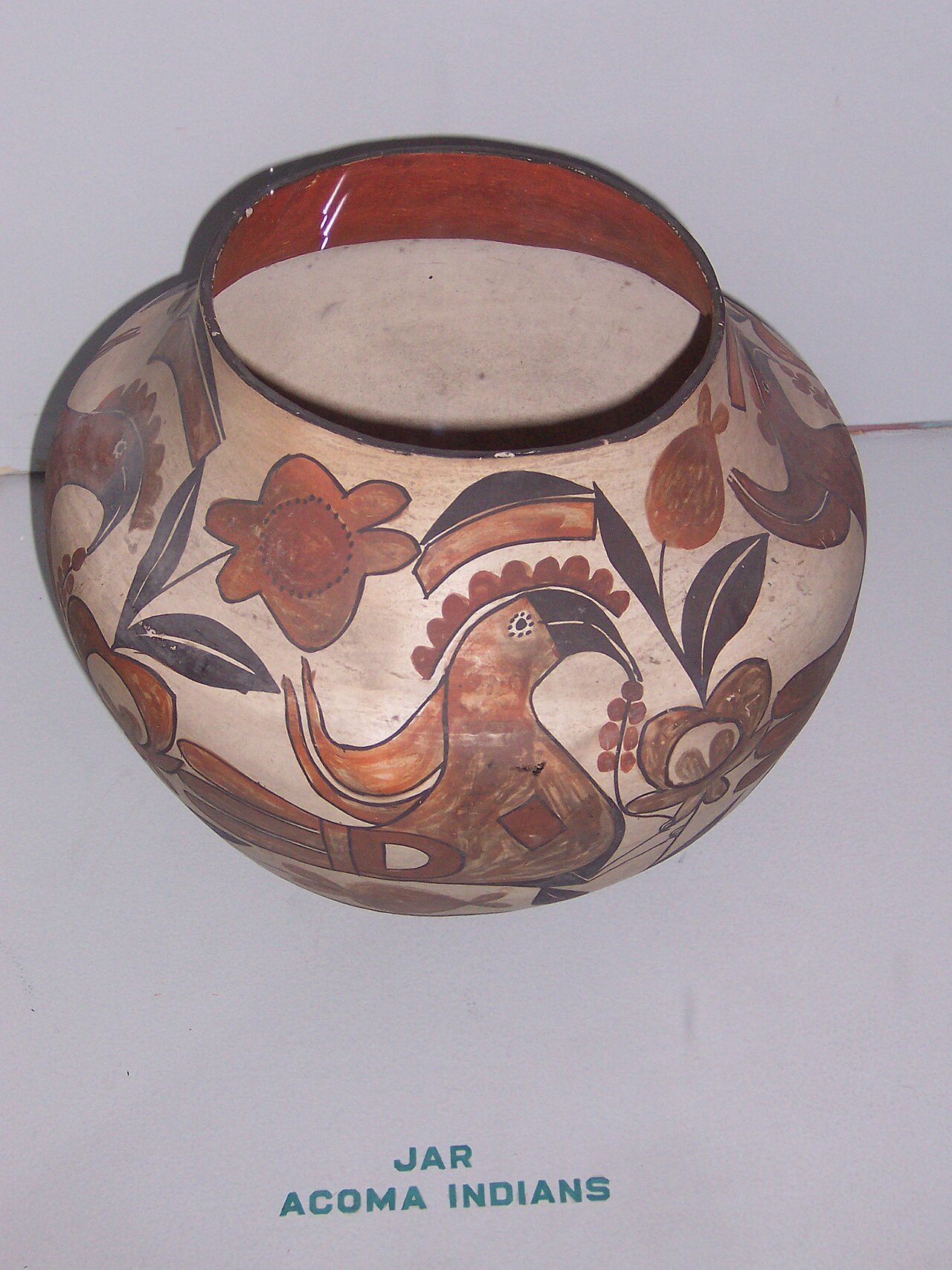
The Ancestral Puebloans, or Anasazi (up to 1400 CE) are the ancestors of today's Pueblo tribes. Their culture formed in the American Southwest after the cultivation of corn was introduced from Mesoamerica about 4,000 years ago. People of this region developed an agrarian lifestyle and lived in sedentary towns. Common early pottery included corrugated gray ware pottery and decorated black-on-white pottery. Corrugated pottery was made from coils of clay wound into the desired shape and the clay is pinched, which created the corrugated texture. White on black evolved as a decorative pottery and was often used as a trade good for food. Sikyátki, a former Hopi village in Arizona inhabited from the 14th through the 16th centuries, is the source of polychrome pottery. Around 300 CE the Hohokam culture developed in Arizona. They are the ancestors of the Tohono O'odham and Akimel O'odham or Pima tribes. The Mimbres, a subgroup of the Mogollon culture, are especially notable for the narrative paintings on their pottery. 1
Turquoise, jet, and spiny oyster shell have been traditionally used by Ancestral Pueblo for jewelry, and they developed sophisticated inlay techniques centuries ago. The Ancestral Puebloans (Anasazi) of the Chaco Canyon and surrounding region are believed to have prospered greatly from their production and trading of turquoise objects. 1
Native American nations
Within the last millennium, Athabaskan peoples emigrated from northern Canada in the southwest. These include the Navajo and Apache. Sandpainting is an aspect of Navajo healing ceremonies that inspired an art form. Navajos learned to weave on upright looms from Pueblos and wove blankets that were eagerly collected by Great Basin and Plains tribes in the 18th and 19th centuries. After the introduction of the railroad in the 1880s, imported blankets became plentiful and inexpensive, so Navajo weavers switched to producing rugs for trade. Pueblo, Navajo and Apache tribes cherished turquoise for its amuletic use; the latter tribe believe the stone to afford the archer dead aim. Among these peoples turquoise was used in mosaic inlay, in sculptural works, and was fashioned into toroidal beads and freeform pendants. The distinctive silver jewelry produced by the Navajo and other Southwestern Native American tribes today is a rather modern development, thought to date from c. 1880 as a result of European influences. 1
Colonial Spanish
With a need to be self-sufficient, many Hispanic people woodworking, weaving, tinsmith, farming and leather work skills to create the furniture and furnishings for their homes. 1
Anglo-Americans
Ancient artistic traditions have been manifested in native craft for generations when Europeans began to settle in the American Southwest; an important acknowledgement for understanding the inherent aesthetic allure of this area to the Anglo-American artists. 1
Integration of influences
Silverworking was adopted by native Southwest artists beginning in the 1850s, when Mexican silversmiths had to trade their silverwork for cattle from the Navajo. The Zuni admired the silver jewelry made by the Navajos, such as Atsidi Sani (Old Smith), so they began trading livestock for instruction in working silver. By 1890, the Zuni had taught the Hopi how to make silver jewelry. Native Americans were also influenced by the introduction of paintings made with oil and watercolor on canvas, where they traditionally painted objects such as hides or inside buildings, such as on the walls of a kiva. The Native American paintings provided artwork that was realistic of the Native American lifestyle in contrast to the work of Anglo-Americans romantic depictions. Traditional design elements were formalized at the Studio at the Santa Fe Indian School, defining flatstyle Native American art. The Studio was developed in 1932 by Dorothy Dunn, who taught there until 1932, and was replaced by Geronima Cruz Montoya (Ohkay Owingeh), who taught art at the Studio until its closing in 1962, when the Institute of American Indian Arts was established. Following World War I, the completion of the Santa Fe Railroad enabled American settlers to travel across the west, as far as the California coast. New artists’ colonies started growing up around Santa Fe and Taos, the artists' primary subject matter being the native people and landscapes of the Southwest. Images of the Southwest became a popular form of advertising, used most significantly by the Santa Fe Railroad to entice settlers to come west and enjoy the “unsullied landscapes”. Walter Ufer, Bert Geer Phillips, E. Irving Couse, William Henry Jackson, Tom Lea, and Georgia O'Keeffe are some of the more prolific artists of the Southwest. 1
The text above is adapted from the Wikipedia article “Art of the American Southwest”, available under the Creative Commons Attribution-ShareAlike 4.0 licence. 1
art of the American southwest is regional art tradition, according to the structured record cited below. This entry was generated automatically from that record and has not yet been reviewed by a person familiar with the tradition. 2