The tradition & historical record
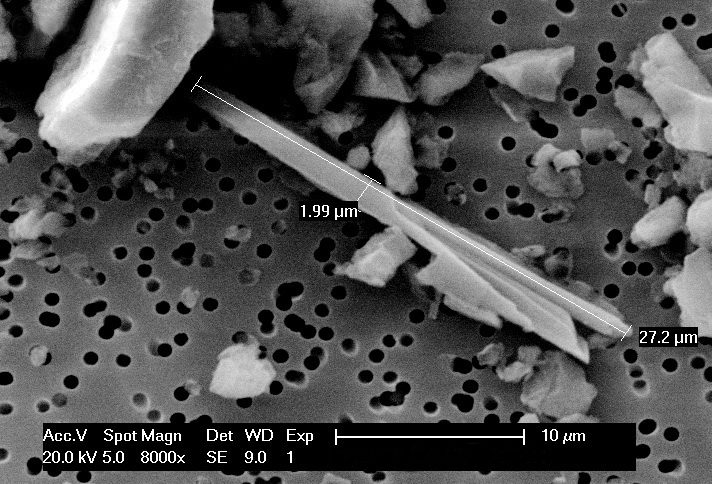
6 min read · 2 sourcesAsbestos or asbestus ( ass-BES-təs, az-, -toss) is a group of naturally occurring, fibrous silicate minerals that have been used for thousands of years to create flexible fire-resistant objects, such as fireproof fabrics. It is toxic and carcinogenic. There are six types, all of which are composed of long and thin fibrous crystals, with each fibre (particulate with length substantially greater than width) composed of many microscopic "fibrils" that can be released into the atmosphere by abrasion and other processes. Inhalation of asbestos fibres can lead to various dangerous lung conditions, including mesothelioma, asbestosis, and lung cancer. As a result of these health effects, asbestos is considered a serious health and safety hazard. Archaeological studies have found evidence of asbestos being used as far back as the Stone Age to strengthen ceramic pots, but large-scale mining began at the end of the 19th century when manufacturers and builders began using asbestos for its desirable physical properties. Asbestos is an excellent thermal and electrical insulator, and is highly fire-resistant, so for much of the 20th century, it was very commonly used around the world as a building material (particularly for its fire-retardant properties), until its adverse effects on human health were more widely recognized and acknowledged in the 1970s. 1
History
Asbestos has been used for thousands of years to create flexible objects that resist fire, such as napkins and other textiles. Mass production of asbestos-containing consumer goods began in the modern era. Today, the risk of asbestos has been recognized; the use of asbestos is completely banned in 66 countries and strictly regulated in many others. 1
Terminology
The word "asbestos", first used in the 1600s, ultimately derives from the Ancient Greek: ἄσβεστος, meaning "unquenchable" or "inextinguishable". The name reflects use of the substance for wicks that would never burn up. It was adopted into English via the Old French abestos, which derived the word from Greek via Latin, but in the original Greek, "asbestos" actually referred to quicklime. It is said by the Oxford English Dictionary that the word was wrongly used by Pliny the Elder for what is now called asbestos, and that he popularized the misnomer. Asbestos was originally referred to in Greek as amiantos, meaning "undefiled", because when thrown into a fire it came out unmarked. "Amiantos" is the source for the word for asbestos in many languages, such as the Portuguese, the Spanish, and the Italian amianto and the French amiante. It had also been called "amiant" in English in the early 15th century, but this usage was superseded by "asbestos". The word is pronounced or . 1
Early references and uses
Asbestos use dates back at least 4,500 years, when the inhabitants of the Lake Juojärvi region in East Finland strengthened earthenware pots and cooking utensils with the asbestos mineral anthophyllite; archaeologists call this style of pottery "asbestos-ceramic". Some archaeologists believe that ancient peoples made shrouds of asbestos, wherein they burned the bodies of their kings to preserve only their ashes and to prevent the ashes being mixed with those of wood or other combustible materials commonly used in funeral pyres. Others assert that these peoples used asbestos to make perpetual wicks for sepulchral or other lamps. A famous example is the golden lamp asbestos lychnis, which the sculptor Callimachus made for the Erechtheion. In more recent centuries, asbestos was indeed used for this purpose. A once-purported first description of asbestos occurs in Theophrastus, On Stones, from around 300 BC, but this identification has been refuted. In both modern and ancient Greek, the usual name for the material known in English as "asbestos" is amiantos ("undefiled", "pure"), which was adapted into the French as amiante and into Italian, Spanish and Portuguese as amianto. In modern Greek, the word ἀσβεστος or ασβέστης stands consistently and solely for lime. The term asbestos is traceable to Roman naturalist Pliny the Elder's first-century manuscript Natural History and his use of the term asbestinon, meaning "unquenchable"; he described the mineral as being more expensive than pearls. 1
Industrial era
The large-scale asbestos industry began in the mid-19th century. Early attempts at producing asbestos paper and cloth in Italy began in the 1850s but failed to create a market for these products. Canadian asbestos samples were displayed in London in 1862, and the first companies were formed in England and Scotland to exploit this resource. Asbestos was first used in the manufacture of yarn, and German industrialist Louis Wertheim adopted this process in his factories in Germany. In 1871, the Patent Asbestos Manufacturing Company was established in Glasgow, and during the following decades, the Clydebank area became a centre for the nascent industry. 1
Industrial-scale mining began in the Thetford Hills, Quebec, from the 1870s. Sir William Edmond Logan was the first to notice the large deposits of chrysotile in the hills in his capacity as head of Geological Survey of Canada. Samples of the minerals from there were displayed in London and elicited much interest. With the opening of the Quebec Central Railway in 1876, mining entrepreneurs such as Andrew Stuart Johnson and William Henry Jeffrey established the asbestos industry in the province. The 50-ton output of the mines in 1878 rose to over 10,000 tonnes in the 1890s with the adoption of machine technologies and expanded production. For a long time, the world's largest asbestos mine was the Jeffrey Mine in the town of Asbestos, Quebec. 1
Asbestos production began in the Urals of the Russian Empire in the 1880s (notably the Bazhenovsky asbestos field), and the Alpine regions of Northern Italy with the formation in Turin of the Italo-English Pure Asbestos Company in 1876, although the greater production levels from the Canadian mines soon overtook European production. 1
Discovery of toxicity
The 1898 Annual Report of the Chief Inspector of Factories and Workshops in the United Kingdom noted the negative health effects of asbestos, the contribution having been made by Lucy Deane Streatfeild, one of the first women factory inspectors. In 1899, H. Montague Murray noted the negative health effects of asbestos. The first documented death related to asbestos was in 1906. In the early 1900s, researchers began to notice a large number of early deaths and lung problems in asbestos-mining towns. The first such study was conducted by Murray at the Charing Cross Hospital, London, in 1900, in which a postmortem investigation discovered asbestos traces in the lungs of a young man who had died from pulmonary fibrosis after having worked for 14 years in an asbestos textile factory. Adelaide Anderson, the Inspector of Factories in Britain, included asbestos in a list of harmful industrial substances in 1902. 1
The text above is adapted from the Wikipedia article “Asbestos”, available under the Creative Commons Attribution-ShareAlike 4.0 licence. 1
asbestos is group of highly stable, non-flammable silicate minerals with a fibrous structure, according to the structured record cited below. This entry was generated automatically from that record and has not yet been reviewed by a person familiar with the tradition. 2
The source record links this tradition to 84 external registers, which can be verified through the citation. 2