The tradition & historical record
7 min read · 2 sourcesAvalon () is an island featured in the Arthurian legend. It first appeared in Geoffrey of Monmouth's 1136 Historia Regum Britanniae as a place of magic where King Arthur's sword Excalibur was made and later where Arthur was taken to recover from being gravely wounded at the Battle of Camlann. Since then, the island has become a symbol of Arthurian mythology, similar to Arthur's castle, Camelot. Avalon was associated from an early date with mystical practices and magical figures such as King Arthur's sorceress sister Morgan, cast as the island's ruler by Geoffrey and many later authors. Certain Cornish and Welsh traditions have maintained that Arthur is an eternal king who had never truly died but would return as the "once and future" king. The particular motif of his rest in Morgan's care in Avalon has become especially popular. It can be found in various versions in many French and other medieval Arthurian and other works written in the wake of Geoffrey, some of them also linking Avalon with the legend of the Holy Grail. Avalon has often been identified as the former island of Glastonbury Tor. An early and long-standing belief involves the purported discovery of Arthur's remains and their later grand reburial, in accordance with the medieval English tradition in which Arthur did not survive the fatal injuries he suffered in his final battle. Besides Glastonbury, several other alternative locations of Avalon have also been claimed or proposed. 1
Etymology
The meaning and origin of the name Avalon have been long debated by Arthurian scholars as well as Celtic and Romance philologists. Geoffrey of Monmouth in his pseudo-chronicle Historia Regum Britanniae ("The History of the Kings of Britain", c. 1136) calls the place Insula Avallonis, meaning the "Isle of Avallon" in Latin. In his later Vita Merlini ("The Life of Merlin", c. 1150), he calls it Insula Pomorum, the "Isle of Fruit Trees" (from Latin pōmus "fruit tree"). Today, the name is generally considered to be from the Welsh afallen "apple tree, fruit tree" (from Proto-Celtic *abalnā, literally "fruit-bearing (thing)"). A Cornish or Breton origin is also possible, deriving from aball or avallen(n). The tradition of an "apple" island among the ancient Britons may also be related to Irish legends of the otherworld island home of Manannán mac Lir and Lugh, Emain Ablach (also the Old Irish poetic name for Isle of Man), where Ablach means "Having Apple Trees"— from Old Irish aball ("apple tree") — and is similar to the Middle Welsh name Afallach, which was used to replace the name Avalon in medieval Welsh translations of French and Latin Arthurian tales. All are related to the Gaulish root *aballo- "apple tree" (found in the place name Aballo/Aballone) and are derived from Proto-Celtic *abūl "apple", which is related at the Indo-European level to English apple, Russian яблоко (jabloko), Latvian ābele, etc. In the early 12th century, William of Malmesbury claimed the name of Avalon came from a man called Avalloc, who once lived on this isle with his daughters. Gerald of Wales similarly derived the name of Avalon from its purported former ruler, Avallo. 1
Geoffrey of Monmouth
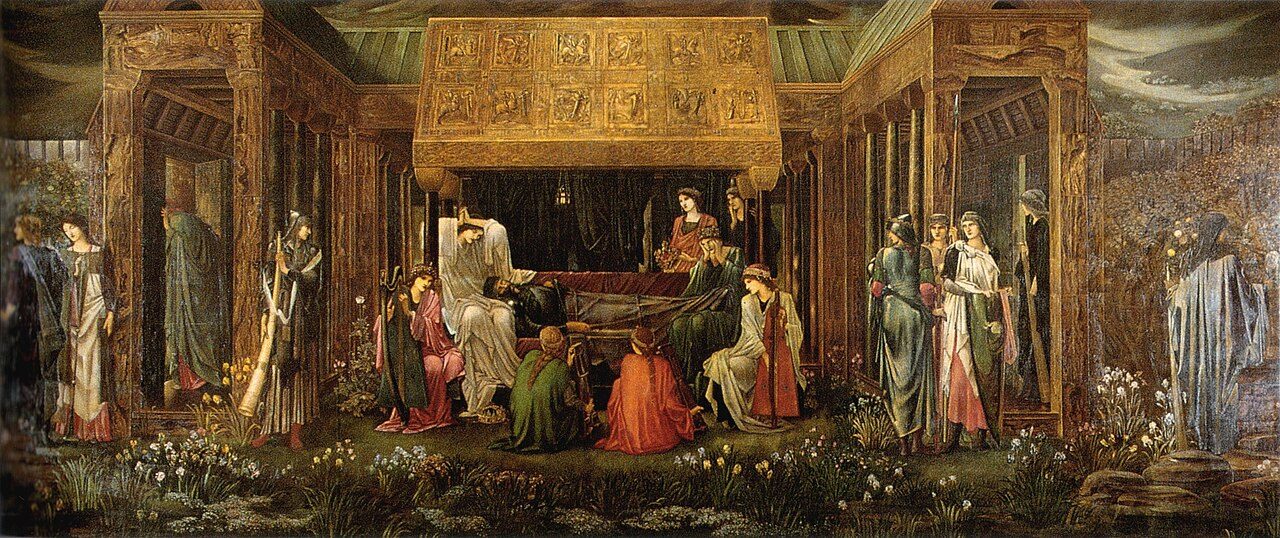
According to Geoffrey in the Historia, and much subsequent literature which he inspired, King Arthur was taken to Avalon (Avallon) in hope that he could be saved and recover from his mortal wounds following the tragic Battle of Camlann. Geoffrey first mentions Avalon as the place where Arthur's sword Excalibur (Caliburn) was forged. Geoffrey dealt with the subject in more detail in the Vita Merlini, in which he describes for the first time in Arthurian legend the fairy or fae-like enchantress Morgen (i.e. Morgan) as the chief of nine sisters (including Moronoe, Mazoe, Gliten, Glitonea, Gliton, Tyronoe and Thiten) who together rule Avalon. Geoffrey's telling, in the in-story narration by the bard Taliesin to Merlin, indicates a sea voyage was needed to get there. The description of Avalon, which is heavily indebted to the early medieval Spanish scholar Isidore of Seville (having been mostly derived from the section on famous islands in Isidore's work Etymologiae, XIV.6.8 "Fortunatae Insulae"), shows the magical nature of the island: 1
The Isle of Fruit Trees which men call the Fortunate Isle (Insula Pomorum quae Fortunata uocatur) gets its name from the fact that it produces all things of itself; the fields there have no need of the ploughs of the farmers and all cultivation is lacking except what nature provides. Of its own accord it produces grain and grapes, and apple trees grow in its woods from the close-clipped grass. The ground of its own accord produces everything instead of merely grass, and people live there a hundred years or more. 1
Later medieval literature
In many versions of Arthurian legend, including Thomas Malory's compilation Le Morte d'Arthur, Morgan the Fairy and several other magical queens (numbering either three, four, or "many") arrive after the battle to take the mortally wounded Arthur from the battlefield of Camlann (Salisbury Plain in the romances) to Avalon in a black boat. Besides Morgan, who by this time had already become Arthur's supernatural sibling in the popular romance tradition, they sometimes come with the Lady of the Lake among them. The others may include the Queen of Northgales (North Wales) and the Queen of the Wasteland. In the Vulgate Queste, Morgan tells Arthur of her intention to relocate to Avalon, "where the ladies who know all the magic in the world are" (ou les dames sont qui seiuent tous les enchantemens del monde [sic]), not long before his final battle. Its Welsh version also claims, within its text, to be a translation of old Latin books from Avalon, as does the French Perlesvaus. In Lope Garcia de Salazar's Spanish summary of the Post-Vulgate Roman du Graal, Avalon is conflated with (and explicitly named as) the mythological Island of Brasil, said to be located west of Ireland and afterwards forever hidden in mist by Morgan's enchantment. 1
In some texts, Arthur's fate in Avalon is left untold or uncertain. In the Vera historia de morte Arthuri ("True story of the death of Arthur"), for instance, Arthur is taken by four of his men to Avalon in the land of Gwynedd (north-west Wales), where he is about to die but then mysteriously disappears in a mist amongst sudden great storm. 1
Escavalon
In his final romance, Perceval, the Story of the Grail, Chrétien de Troyes featured the sea fortress of Escavalon, ruled by the unspecified King of Escavalon. The name Escavalon might be simply a corruption of the word Avalon that can be literally translated as "Water-Avalon", albeit some scholars proposed various other developments of the name Escavalon from that of Avalon (with Roger Sherman Loomis noting the similarity of the evolution of Geoffrey's Caliburn into the Chrétien's Escalibur in the case of Excalibur), perhaps in connection with the Old French words for either Slav or Saracen. 1
Post-Arthurian stories
Morgan features as an immortal ruler of a fantastic Avalon, sometimes alongside the still-alive Arthur, i… 1
The text above is adapted from the Wikipedia article “Avalon”, available under the Creative Commons Attribution-ShareAlike 4.0 licence. 1
Avalon is legendary island featured in the Arthurian legend, according to the structured record cited below. This entry was generated automatically from that record and has not yet been reviewed by a person familiar with the tradition. 2
The source record links this tradition to 9 external registers, which can be verified through the citation. 2