The tradition & historical record
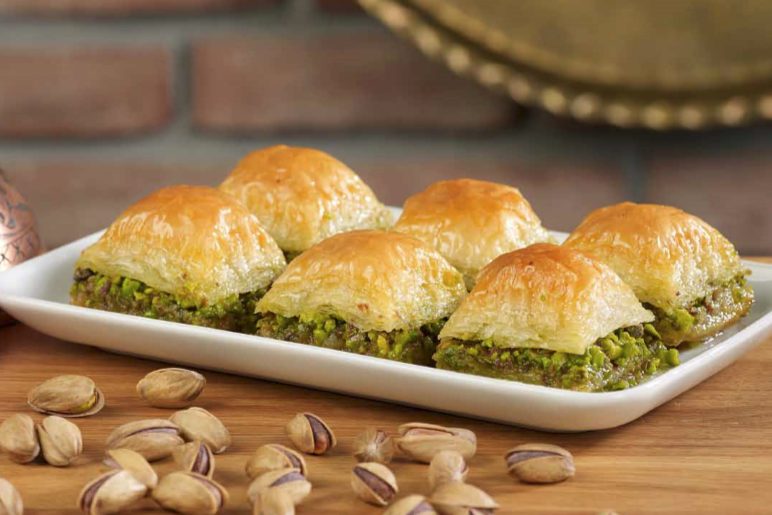
6 min read · 2 sourcesBaklava ( , or ) is a layered pastry dessert made of filo pastry, filled with chopped nuts, and sweetened with either syrup or honey. There are several theories for the origin of this pastry, but it is considered a traditional dessert among the cuisines of countries in West Asia, Southeast Europe, Central Asia, and North Africa. 1
Etymology
The word baklava is first attested in English in 1650, a borrowing from Ottoman Turkish: باقلاوه /bɑːklɑvɑː/. The name baklava is used in many languages with minor phonetic and spelling variations. The earliest known reference to baklava is in a poem by the 15th century mystic Kaygusuz Abdal. The historian Paul D. Buell argues that the word baklava may come from the Mongolian root baγla- 'to tie, wrap up, pile up' composed with the Turkic verbal ending -v; baγla- itself in Mongolian is a Turkic loanword. The lexicographer Sevan Nişanyan considers its oldest known forms (pre-1500) to be baklağı and baklağu, and labels it as being of Proto-Turkic origin. Another form of the word is also recorded in Persian, باقلبا (bāqlabā). Though the suffix -vā might suggest a Persian origin, the baqla- part does not appear to be Persian and remains of unknown origin. The linguist Tuncer Gülensoy states that the origin of baklava is bakl-ı (feed) in proto-Turkish and suffixes -la-ğı are added. The word changes as bakılağı > bakılavı > baklava. The Arabic name بقلاوة baqlāwa originates from Turkish. 1
History
The modern form of baklava was developed in the imperial kitchens of the Topkapı Palace of modern-day Istanbul during the Ottoman Empire. The American food historian and writer Gil Marks points to a Persian and Turkish origin for the dish. The early history of baklava remains contested. There are several proposals for the original roots of baklava like the Greek placenta cake, the medieval Arabic confection lauzinaj, and the Central Asian tradition of layered yufka. There are also some similarities between baklava and the Ancient Greek desserts gastris (γάστρις), kopte sesamis (κοπτὴ σησαμίς), and kopton (κοπτόν) found in book XIV of the Deipnosophistae. The recipe for gastris in Book XIV of Athenaeus’ Deipnosophistae describes a mixture of nuts, poppy seeds, honey, and pepper, shaped into a square. It then instructs the cook to prepare white sesame with boiled honey and to stretch out two lagania (λαγάνιον, i.e. a thin broad cake ), placing one underneath the filling and the other on top. Another recipe for a similar dessert is güllaç, a dessert found in Turkish cuisine and considered by a small minority as the origin of baklava. It consists of layers of filo dough that are put one by one in warmed up milk with sugar. It is served with walnut and fresh pomegranate and generally eaten during Ramadan. The first known documentation of güllaç is attested in Yinshan Zhengyao, a food and health manual that documents foods of the Mongol Empire, written in 1330 by Hu Sihui, an ethnic Mongol court dietitian of China's Yuan dynasty. The Ottoman Sultan presented trays of baklava to the Janissaries every 15th of the month of Ramadan in a ceremonial procession called the Baklava Alayı. 1
Placenta cake
Many claim that the placenta cake, and therefore baklava, derived from a recipe from Ancient Greece. Homer's Odyssey, written around 800 BC, mentions thin breads sweetened with walnuts and honey. In the fifth century BC, Philoxenos states in his poem "Dinner" that, in the final drinking course of a meal, hosts would prepare and serve cheesecake made with milk and honey that was baked into a pie. The word "placenta" originally comes from the Greek language plakous (πλακοῦς), which means something "flat and broad". An early Greek language mention of plakous as a dessert (or second table delicacy) comes from the poems of Archestratos from the 5th century BC. He describes plakous as served with nuts or dried fruits and commends the honey-drenched Athenian version of plakous. The earliest known detailed recipe for placenta, from the 2nd century BC, is a honey-covered baked layered-dough dessert which food historian Patrick Faas identifies as the origin of baklava. In the Byzantine Empire, the traditional placenta cake (known as "koptoplakous", κοπτοπλακοῦς), a dish similar to baklava, was consumed. According to a number of scholars, koptoplakous (κοπτοπλακοῦς) was a precursor to the modern baklava. Historian Speros Vryonis describes koptoplakous as a "Byzantine favorite" and "the same as the Turkish baklava", as do other writers. The name plakous (Greek: πλακοῦς) is used today on the island of Lesbos for thin layered pastry leaves with crushed nuts, baked, and covered in syrup. 1
Lauzinaj
Baklava is a common dessert in modern Arab cuisines, but the Arabic language cookbook Kitab al-Tabikh, compiled by Ibn Sayyar al-Warraq in the 10th century, does not contain any recipe for baklava. Its recipe for lauzinaj refers to small pieces of almond paste wrapped in very thin pastry ("as thin as grasshoppers' wings") and drenched in syrup. Some writers say that this is the dessert that most closely resembles the modern baklava. Charles Perry, however, has written that "it was not much like baklava". There are similar recipes for lauzinaj in the 13th-century Kitab al-Tabikh by Muhammad bin Hasan al-Baghdadi. Written in 1226 in today's Iraq, the cookbook was based on an earlier collection of 9th century Persian-inspired recipes. According to Gil Marks, Middle Eastern pastry makers later developed the process of layering the ingredients. 1
Preparation
Baklava is prepared in large pans of various shapes. Multiple layers of filo dough are separated from each other by melted butter and starch that gives baklava its unique texture. During the layering process, finely chopped nuts—typically walnuts or pistachios, occasionally hazelnuts and almonds—are added partway through the layers. Most recipes have multiple layers of filo and nuts, though some have the pastry only at the top and the bottom. Before baking, the dough is cut into regular pieces, often parallelograms (lozenge-shaped), triangles, diamonds or rectangles. After baking, a syrup, which may include honey, rosewater, or orange flower water, is poured over the cooked baklava and allowed to soak. The parallelograms are separated into individual pastries after baking. Baklava is usually served at room temperature, and is often garnished with nuts that have been ground up. 1
The text above is adapted from the Wikipedia article “Baklava”, available under the Creative Commons Attribution-ShareAlike 4.0 licence. 1
baklava is layered pastry from the Middle East, according to the structured record cited below. This entry was generated automatically from that record and has not yet been reviewed by a person familiar with the tradition. 2
The source record links this tradition to 14 external registers, which can be verified through the citation. 2