The tradition & historical record
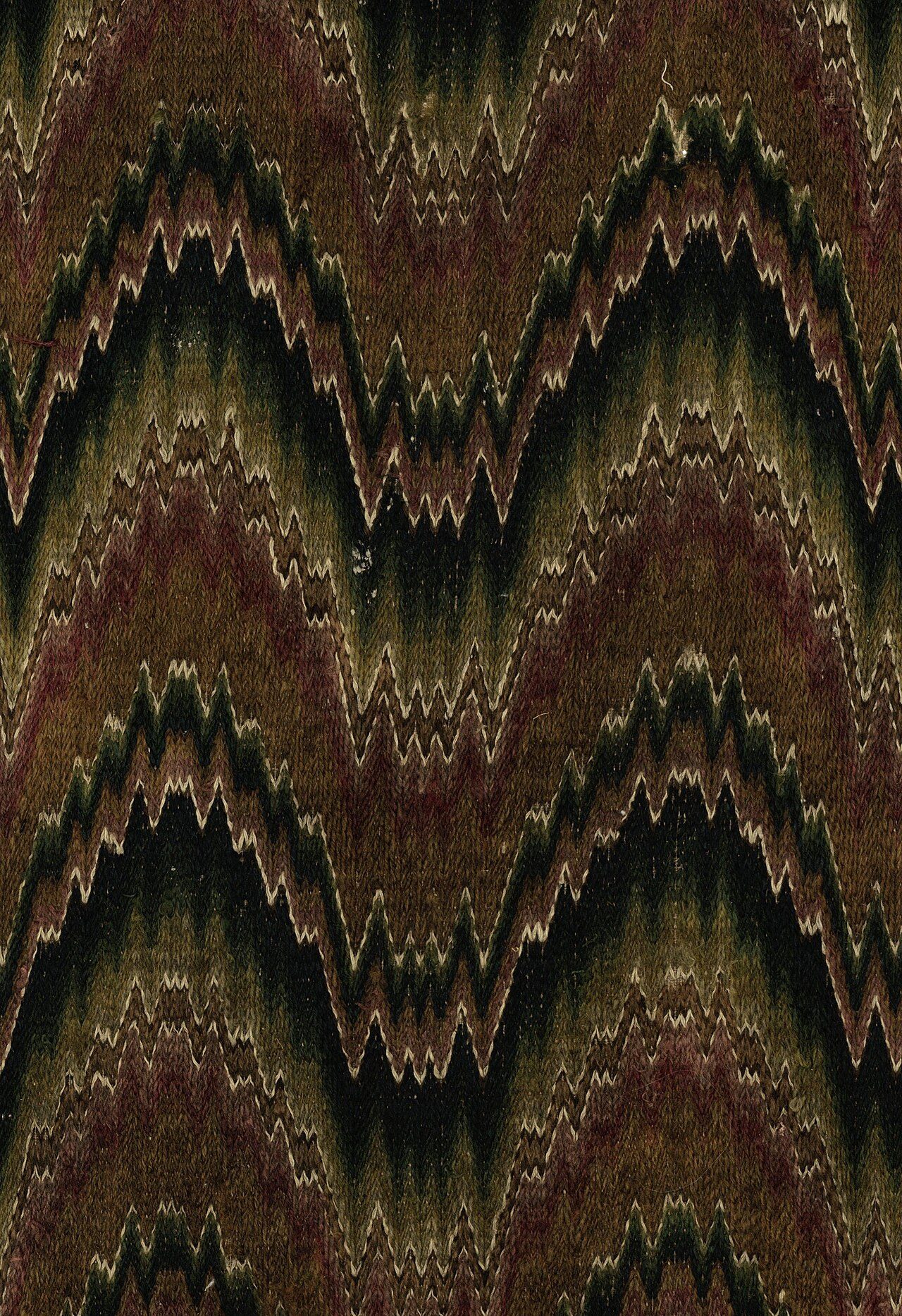
4 min read · 2 sourcesBargello is a type of needlepoint embroidery consisting of upright flat stitches laid in a mathematical pattern to create motifs. The name originates from a series of chairs found in the Bargello palace in Florence, which have a "flame stitch" pattern. Traditionally, Bargello was stitched in wool on canvas. Embroidery done this way is remarkably durable. It is well suited for use on pillows, upholstery and even carpets, but not for clothing. In most traditional pieces, all stitches are vertical with stitches going over two or more threads. Traditional designs are very colourful, and use many hues of one colour, which produces intricate shading effects. The patterns are naturally geometric, but can also resemble very stylised flowers or fruits. 1
Alternative names
A number of alternative names are used by different scholars, including: 1
Florentine work - after the fact that the Bargello Museum is in Florence. Hungarian point (punto unghero) - in Italian, Bargello is known as "Hungarian Point", indicating that the Florentines believed the technique originated in Hungary. However, English embroidery vocabulary also includes a diamond-shaped stitch called Hungarian point, so few English-language books use this term to refer to Bargello. Flame stitch (punto fiamma) - a type of Bargello motif in which zig-zag or flames are created. The chairs in the Bargello Museum do use flame stitch motifs, but curved motifs are also common (see below). These curved Bargello motifs would normally not be "flame stitch", but would be called Bargello. Irish stitch - a term found in early modern British sources, equated with Bargello. Lady Anne Clifford mentioned working Irish stitch cushion covers in her diary. Because of the potential for confusion, most books written in English refer to the technique simply as "Bargello". 1
History
As with many traditional crafts, the origins of Bargello are not well documented. Although early examples are from the Bargello Museum in Florence, there does exist documentation that a Hungarian connection is possible. For one thing, the Bargello Museum inventory identifies the chairs in its inventory as "17th century with backs and seats done in punto unghero (Hungarian Point)". In the 18th century, Queen Maria Theresa of Hungary stitched Bargello and her work has been preserved in the Hungarian National Museum. Petschek also cites legend of Hungarian noblewomen practicing the craft, including a Hungarian princess marrying into the de Medici family, and a princess Jadwiga (Hedwig) of Hungary who married into the Jagiełło dynasty of Poland. It is unknown if those were distinct developments or if they influenced each other. Both Bargello and Hungarian Point tend to be colorful and use many hues of one color, which produces intricate shading effects. The patterns are naturally geometric, but can also resemble very stylized flowers or fruits. 1
Bargello technique
Bargello refers not to just a stitching technique, but also to motifs created by the change of colors in the stitches. This section describes the vertical stitch, and how it is combined with color and "stepping" to create different motifs. 1
Vertical stitches
Most agree that traditional Bargello pieces incorporate a series of all vertical stitches (vs. diagonal stitches). The basic unit is usually a vertical stitch of four threads, but other heights are possible. Some Bargello pieces use only one height of stitch, but even the earliest pieces (such as chairs in the Bargello museum) combine different heights of stitches. 1
Stepping
Bargello patterns are formed when vertical stitches are stepped, or offset vertically, usually by two threads (i.e., halfway down a unit of four threads). The patterns in the steps combined with color changes determines how the overall pattern will emerge. 1
The text above is adapted from the Wikipedia article “Bargello (needlework)”, available under the Creative Commons Attribution-ShareAlike 4.0 licence. 1
Bargello is embroidery worked with vertical stitches offset to form a zigzag or similar geometric design, according to the structured record cited below. This entry was generated automatically from that record and has not yet been reviewed by a person familiar with the tradition. 2
The source record links this tradition to 4 external registers, which can be verified through the citation. 2