The tradition & historical record
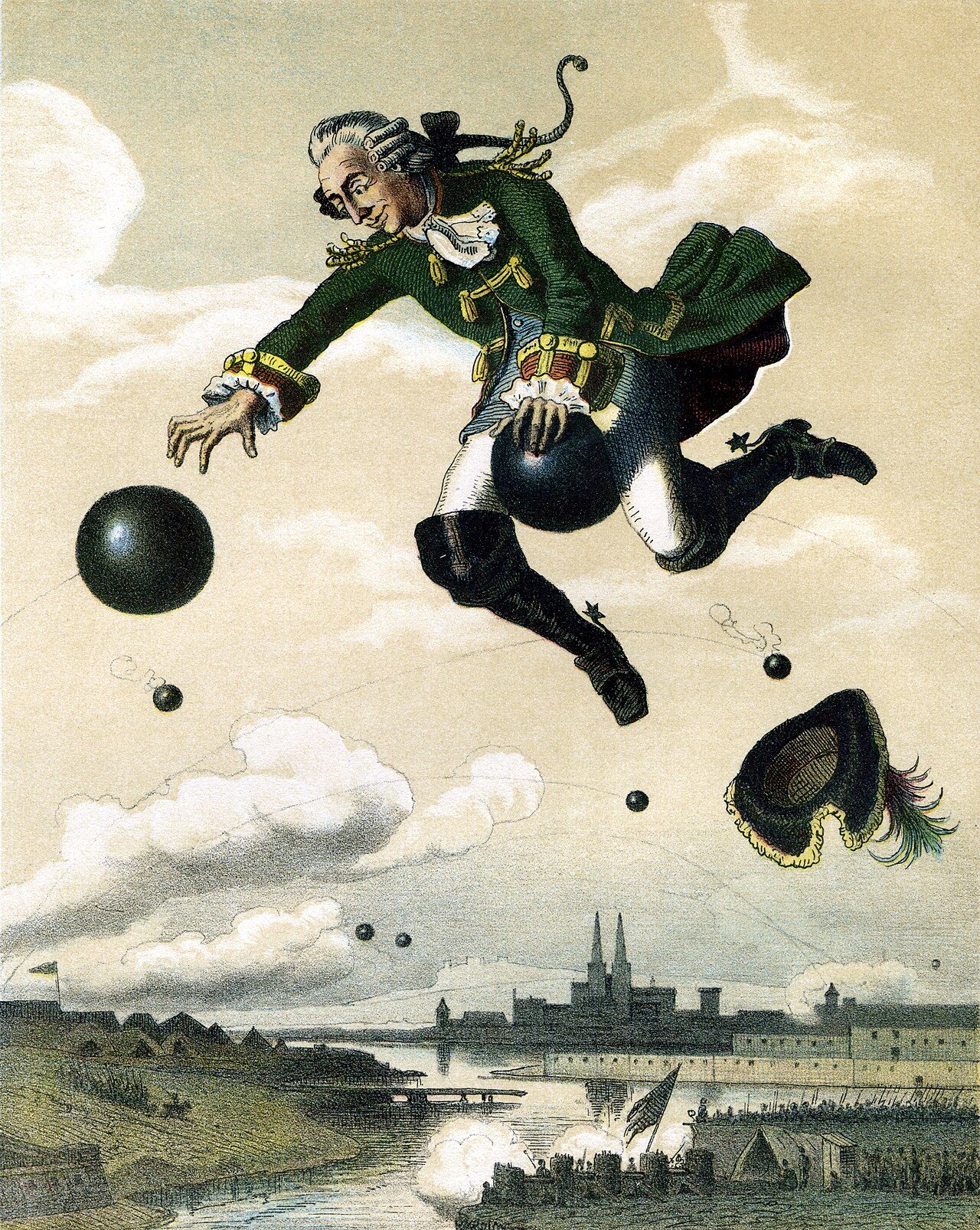
6 min read · 2 sourcesBaron Munchausen () is a fictional German nobleman created by the German writer Rudolf Erich Raspe in his 1785 book Baron Munchausen's Narrative of His Marvellous Travels and Campaigns in Russia. The character is loosely based on Hieronymus Karl Friedrich Freiherr von Münchhausen. Born in Bodenwerder, Hanover, the real-life Münchhausen fought for the Russian Empire during the Russo-Turkish War of 1735–1739. After retiring in 1760, he became a minor celebrity within German aristocratic circles for telling outrageous tall tales based on his military career. After hearing some of Münchhausen's stories, Raspe adapted them anonymously into literary form, first in German as ephemeral magazine pieces and then in English as the 1785 book, which was first published in Oxford by a bookseller named Smith. The book was soon translated into other European languages, including a German version expanded by the poet Gottfried August Bürger. The real-life Münchhausen was deeply upset at the development of a fictional character bearing his name, and threatened legal proceedings against the book's publisher. Perhaps fearing a libel suit, Raspe never acknowledged his authorship of the work, which was only established posthumously. The fictional Baron's exploits, narrated in the first person, focus on his impossible achievements as a sportsman, soldier, and traveller; for instance: riding on a cannonball, fighting a forty-foot (12 m) crocodile, and travelling to the Moon. 1
Historical figure
Hieronymus Karl Friedrich von Münchhausen was born on 11 May 1720 in Bodenwerder, a town in the Electorate of Hanover. He was born into the Münchhausen family, a noble family originally from the Duchy of Brunswick-Lüneburg. The branch to which Münchhausen belonged owned landed estates in Rinteln and Bodenwerder and belonged to the "Black Line" of the family, which was first mentioned in historical records in 1183. During his lifetime, Münchhausen's second cousin once removed Gerlach Adolph von Münchhausen was the most influential member of the family; he spearheaded the establishment of the University of Göttingen in 1734 and served as Hanover's Prime Minister from 1765 to 1770. At a young age, Münchhausen served as a page in the court of Duke Anthony Ulrich of Brunswick, following the duke to Russia in 1733. Münchhausen was commissioned as a cornet (kornet) in the Imperial Russian Army's Brunswick Cuirassiers in 1739, and the duke's wife Anna Leopoldovna became regent of Russia in the next year on the behalf of her newborn son Ivan VI. On 27 November 1740, Münchhausen was promoted to lieutenant (poruchik). Following the overthrow of Anna's regency in 1741, his career stagnated and he was not promoted to captain (rotmistr) until 1750. Riga served as his main place of residence during this period, and in 1744 Münchhausen married Jacobine von Dunten, the daughter of a Baltic knight; the marriage was childless. Münchhausen's time in Riga probably influenced his skills as a storyteller, as among the Baltic German nobility men often told imaginative stories about hunting or wartime experiences. 1
In 1760, Münchhausen retired and settled down on his estates in Bodenwerder as a landowner, remaining there until his death in 1797. 1
Fictionalized version
The fictionalized character was created by a German writer, scientist, and con artist, Rudolf Erich Raspe. Raspe probably met Hieronymus von Münchhausen while studying at the University of Göttingen, and may even have been invited to dine with him at the mansion at Bodenwerder. Raspe's later career mixed writing and scientific scholarship with theft and swindling; when the German police issued advertisements for his arrest in 1775, he fled continental Europe and settled in England. In his native German, Raspe wrote a collection of episodes inspired by Münchhausen's tales, calling the collection "M-h-s-nsche Geschichten" ("M-h-s-n Stories"). It remains unclear how much of Raspe's material comes directly from the Baron, but the majority of the stories are derived from older sources, including Heinrich Bebel's Facetiæ (1508) and Samuel Gotthold Lange's Deliciæ Academicæ (1765). "M-h-s-nsche Geschichten" appeared as a feature in the eighth issue of the Vade mecum für lustige Leute (Handbook for Fun-loving People), a Berlin humor magazine, in 1781. Raspe published a sequel, "Noch zwei M-Lügen" ("Two more M-Fibs"), in the tenth issue of the same magazine in 1783. The protagonist and narrator of these stories was identified only as "M-h-s-n", keeping Raspe's inspiration obscured in part while still allowing knowledgeable German readers to make the connection to Münchhausen. Raspe's name did not appear at all. In 1785, while supervising mines at Dolcoath in Cornwall, Raspe adapted the Vade mecum stories into a short English-language book, this time identifying the narrator of the book as "Baron Munchausen". 1
Publication history
The following tables summarize the early publication history of Raspe's text, from 1785 to 1800. Unless otherwise referenced, information in the tables comes from the Munchausen bibliography established by John Patrick Carswell. 1
Fictional character
The fictional Baron Munchausen is a braggart soldier, defined by his comically exaggerated boasts about his own adventures. All of the stories in Raspe's book are told in first-person narrative, with a prefatory note explaining that "the Baron is supposed to relate these extraordinary Adventures over his Bottle, when surrounded by his Friends". The Baron's stories imply him to be a superhuman figure who spends most of his time either getting out of absurd predicaments or indulging in equally absurd moments of gentle mischief. In some of his best-known stories, the Baron rides a cannonball, travels to the Moon, is swallowed by a giant fish in the Mediterranean Sea, saves himself from drowning by pulling up on his own hair, fights a forty-foot (12 m) crocodile, enlists a wolf to pull his sleigh, and uses laurel tree branches to fix his horse when the animal is accidentally cut in two. In the stories, the Baron is shown as a calm, rational man, describing what he experiences with simple objectivity; absurd happenings elicit, at most, mild surprise from him, and he shows serious doubt about any unlikely events he has not witnessed himself. The resulting narrative effect is an ironic tone, encouraging skepticism in the reader and marked by a running undercurrent of subtle social satire. In addition to his fearlessness when hunting and fighting, he is suggested to be a debonair, polite gentleman given to moments of gallantry, with a scholarly penchant for knowledge, a tendency to be pedantically accurate about details in his stories, and a deep appreciation for food and drink of all kinds. 1
Critical and popular reception
Reviewing the first edition of Raspe's book in December 1785, a writer in The Critical Review commented appreciatively: 1
This is a satirical production calculated to throw ridicule on the bold assertions of some parliamentary declaimers. 1
The text above is adapted from the Wikipedia article “Baron Munchausen”, available under the Creative Commons Attribution-ShareAlike 4.0 licence. 1
Baron Munchausen is Fictional German nobleman created by the German writer Rudolf Erich Raspe, according to the structured record cited below. This entry was generated automatically from that record and has not yet been reviewed by a person familiar with the tradition. 2
The source record links this tradition to 1 external register, which can be verified through the citation. 2