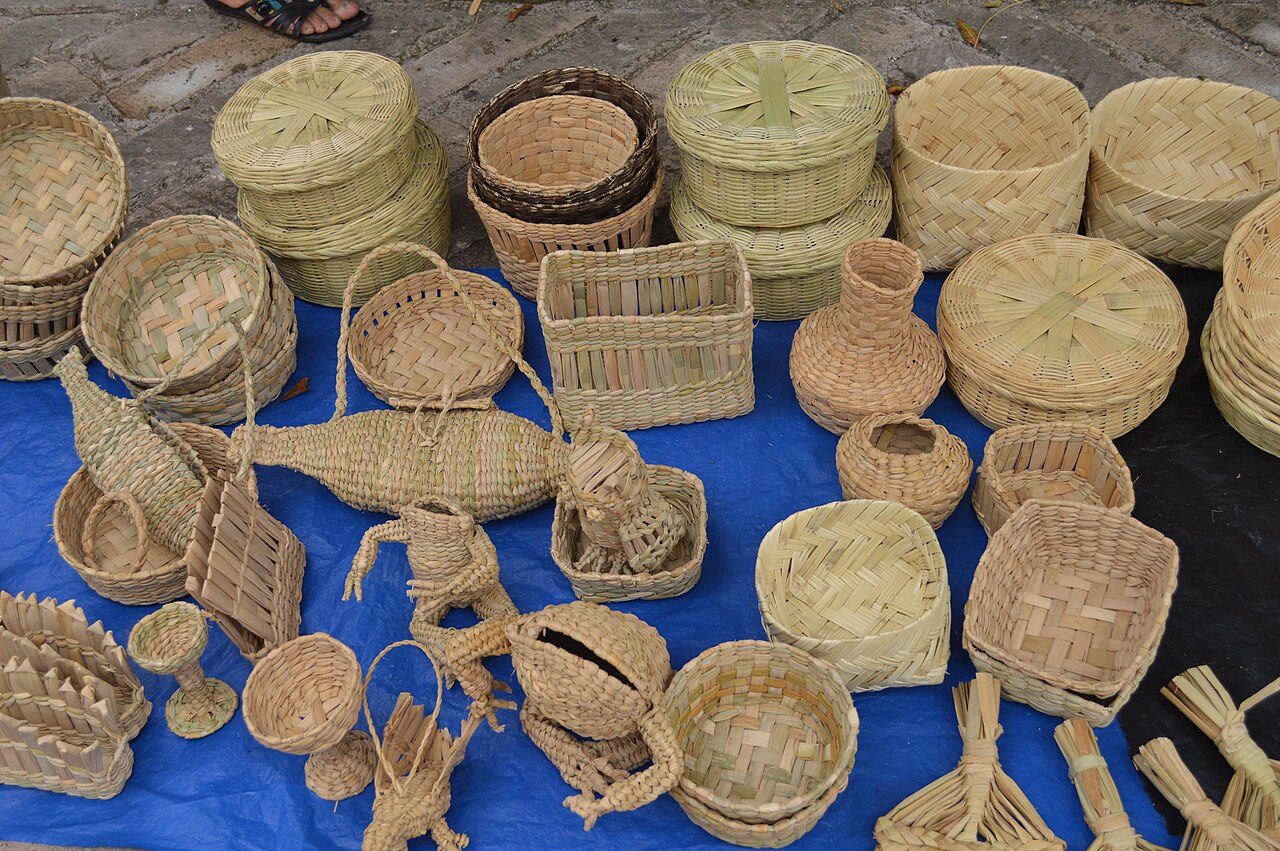
The tradition & historical record
6 min read · 2 sourcesBasketry of Mexico has its origins far into the pre Hispanic period, pre-dating ceramics and the domestication of crops. By the time the Spanish arrived, there were a number of indigenous forms, a number of which are still made today. These and products that the Spanish introduced form the combined tradition that remains today. Like other Mexican handcrafts, sales to tourists and collectors is important, but basketry is not as popular as other handcrafts. Basketry techniques and materials vary from region to region depending on the vegetation available (with about eighty species of plant use nationwide), with important traditions in Sonora, State of Mexico, Michoacán, Veracruz, Oaxaca and the Yucatán Peninsula. 1
Pre Hispanic period
Basketry was one of Mesoamerica’s oldest crafts, important since the early hunting-gathering period and predates both the manipulation of fire and the creation of pottery. The craft was originally developed from simple containers for gathering foodstuffs in nature and storage, to other items such as mats, boxes, chairs, cradles, sandals and some clothing items. Basketry in Mexico has two lineages, one indigenous and one Spanish, distinguished mostly by the products made. Many products that date back from the pre Hispanic period still survive such as mats called petates, carrying braces and baskets for the transport of wares to market. The last two were particularly important in the period because there were no beasts of burden, and merchandise was carried by men over land. Some pre Hispanic pieces were very finely woven with intricate designs, comparable to European tapestries. Much of the history of basketmaking has been lost since baskets are biodegradable. There are only fragments of basketry from archeological records because of the degradation of the biological materials used to make them. The best finds have been in dry caves and rock croppings, as well as basket impressions in ceramics. Most of the finds have been in arid and semi-arid areas in the northwest of Mexico, with some found at the Ocampo and Romero caves in Tamaulipas, containing evidence of both coil and braided wares. Other significant finds include those at Coxcatlán Cave in Tehuacán, Puebla, Guila Naquitz, Oaxaca, the Gallo Caves and Chaguera Cave in Morelos, as well as in Michoacán and the Valley of Mexico. These include evidence of rope and bag making. 1
Colonial period
As no complete pieces survive, the best evidence of pre-Hispanic and colonial period basketry forms is from contemporary codices such as the Mendocino Codex, written chronicles and pieces that appear in paintings. They confirm the existence of indigenous products such as petates, seats (tollicpalli), seats with back (tepotzoicpali), chiquihuites, tanates, tompeates, boxes (petlanali), sandals, nets, fans, mecapals (carrying braces) and more. They also indicate that a number of products and techniques have since disappeared. For example, in the Valley of Mexico, lakeside communities such as Xochimilco and Xoltocan were dedicated to making items such as petates from the rushes growing at the water's edge. However, this has died out with the draining of the lakes. Indigenous artisans continued to make basketry through the entire colonial period. Unlike other handcrafts, it was considered completely domestic and therefore not regulated like ceramics and woodworking, nor was there any formal teaching by Spanish missionaries. However, European designs, such as baskets with handles, sombreros, palms braided for Palm Sunday and heart decorations were introduced, along with the working of wheat and rye straw. 1
19th century
Likewise, no pieces from the 19th century survive, but at that time, the painting of everyday scenes became more popular, including images of homes, which show the survival of indigenous items like petates, along with sombreros and European style baskets. European travelers in Mexico documented what they saw, including the lives of common people, with baskets getting mentioned. One item noted in the records of this time but not before is that of the capote, a kind of rain cape created with layers of palm fronds. 1
20th century to the present
The early 20th century saw a revived interest in Mexico's handcraft traditions, including basketry. During the early 20th century the making of hats from palm and other fibers was taught to prisoners in municipal jails, something that survives to the present. Writer Manuel Toussaint noted the quantity and quality of baskets he found in Oaxaca during his travels, along with those in Puebla and the State of Mexico. For the 100th anniversary of the conclusion of the Mexican War of Independence, artists such as Dr. Atl, Roberto Montenegro and others organized an exhibition of the country's handcrafts and folk art. The exhibition resulted in a large catalog, of which Chapter 16 was dedicated to basketry. It provides a snapshot of the state of the craft at the end of the 19th century and beginning of the 20th. In this catalog, Dr Atl affirms that the most important basketry item remained the petate, noted the use of tenates as basic utilitarian items, with documentation of the large basketry production in the states of Puebla, State of Mexico, Guanajuato, Michoacán and Jalisco. The creation of miniature figures from Silao, Irapuato, Guanajuato and Santa María del Río, SLP are also mentioned. However mention of the work done in the north of the country is absent. Despite the interest in documenting handcraft traditions, no complete pieces from before the 1960s remain. Although not as popular as other handcraft traditions, basketry can be found all over Mexico, especially in indigenous communities in Oaxaca, Chiapas and Veracruz, with many created for collectors. 1
Materials
Basketry is related to other textiles arts, except that the plant fibers used are stiffer, ranging from rigid, hard works made from branches or strips of wood to the nearly cloth-like pieces from leaf fibers such as ixtle (maguey fiber) and henequen. Apart from ixtle and henequen, the vegetation used can be divided into two types: hard or semi rigid, which include materials such as wood strips and willow branches or canes to softer materials such as palm fronds, reeds, straw and other plant stems. The latter materials create items of more flexibility than the first. The materials used in a give location vary, depending on the local vegetation, and since it mostly depends on plant fibers, it is mostly a rural occupation, being close to sources. Materials may be mixed in the making of a piece, generally to provide patterns and textures, sometimes color. Since most materials are taken from the wild, basketry affects the surrounding ecosystems to varying degrees. In Mexico about eighty species of plants are used in basketry from twenty botanical families. These include agaves (Agavefourcroydes, A. sisalana, A. letonae, A. zapupe, A. funkiana), rushes and reeds (Arundo donax, Phragmites communis), palms (Acanthorriza mocinni, Brahea dulcis, Sabal mexicana, S. 1
The text above is adapted from the Wikipedia article “Basketry of Mexico”, available under the Creative Commons Attribution-ShareAlike 4.0 licence. 1
Basketry of Mexico is basket weaving in Mexico, according to the structured record cited below. This entry was generated automatically from that record and has not yet been reviewed by a person familiar with the tradition. 2
The source record links this tradition to 1 external register, which can be verified through the citation. 2