The tradition & historical record
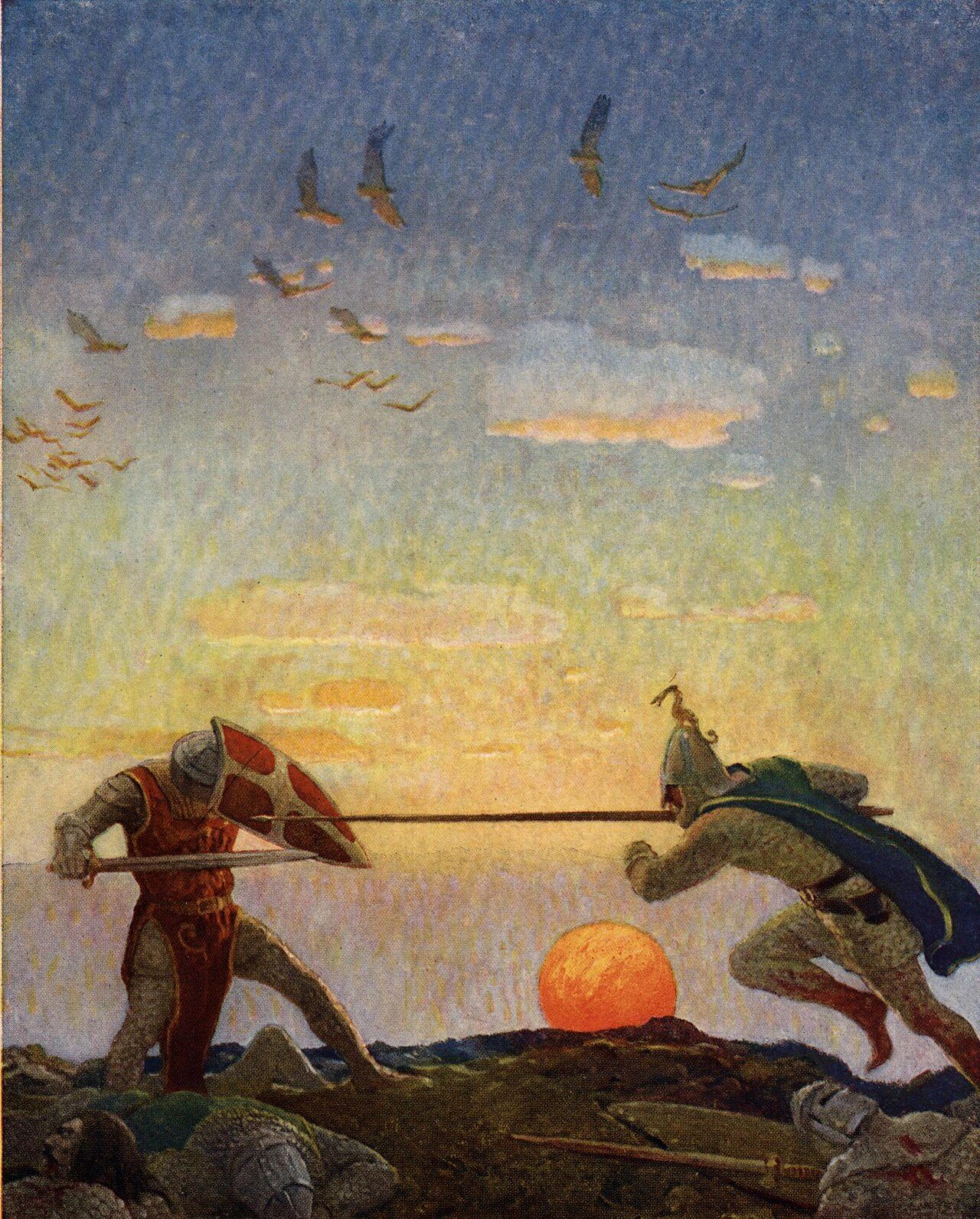
6 min read · 2 sourcesThe Battle of Camlann (Welsh: Gwaith Camlan or Brwydr Camlan) is the legendary final battle of King Arthur, in which Arthur either died or was mortally wounded while fighting either alongside or against Mordred, who also perished. The battle's historicity is uncertain and disputed. The original legend of Camlann, inspired by a purportedly historical event said to have taken place in early 6th-century Britain, is only vaguely described in several medieval Welsh texts dating from around the 10th century. The battle's much more detailed depictions have emerged since the 12th century, generally based on that of a catastrophic conflict described in the pseudo-chronicle Historia Regum Britanniae. The further greatly embellished variants originate from the later French chivalric romance tradition, in which it became known as the Battle of Salisbury, and include the 15th-century telling in Le Morte d'Arthur that remains popular today. 1
Etymology
The name may derive from a Brittonic from *Cambo-glanna ("crooked/twisting bank (of a river)") or less likely *Cambo-landa ("crooked/twisting-enclosure" or "crooked/twisting open land"). The name of the Roman fort of Camboglanna (Castlesteads) in Cumbria shows it was in use but is probably not the site. 1
Historicity
The earliest dateable reference to the battle is found in the 10th-century Welsh annals Annales Cambriae. An entry for the year 537 mentions the "strife of Camlann, in which Arthur and Medraut fell, and there was great mortality in Britain and Ireland." This is also the first written mention of Medraut (the later Mordred), but it does not specify whether he and Arthur fought on the same side or who won the battle. Andrew Breeze (2020) argues that the battle is historical, and that it was an aftermath of the famine associated by the documented extreme weather events of 535–536, which caused, in the words of the Annales Cambriae, "great mortality in Britain and Ireland". He interprets Camlann as a cattle raid on central Britain; Breeze cites R. G. Collingwood, to the effect that an identification of Camlann with "Camboglanna on Hadrian's Wall" was "convincing". Discussing further indications suggesting Camlann as Castlesteads, near Carlisle, Breeze concludes: "There is every reason to think that, in 537, when the walls of this stronghold stood high [...], Arthur was killed [there] by men of Rheged, the British kingdom centred on Penrith." Flint Johnson disagrees with Breeze's interpretation of Camlann as a cattle raid, but also agrees that the battle was historical and that the causes would have been political, although the date is still uncertain. Johnson concluded: "The most reasonable reason why Arthur's death was associated with 537 is because as a king he was associated with the fertility of his kingdom and 537 was a period of famine. It would have made perfect sense to a medieval scholar with a British cultural background that the death of a renowned king had caused [that]." However, other historians regard Arthur and the Battle of Camlann as legendary. 1
Medieval Welsh tradition
Besides the Annales Cambriae, one of the earliest mentions of Camlann is found in the circa 9th/10th-century Englynion y Beddau ("Stanzas of the Graves", Stanza 12) from the Black Book of Carmarthen, as the site of the grave of Osfran's son. The Welsh prose text Culhwch and Olwen, dated to the 11th or 12th century, mentions the battle twice in connection to heroes who fought there. The text includes a triad naming Morfran ail Tegid, Sandde Bryd Angel, and Cynwyl Sant as the three men who survived Camlann: Morfran because of his fearsome ugliness, Sandde because of his angelic beauty, and Cynwyl because he left Arthur last. This triad shows that Camlann was famous as a battle that few survived. Caitlin Green suggests that "Osfran's son" from the Englynion y Beddau is connected to Morfran from Culhwch and Olwen. The text also mentions Gwyn Hywar, overseer of Cornwall and Devon, one of the nine men who plotted the Battle of Camlann, suggesting a now-lost tradition of complex intrigue underpinning Arthur's last battle. The Welsh Triads offer clues to the alleged cause of the Battle of Camlann. Triad 51 largely reflects (and is derived from) Geoffrey (see below): Medrawd (Mordred) rebels against Arthur while the latter is campaigning on the continent and usurps the throne, instigating the battle. Triad 53 lists a slap Gwenhwyvach gave to her sister Gwenhwyfar (Guinevere), wife of Arthur, as one of the "Three Harmful Blows of the Island of Britain", causing the Strife of Camlann. Calling Camlann one of Britain's "Three Futile Battles", Triad 84 also mentions this dispute between sisters. Triad 54 describes Medrawd raiding Arthur's court, throwing Gwenhwyfar to the ground and beating her. 1
Chronicle tradition
Geoffrey of Monmouth included the Battle of Camlann in his pseudo-historical chronicle Historia Regum Britanniae, written circa 1136. Geoffrey's version drew on existing Welsh tradition, but embellished the account with invented details. His focus was not on individuals but the 'character of the British nation'. In Books X and IX, Arthur goes to war against the Roman leader Lucius Tiberius, leaving his nephew Modredus (Mordred) in charge of Britain. In Arthur's absence, Modredus secretly marries Arthur's wife Guenhuvara (Guinevere) and takes the throne for himself. Arthur returns and his army faces Modredus' at Camblana (the River Camel in Cornwall). Many are killed, including Modredus; Arthur is mortally wounded and taken to the Isle of Avalon to recover, passing the crown to his kinsman Constantine. Geoffrey's work was highly influential, and was adapted into various other languages, including Wace's Anglo-Norman Roman de Brut (c. 1155), Layamon's Middle English Brut (early 13th century), and the Welsh Brut y Brenhinedd (mid-13th century). Various later works are based fairly closely on Geoffrey, including the Middle English Alliterative Morte Arthure, written around 1400. The chronicle tradition typically follows Geoffrey in placing Camlann on the Camel in Cornwall: Wace places it at "Camel, over against the entrance to Cornwall," and Layamon specifies the location as Camelford, where John Aubrey reports that as signs of the battle "pieces of armour both for horse and man are many times found in digging of the ground" in his Monumenta Britannica (1663–1693). In Layamon's telling, only Arthur and his two nameless knights are left alive after the battle. Wace wrote: "I neither know who lost, nor who gained that day. 1
Romance tradition
Further traditions about Arthur's final battle are developed in the Arthurian chivalric romances. These often follow Geoffrey's blueprint, but alter many of the details. 1
The text above is adapted from the Wikipedia article “Battle of Camlann”, available under the Creative Commons Attribution-ShareAlike 4.0 licence. 1
Battle of Camlann is Legendary conflict, according to the structured record cited below. This entry was generated automatically from that record and has not yet been reviewed by a person familiar with the tradition. 2
The source record links this tradition to 2 external registers, which can be verified through the citation. 2