The tradition & historical record
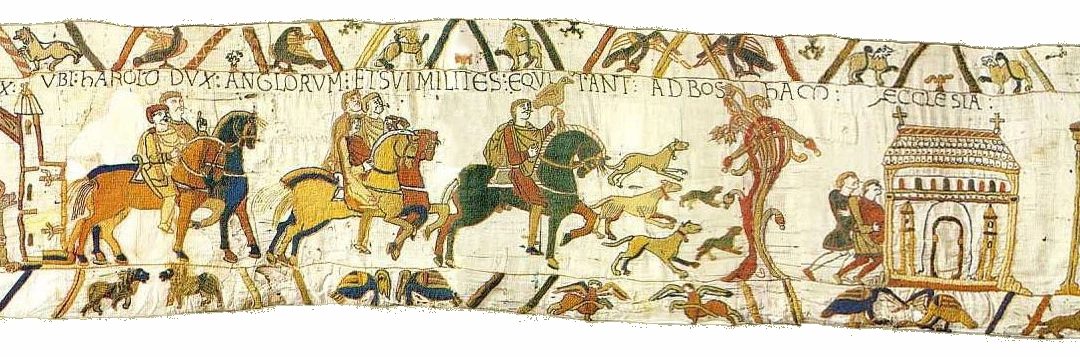
5 min read · 2 sourcesThe Bayeux Tapestry tituli are Medieval Latin captions embroidered on the Bayeux Tapestry, which describe the 58 scenes portrayed on the tapestry. These help describe the main events depicted, which lead up to the Norman conquest of England concerning William, Duke of Normandy, and Harold, Earl of Wessex, later King of England, culminating in the Battle of Hastings. The tituli, composed of 2,226 characters and symbols, is the longest known text of its kind. 1
The tapestry
The Bayeux Tapestry is a 70-metre (77 yd) long embroidered-linen cloth which narrates the story of the Norman conquest of England in 1066, and has been said to be "one of the most powerful pieces of visual propaganda ever produced, as well as one of the few medieval works of art familiar to almost everyone in the Western world." The tapestry has compelled many people to study and question who commissioned it and for what purpose. The tapestry is usually displayed in the Musée de la Tapisserie de Bayeux in Bayeux, Normandy, France, and is protected by a glass case. The events are depicted in 58 scenes, which lead up to the Norman conquest of England concerning William, Duke of Normandy, and Harold, Earl of Wessex, later King of England, culminating in the Battle of Hastings. 1
Description
Many palaeographers who study manuscripts can distinguish different hands within the writings on manuscripts. In the same way, Bayeux Tapestry scholars have argued that there were different "scribes" at work, as there are subtle differences between similar letters along the entire tapestry. For example, at scene 17 the uncial letter Es in the top line of the tituli have elegant serifs with tiny points; while those in the lower two lines have straight bars. In scenes 52 to 57, different techniques and use of colour similarly suggest different writers. The Bayeux Tapestry was most likely commissioned by William the Conqueror's half-brother, Bishop Odo, possibly at the same time as Bayeux Cathedral's construction in the 1070s, and completed by 1077 in time for display on the cathedral's dedication. It is embroidered in wool yarn on a tabby-woven linen ground using outline or stem stitch for detailing and lettering. A dark blue wool, almost black, is used for most of the tapestry's lettering but towards the end other colours are used, sometimes for each word and other times for each letter. The content of the hanging is primarily pictorial but tituli are included on many scenes of the action to point out names of people and places or to explain briefly the event being depicted. The text is in Latin (which for the most part is grammatically correct), and is extremely direct, with each statement being closely tied to the scenes depicted in a given section. The text is frequently abbreviated as indicated by tildes placed over words at the place of omission of a letter. The words themselves are often demarcated by two points (which Lucien Musset likens to colons); sometimes, more important section breaks are demarcated by three points. 1
Scene 12
Scene 12 is a notable scene studied because of its tituli. It appears as though "a different writer took over the inscription at this point and saw himself as beginning here; or that the same scribe began a new stint of work here." The upper border has dipped at this point and the birds and beasts depicted in it are large. "The tituli is accordingly forced into smaller letters and is very intermittent, being fitted in round a tree, a sword, hands, spears, and birds’ heads. It seems likely that the first workshop completed the main register and the upper border, leaving the inscription (and possibly the lower border) incomplete." 1
Scenes 29 and 30
Another notable event occurs in scenes 29 and 30, depicting the coronation of Harold as king. In this scene, Harold is seated on the throne, with nobles to his left and Archbishop Stigand to his right. The tituli states, "Here they gave the king's crown to Harold" in scene 29, and "Here sits Harold King of the English" in scene 30. The coronation of King Harold is important because as the masses are cheering for Harold, Halley's Comet appears in the sky. This scene also includes a fleet of ships in the lower border, which foreshadows the Norman invasion and the English defeat at the hands of William the Conqueror. 1
Scene 57
The most famous scene within the Bayeux Tapestry is scene 57, depicting Harold's death. In this scene, the tituli states, "HIC HAROLD REX INTERFECTUS EST" which can be translated to "Here King Harold was slain." Harold's death marks the end of the Anglo-Saxon era in England and births the beginning of Norman rule. Harold appears to be plucking an arrow from his eye in the scene. According to many historians, The Bayeux Tapestry is considered one of the earliest and most convincing pieces of evidence that Harold was killed by an arrow. Scene 57 also holds evidence that there was more than one "writer". Scene 52, within the first new titulus after the sixth seam, the colours change to black and yellow with intermittent red letters. They continue, mostly in letters of alternating colour, until Scene 57, Harold's death. At this point green is introduced to the inscription and there are some words in black, some in the lighter greenish shade, to the present limit of the Tapestry. "The change of colour at Scene 57 may, again, relate to a different production team: The episode of Harold's death also contains a seam, the eighth, although it is invisible from the front of the Tapestry." 1
The text above is adapted from the Wikipedia article “Bayeux Tapestry tituli”, available under the Creative Commons Attribution-ShareAlike 4.0 licence. 1
Bayeux Embroidery tituli is captions on the Bayeux Embroidery, according to the structured record cited below. This entry was generated automatically from that record and has not yet been reviewed by a person familiar with the tradition. 2
The source record links this tradition to 1 external register, which can be verified through the citation. 2