The tradition & historical record
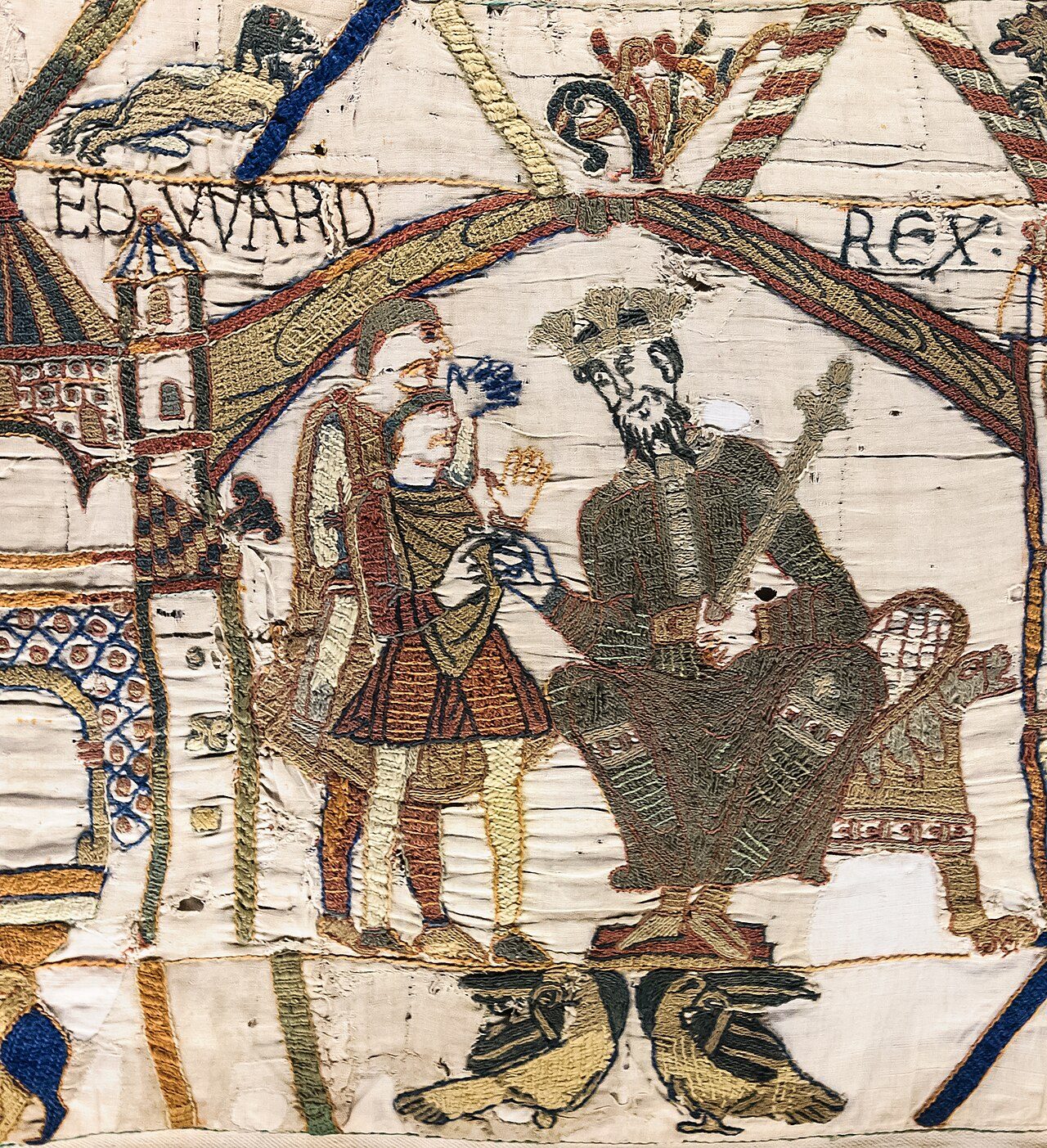
7 min read · 2 sourcesThe Bayeux Tapestry (French: Tapisserie de Bayeux) is an embroidered cloth nearly 70 metres (230 feet) long and 50 centimetres (20 inches) tall that depicts the events leading up to the Norman conquest of England, led by William, Duke of Normandy, and the Battle of Hastings in 1066. It is normally thought to have been made in England in the decades after the events it shows, although the earliest known written reference to it was in 1476. Since 2007 it has been inscribed on UNESCO's Memory of the World Register. It is normally displayed in the Bayeux Tapestry Museum in Bayeux, Normandy, France, but this is closed for renovation until 2027, and the work is currently on display in London. Despite its name, the work is technically an embroidery rather than a true tapestry, since the images are stitched rather than woven into the fabric. It was worked in wool thread on a coarse linen ground using four different stitches and ten natural dye colours. The cloth now consists of 58 scenes, all with Medieval Latin tituli. The surviving piece depicts 623 human figures, 994 animals, 438 plants, 37 buildings and fortifications, 41 ships and boats, and a vast array of other objects. The narrative runs from the final years of the reign of Edward the Confessor in 1064 through to the Battle of Hastings in 1066, when William, Duke of Normandy, defeated Harold Godwinson to claim the English throne. The final scenes are missing. 1
Origins
The earliest known written reference to the tapestry is a 1476 inventory of Bayeux Cathedral, but its origins have been the subject of much speculation and controversy. French legend maintained the tapestry was commissioned and created by Queen Matilda, the powerful wife of William the Conqueror, and her ladies-in-waiting. Indeed, in France, it is occasionally known as La Tapisserie de la Reine Mathilde ("The Tapestry of Queen Matilda"). However, scholarly analysis in the 20th century concluded it was probably commissioned by William's half-brother, Bishop Odo of Bayeux, who, after the Conquest, also became Earl of Kent and, when William was absent in Normandy, regent of England. The reasons for the Odo commission theory include: 1
three of the bishop's followers mentioned in the Domesday Book appear on the tapestry it was found in Bayeux Cathedral, built by Odo it may have been commissioned at the same time as the cathedral's construction in the 1070s, and possibly completed by 1077 in time for display at the cathedral's dedication Odo himself appears four times If the tapestry was indeed commissioned by Odo, it was probably designed and constructed in England by Anglo-Saxon artists, with most contemporary scholars arguing that it was probably made in or around Canterbury: it is similar to illuminated manuscripts made in monastic libraries there or owned by them; Odo's English power base was by then in Kent; the Latin text contains hints of Anglo-Saxon; other embroideries originate from England at this time; and the vegetable dyes can be found in cloth traditionally woven there. Howard B. 1
To the French Revolution
It has been known by several names over the centuries: the canons of Bayeux Cathedral called it the Telle du Conquest ("Cloth of the Conquest"), 18th-century sources referred to it as the Toilette de la Saint-Jean or the Toilette du duc Guillaume, and in the 19th century it was sometimes called the Tapestry of Queen Matilda. The first reference to the tapestry is from 1476 when it was listed in an inventory of the treasures of Bayeux Cathedral. It survived the sack of Bayeux by the Huguenots in 1562, and the next certain reference is from 1724. Antoine Lancelot sent a report to the Académie Royale des Inscriptions et Belles-Lettres concerning a sketch he had received about a work concerning William the Conqueror. He had no idea where or what the original was, although he suggested it could have been a tapestry. Despite further enquiries he discovered no more. 1
The inventory listing of 1476 shows that the tapestry was being hung annually in Bayeux Cathedral for the week of the Feast of St John the Baptist; this was still the case in 1728, although by that time the purpose was merely to air the hanging, which was otherwise stored in a chest. Clearly, the work was being well cared for. By the eighteenth century, however, the artistry was regarded as crude or even barbarous—red and yellow multi-coloured horses upset some critics. It was thought to be unfinished because the linen was not covered with embroidery. The Benedictine scholar Bernard de Montfaucon made more successful investigations and found that the sketch was of a small portion of a tapestry preserved at Bayeux Cathedral. In 1729 and 1730, he published drawings and a detailed description of the complete work in the first two volumes of his Les Monuments de la Monarchie française. 1
French Revolution onwards
During the French Revolution, in 1792, the tapestry was confiscated as public property to be used for covering military wagons. It was rescued from a wagon by a local lawyer who stored it in his house until the troubles were over, whereupon he sent it to the city administrators for safekeeping. After the Reign of Terror, the Fine Arts Commission, set up to safeguard national treasures in 1803, required it to be removed to Paris for display at the Musée Napoléon. Its exhibition in the Louvre in 1797 caused a sensation, with Le Moniteur, which normally dealt with foreign affairs, reporting on it on its first two pages. It inspired a one-act musical play, La Tapisserie de la Reine Mathilde, in 1804. It was because the tapestry was regarded as an antiquity rather than a work of art that in 1804 it was returned to Bayeux, where in 1823 one commentator, A. L. Léchaudé d'Anisy, reported that "there is a sort of purity in its primitive forms, especially considering the state of the arts in the eleventh century". When Napoleon abandoned his planned invasion of Britain, the tapestry's propaganda value was lost and it was returned to Bayeux where the council displayed it on a winding apparatus of two cylinders. Despite scholars' concern that the tapestry was becoming damaged, the council refused to return it to the cathedral. 1
In 1816, the Society of Antiquaries of London commissioned its historical draughtsman, Charles Stothard, to visit Bayeux to make an accurate hand-coloured facsimile of the tapestry. His drawings were subsequently engraved by James Basire Jr. and published by the Society in 1819–1823. 1
Loan to the United Kingdom
In 2018 French President Emmanuel Macron announced that the tapestry would be loaned to Britain for public display. 1
Construction, design and technique
In common with other embroidered hangings of the early medieval period, this piece is conventionally referred to as a "tapestry", although it is not a true tapestry in which the design is woven into the cloth in tapestry weave; it is technically an embroidery, although it meets the traditional broader definition of "tapestry" as: "A textile fabric decorated with designs of ornament or pictorial subjects, painted, embroidered, or woven in colours, … 1
The text above is adapted from the Wikipedia article “Bayeux Tapestry”, available under the Creative Commons Attribution-ShareAlike 4.0 licence. 1
Bayeux Tapestry is embroidered wall-hanging art depicting the Norman invasion of England, according to the structured record cited below. This entry was generated automatically from that record and has not yet been reviewed by a person familiar with the tradition. 2
The source record links this tradition to 39 external registers, which can be verified through the citation. 2