The tradition & historical record
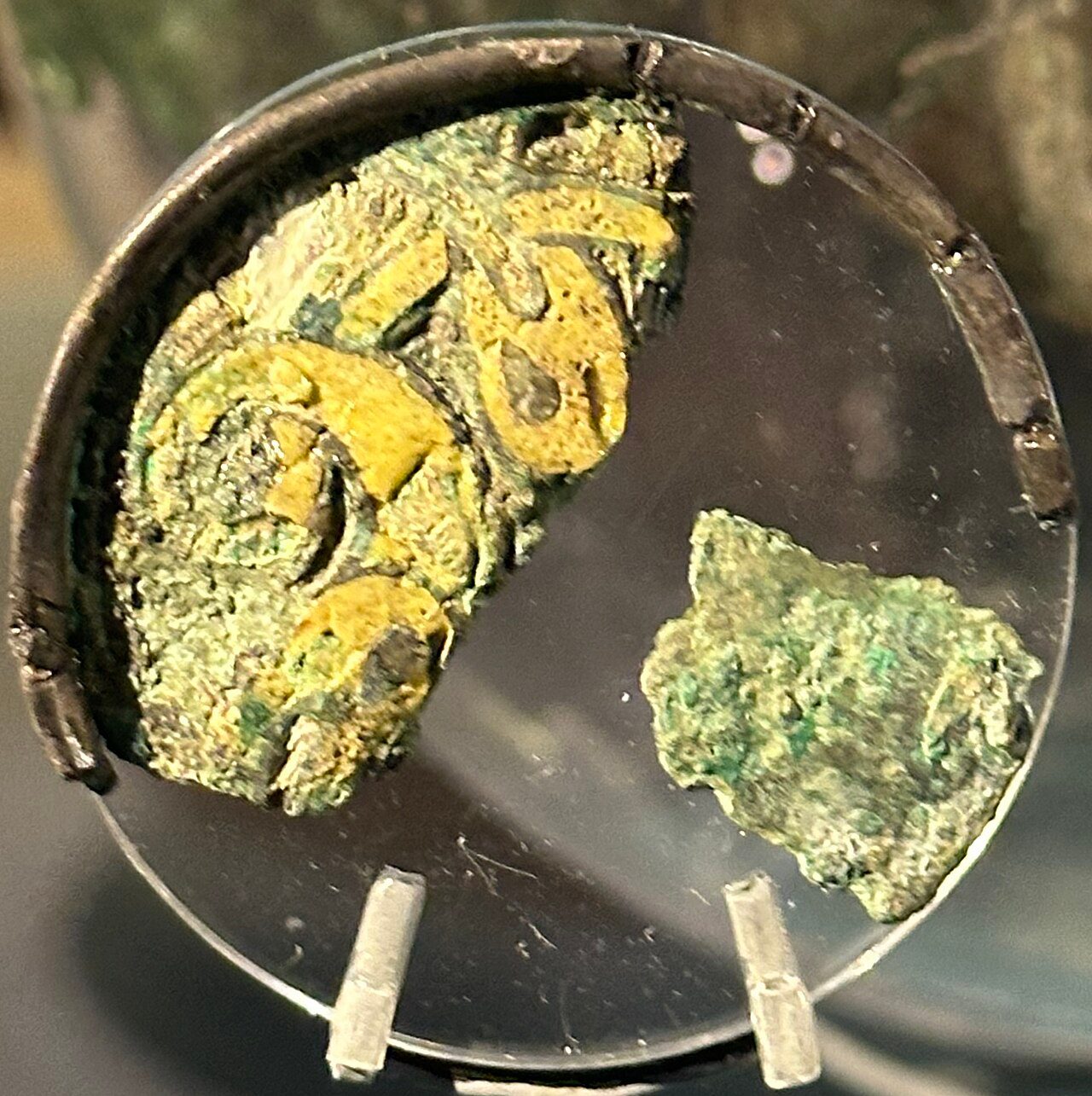
6 min read · 2 sourcesThe Benty Grange hanging bowl is a fragmentary Anglo-Saxon artefact from the seventh century AD. All that remains are parts of two escutcheons: bronze frames that are usually circular and elaborately decorated, and that sit along the outside of the rim or at the interior base of a hanging bowl. A third one disintegrated soon after excavation, and no longer survives. The escutcheons were found in 1848 by the antiquary Thomas Bateman, while excavating a tumulus at the Benty Grange farm in western Derbyshire. They were presumably buried as part of an entire hanging bowl. The grave had probably been looted by the time of Bateman's excavation, but still contained high-status objects suggestive of a richly furnished burial, including the hanging bowl and the boar-crested Benty Grange helmet. The surviving escutcheons are made of enamelled bronze and are 40 mm (1.6 in) in diameter. They show three dolphin-like creatures arranged in a circle, each biting the tail of the one ahead of it. Their bodies and the background are made of enamel, likely all yellow; the creatures' outlines and eyes are tinned or silvered, as are the borders of the escutcheons. Although three escutcheons from a hanging bowl at Faversham also contain dolphin-like creatures, the Benty Grange design is most closely paralleled by Insular manuscripts, particularly figures in the Durham Gospel Fragment and the Book of Durrow. 1
Hanging bowls
Hanging bowls are thin-walled bronze vessels with three or four equidistant hooks around the rim for suspension. They are a fixture of Late Celtic, Anglo-Saxon, and Viking archaeology and art, spanning approximately 400 AD to 1100 AD. The hooks project from escutcheons: bronze plates or frames that are usually circular or oval, that are frequently elaborately decorated, and that are riveted or soldered (or occasionally both) to the bowl. Basal escutcheons, also known as basal discs, would sometimes sit at the base of the interior. A 2005 catalogue of hanging bowls identified approximately 174 known examples, around 68 of which were relatively complete. England accounted for 117, Scotland for 7, and Ireland for 17, Norway for 26, and the remainder of Europe for 7. The purpose of hanging bowls, and their places of manufacture, is unknown. They appear to have been manufactured by Celtic makers in Britain in the post-Roman period; examples were also used by Anglo-Saxons (who likely received bowls via trade) and, later, by Vikings. 1
Description
Two escutcheons are all that remain of the Benty Grange hanging bowl. They are made of enamelled bronze and are 40 mm (1.6 in) in diameter. They have the same design and plain frames, parts of which survive. Both escutcheons are fragmentary; enough survives of each for the design to be reconstructed, and, because of overlapping segments, for it to be certain that they represent two distinct pieces. Whether they are hook or basal escutcheons is uncertain, but a contemporary watercolour by Llewellynn Jewitt suggests that a hook was present at excavation, and an iron ring, 2 millimetres in width and 16 in diameter, stuck to the back of one fragment may have been part of a suspension chain. The decomposed enamel background appears uniformly yellow to the eye, as it did when excavated. A yellow-creatures-on-red-background colour scheme has alternatively been claimed, but no evidence for such a layout has been presented. As sampling of the enamel was not permitted when one of the escutcheons was analysed in 1968, the all-yellow hypothesis is not definitive. The reconstructed design shows three ribbon-style creatures resembling dolphins or fish, depicted in and arranged in a circle with each biting the tail of the one in front. The bodies are defined by their outlines. They are limbless, the tails curled in a circle, the jaws long and curved, and slightly ajar; the bitten tails pass under each creature's upper jaw and over its lower, but are missing where one would expect to see them passing through the gap between jaws. Each creature has a small eye shaped like a pointed oval. 1
Parallels
The dolphin-like designs on the Benty Grange hanging bowl are paralleled by designs on other escutcheons, and even more closely by designs on medieval illuminated manuscripts. Three escutcheons from a hanging bowl found in Faversham show creatures that also look like dolphins, but with more detailed bodies; a better parallel is with a disc found near the Lullingstone hanging bowl which dates to the late seventh century and is also decorated with dolphin-like creatures. Two other sixth- or seventh-century discs, found in Chilton and Coltishall, also depict intertwined serpent-like creatures attempting to eat their own tails. The third escutcheon from Benty Grange, meanwhile, surviving only in illustration, is most closely paralleled by the basal disc of the Winchester hanging bowl. 1
Even closer parallels to the Benty Grange designs are found in manuscript illustrations. Bateman remarked on this as early as 1861, noting that similar patterns were used in "several manuscripts of the [seventh] Century, for the purpose of decorating the initial letters". Metalwork designs like those on the Benty Grange escutcheons may have inspired aspects of the manuscript art. In particular, the mid-seventh-century Durham Gospel Fragment contains two similar fish-like motifs contained within the lateral stroke of the INI monogram that introduces the Gospel of Mark. The Book of Durrow also contains an illustration of similarly linked yellow dolphin-like creatures. 1
Date
The Benty Grange hanging bowl is dated by most experts to the second half of the seventh century, based on its design and the associated finds from the barrow in which it was found. Given the presence of a helmet and cup with silver crosses, wrote Audrey Ozanne, "[t]he straightforward interpretation of this find would seem to be that it dates from a period subsequent to the official introduction of Christianity into Mercia in 655". The surviving escutcheons also suggest a date in the mid-seventh century, given their resemblance to the illustrations in the Durham Gospel Fragment and the Book of Durrow; the Winchester hanging bowl's basal disc, which the third Benty Grange escutcheon resembles, has traditionally been given the same date. 1
Location
The hanging bowl was discovered in a barrow on the Benty Grange farm in Derbyshire, in what is now the Peak District National Park. Thomas Bateman, an archaeologist and antiquarian who led the excavation, described Benty Grange as "a high and bleak situation"; its barrow, which still survives, is prominently located by a major Roman road, now roughly parallel to the A515 in the area, possibly to display the burial to passing travellers. 1
The text above is adapted from the Wikipedia article “Benty Grange hanging bowl”, available under the Creative Commons Attribution-ShareAlike 4.0 licence. 1
Benty Grange hanging bowl is Anglo-Saxon artefact from the seventh century AD., according to the structured record cited below. This entry was generated automatically from that record and has not yet been reviewed by a person familiar with the tradition. 2
The source record links this tradition to 2 external registers, which can be verified through the citation. 2