The tradition & historical record
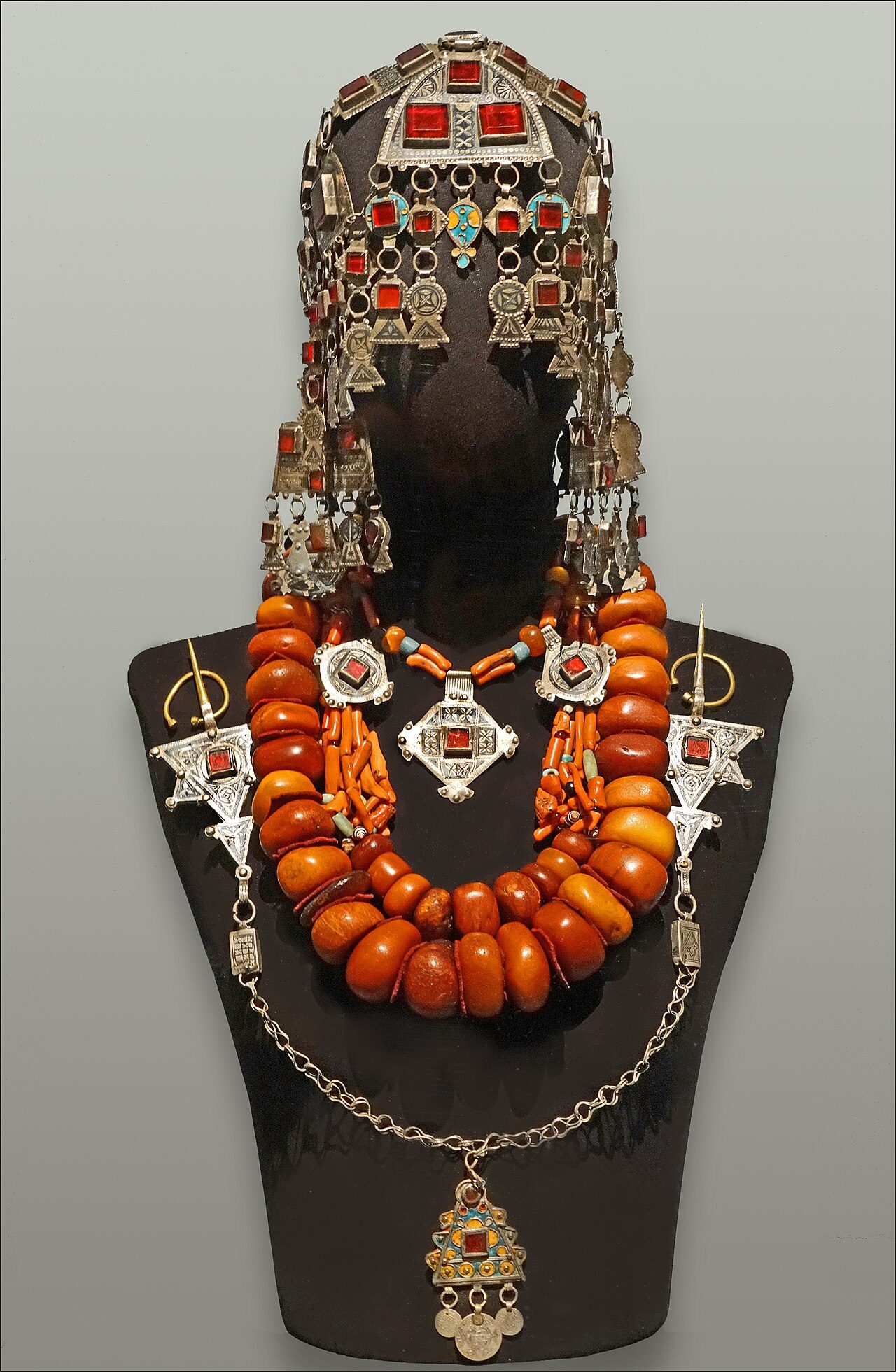
6 min read · 2 sourcesJewellery of the Berber cultures (Tamazight language: iqqchochn imazighn, ⵉⵇⵇⵛⵓⵛⵏ ⵉⵎⴰⵣⵉⵖⵏ) is a historical style of traditional jewellery that was worn by women mainly in rural areas of the Maghreb region in North Africa and inhabited by Indigenous Berber people (in the Berber language Tamazight: Amazigh (sg.), Imazighen, pl). Following long social and cultural traditions, Berber or other silversmiths in Morocco, Algeria and neighbouring countries created intricate jewellery with distinct regional variations. In many towns and cities, there were Jewish silversmiths, who produced both jewellery in specific Berber styles as well as in other styles, adapting to changing techniques and artistic innovations. Handing their jewellery on from generation to generation, as a visual element of the Berber ethnic identity, women maintained this characteristic cultural tradition as part of their gender-specific adornments. Berber communities exist in Morocco, Algeria, Tunisia and other locations, such as Libya. The numbers and varieties of their ethnic jewellery correspond to demographic patterns. Berber jewellery was usually made of silver and included elaborate triangular plates and pins, originally used as clasps for garments, necklaces, bracelets, earrings and similar items. During the second part of the 20th century, the tradition of Berber jewellery was gradually abandoned in favour of different styles of jewellery made of gold. 1
History
In their documented history going as far back to prehistoric times, the different indigenous Berber peoples of North Africa, ranging from the Siwa Oasis in Egypt to Morocco and Mauritania, and historically including the Guanches of the Canary Islands, have undergone constant changes in lifestyles and culture. Most notably, the Arab conquest brought about important changes from the late 7th century onwards. Over time, the different Berber groups of the vast area that is North Africa adapted to external influences and their cultures, living partially as rural, but also as urban populations. Especially in larger cities and towns, such as Marrakesh or Meknes, Berbers mixed with people of other ethnic backgrounds, gradually bringing forth an urban, Islamized and partially Arabized society, which led to a gradual change of traditional Berber culture. 1
Rural Berber cultures
In rural areas, Berbers were traditionally farmers, living in mountains, plains or an oasis, such as the Siwa oasis in Egypt; but others, like the Tuareg and Zenata of the southern Sahara, were almost wholly nomadic. Some groups, such as the Chaouis, practised a semi-nomadic life (transhumance) and, during some months of the year, roamed the country with their herds of livestock (donkeys, sheep, goats, and camels in some areas) in search of fertile pastures. While sedentary life had flourished since prehistorical times, survival in the drier regions, and especially in the High Atlas and Anti-Atlas mountains, was only possible if people moved with their cattle to the higher mountain regions, where grass, herbs and above all water were still available in sufficient quantity. As they did not return to their villages until late autumn, their winter harvests were stored in a fortified communal granary, called agadir, and protected against other nomads and hostile neighbouring villages by guards, who stayed there at all times. This regime was also followed in the Aures region of Algeria, where local clans stored grains in fortified granaries. In villages and small towns of Morocco, people often lived in traditional buildings called ksour (pl.). In most settlements, blacksmiths and silversmiths operated small, family-run workshops. Based on their skills of handling the four elements: fire, air, water and metals, originally taken from the earth, these professions were often not highly regarded, which was partly due to superstitious beliefs attributed to these skills. 1
Berber jewellery in Morocco, Algeria and Tunisia
Jewellery is easy to transport, and the women could take it along on the annual migrations. In a traditional world that functioned completely or largely without money, jewellery also played a role as a means of savings for emergencies. Thus, official coins were often used to adorn headgear, necklaces, etc. When necessary, they could be broken off and sold, but their value only consisted of pure material value. 1
While the Arabized and urban inhabitants of North Africa preferred jewellery made of gold, the rural Berbers held on to silver jewellery for centuries. This provided the economic basis for the silversmiths in medium-sized towns, such as Tiznit or Sefrou in Morocco or in the Kabylia mountains in Algeria, which were often run by Jewish silversmiths. Whether the preference for silver happened solely for social, economic or reasons attributed to folklore, such as the belief that these pieces bestow a protective effect (baraka), or for other reasons, can no longer be determined. In Algeria, important centres of jewellery production and usage were the villages of the Beni Yenni district and the town of Ouadhiya in the Great Kabylia mountains east of Algiers. In the north-eastern mountain region of the Aurès, the Chaoui Berbers used silver jewellery, typically made with enamel applications and corals. In southern Tunisia, the island of Djerba was a traditional centre of jewellery production, whereby figurative motifs (plants, fish, birds), and sometimes gold instead of silver were used in contrast to the traditions in Morocco and Algeria. 1
Tuareg and Mauritanian jewellery
Jewellery made of silver, coloured glass or iron is also a special tradition of the Tuareg people. They belong to the Berber peoples and mostly still live as semi-nomads in parts of the Sahara in the Hoggar region of modern-day Algeria, Libya, Niger, Mali and Burkina Faso. Their jewellery is remarkable for the so-called Cross of Agadez, even though only a few of these pieces resemble a cross. Most are worn as pendants with varied shapes that either resemble a cross or have the shape of a plate or shield. Historically, the oldest known specimens were made of stone or copper, but subsequently, the Tuareg blacksmiths also used iron and silver made in the lost-wax casting technique. According to the article "The cross of Agadez", this piece has become a national and African symbol for Tuareg culture and political rights. Today, these pieces of jewellery are often made for tourists or as items of ethnic-style fashion for customers in other countries, with certain modern changes. Tuareg jewellery has been compared to similar styles of southwestern Morocco, the western parts of the Sahara and Mauritania, like the Cross of Trarza, traditionally produced by Berber people, who speak Hassaniya Arabic and are sometimes referred to as Moors or Beidane. According to studies of Tuareg and Mauritanian jewellery, the latter are usually more embellished and may carry typical pyramidal elements. Specimens of their jewellery, including heavy silver anklets, were published in the book Berber women of Morocco. 1
Methods, forms and society
Traditional Berber jewellery consists … 1
The text above is adapted from the Wikipedia article “Jewellery of the Berber cultures”, available under the Creative Commons Attribution-ShareAlike 4.0 licence. 1
Berber jewellery is traditional jewellery of Amazigh ( berber ) peoples in north-western Africa, according to the structured record cited below. This entry was generated automatically from that record and has not yet been reviewed by a person familiar with the tradition. 2
The source record links this tradition to 3 external registers, which can be verified through the citation. 2