The tradition & historical record
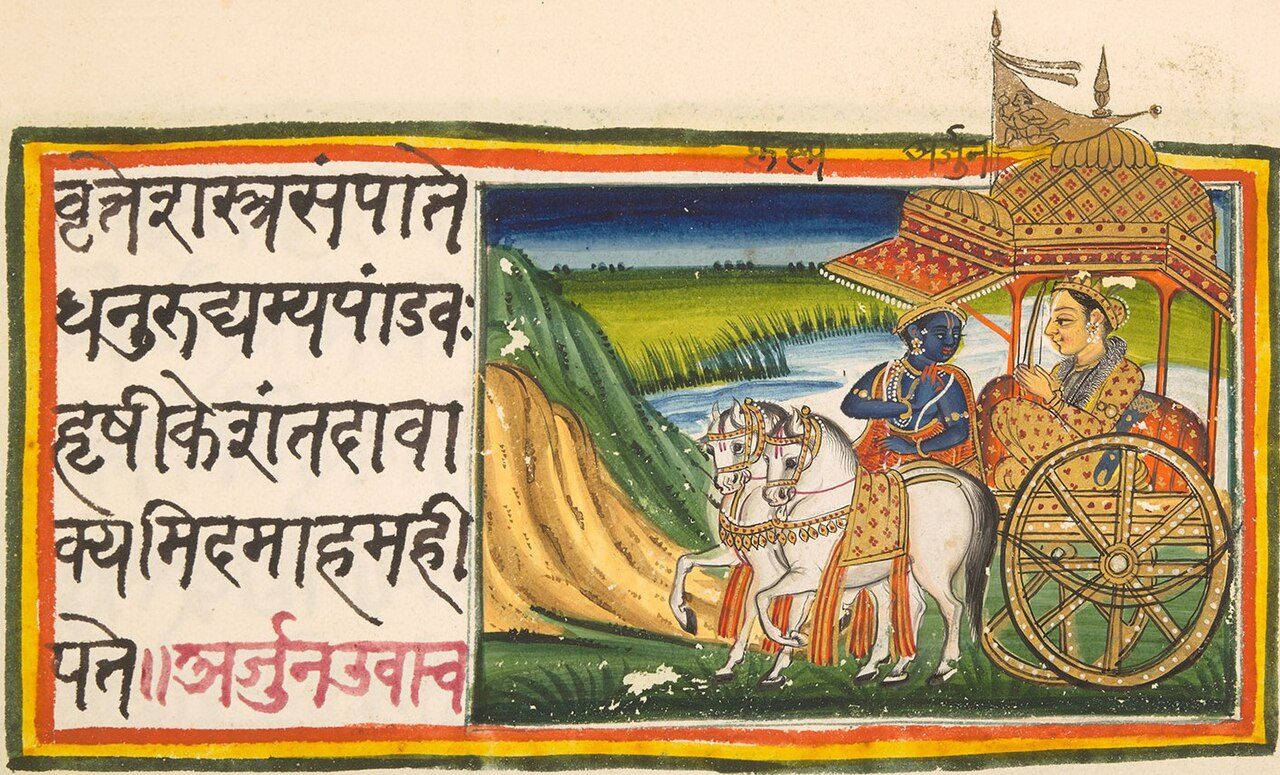
7 min read · 2 sourcesThe Bhagavad Gita (; Sanskrit: भगवद्गीता, IPA: [ˌbʱɐɡɐʋɐd ˈɡiːtaː], romanized: bhagavad-gītā, lit. 'God's song'), often referred to as the Gita (IAST: Gītā), is a Hindu scripture, likely composed in the second or first century BCE, which forms part of the epic poem Mahabharata. The Bhagavad Gita is a synthesis of various strands of Indian religious thought, including the Vedic concept of dharma (duty, rightful action); Sankhya-based yoga and jñana (knowledge); and bhakti (devotion). Among the Hindu traditions, the Bhagavad Gita holds a unique pan-Hindu influence as the most prominent sacred text and is a central text in the Vedanta and Vaishnava traditions. While traditionally attributed to the sage Veda Vyasa, the Bhagavad Gita is historiographically regarded as a composite work by multiple authors. Incorporating teachings from the Upanishads and the Samkhya Yoga philosophy, the Bhagavad Gita is set in a framework of dialogue between the Pandava prince Arjuna and his charioteer guide Krishna, an avatar of Vishnu, at the onset of the Kurukshetra War. While the Bhagavad Gita praises the benefits of yoga in releasing man's inner essence from the bounds of desire and the wheel of rebirth, the text stresses the Brahmanic idea of living according to one's duty or dharma, in contrast to the ascetic ideal of seeking liberation by avoiding all karma. Facing the perils of war, Arjuna hesitates to perform his duty (dharma) as a warrior. 1
Etymology
The Gita in the title of the Bhagavad Gita means "song". Religious leaders and scholars interpret the word Bhagavad in several ways. Accordingly, the title has been interpreted as "the song of God", "the word of God" by theistic schools, "the words of the Lord", "the Divine Song", and "Celestial Song" by others. The Sanskrit name is often written as Shrimad Bhagavad Gita (श्रीमद्भगवद्गीता). The prefix shrimad denotes a high degree of respect. The Bhagavad Gita is not to be confused with the Bhagavata Purana, which is one of the eighteen major Puranas dealing with the life of the Hindu God Krishna and various avatars of Vishnu. The word Gītā (गीता) is in the feminine gender. This is because the text is traditionally treated as an Upaniṣad, and Upaniṣad is a feminine noun in Sanskrit. Each chapter of the Gita ends with the phrase "Gītāsu Upaniṣatsu," confirming this connection. It even contains many verses that closely parallel those found in the Upanishads, often with only minor differences The work is also known as the Iswara Gita, the Ananta Gita, the Hari Gita, the Vyasa Gita, or the Gita. 1
Dating
The text is generally dated to the second or first century BCE, though later (1st c. CE) and earlier estimates (400-500 BCE) have also been given, while 200 BCE may also be the date of a major revision. According to Jeaneane Fowler, "the dating of the Gita varies considerably" and depends in part on whether one accepts it to be a part of the early versions of the Mahabharata, or a text that was inserted into the epic at a later date. The earliest "surviving" components therefore are believed to be no older than the earliest "external" references we have to the Mahabharata epic. The Mahabharata – the world's longest poem – is itself a text that was likely written and compiled over several hundred years, one dated between "400 BCE or little earlier, and 2nd century CE, though some claim a few parts can be put as late as 400 CE", states Fowler. The dating of the Gita is thus dependent on the uncertain dating of the Mahabharata. The actual dates of composition of the Gita remain unresolved. 1
According to Arthur Basham, the context of the Bhagavad Gita suggests that it was composed in an era when the ethics of war were being questioned and renunciation of monastic life was becoming popular. Such an era emerged after the rise of Buddhism and Jainism in the 5th century BCE, and particularly after the semi-legendary life of Ashoka in the 3rd century BCE. Thus, the first version of the Bhagavad Gita may have been composed in or after the 3rd century BCE. Winthrop Sargeant linguistically categorizes the Bhagavad Gita as Epic-Puranic Sanskrit, a language that succeeds Vedic Sanskrit and precedes classical Sanskrit. 1
Authorship
In the Indian tradition, the Bhagavad Gita, as well as the epic Mahabharata of which it is a part, is attributed to the sage Vyasa. A Hindu legend narrates that Vyasa composed it, and Ganesha, who broke one of his tusks, used this tusk to write down the Mahabharata along with the Bhagavad Gita. Scholars consider Vyasa to be a mythical or symbolic author, in part because Vyasa is also a title or generic name for the compiler of a text, and Vyasa is also regarded by tradition as the compiler of the Vedas and the Puranas, texts dated with a time-difference of circa two millennia. According to Alexus McLeod, a scholar of Philosophy and Asian Studies, it is "impossible to link the Bhagavad Gita to a single author", and it may be the work of many authors. This view is shared by the Indologist Arthur Basham, who states that there were three or more authors or compilers of Bhagavad Gita. This is evidenced by the discontinuous intermixing of philosophical verses with theistic or passionately theistic verses, according to Basham. J. A. B. van Buitenen, an Indologist known for his translations and scholarship on Mahabharata, finds that the Gita is so contextually and philosophically well-knit within the Mahabharata that it was not an independent text that "somehow wandered into the epic". The Gita, states van Buitenen, was conceived and developed by the Mahabharata authors to "bring to a climax and solution the dharmic dilemma of a war". 1
Vāsudeva-Krishna roots
According to Dennis Hudson, there is an overlap between Vedic and Tantric rituals within the teachings found in the Bhagavad Gita. Dennis Hudson places the Pancaratra Agama in the last three or four centuries of 1st-millennium BCE, and proposes that both the tantric and vedic, the Agama and the Gita share the same Vāsudeva-Krishna roots. According to Hudson, a story in this Vedic text highlights the meaning of the name Vāsudeva as the 'shining one (deva) who dwells (Vasu) in all things and in whom all things dwell', and the meaning of Vishnu to be the 'pervading actor'. In the Bhagavad Gita, similarly, 'Krishna identified himself both with Vāsudeva, Vishnu and their meanings'. The ideas at the centre of Vedic rituals in Shatapatha Brahmana and the teachings of the Bhagavad Gita revolve around this absolute Person, the primordial genderless absolute, which is the same as the goal of Pancaratra Agama and Tantra. 1
Manuscripts and layout
The Bhagavad Gita manuscript is found in the sixth book of the Mahabharata manuscripts – the Bhisma-parvan. Therein, in the third section, the Gita forms chapters 23–40, that is 6.3.23 to 6.3.40. The Bhagavad Gita is often preserved and studied on its own, as an independent text with its chapters renumbered from 1 to 18. The Bhagavad Gita manuscripts exist in numerous Indic scripts. 1
The text above is adapted from the Wikipedia article “Bhagavad Gita”, available under the Creative Commons Attribution-ShareAlike 4.0 licence. 1
Bhagavad Gita is primary holy scripture for Hinduism, according to the structured record cited below. This entry was generated automatically from that record and has not yet been reviewed by a person familiar with the tradition. 2
The source record links this tradition to 44 external registers, which can be verified through the citation. 2