The tradition & historical record
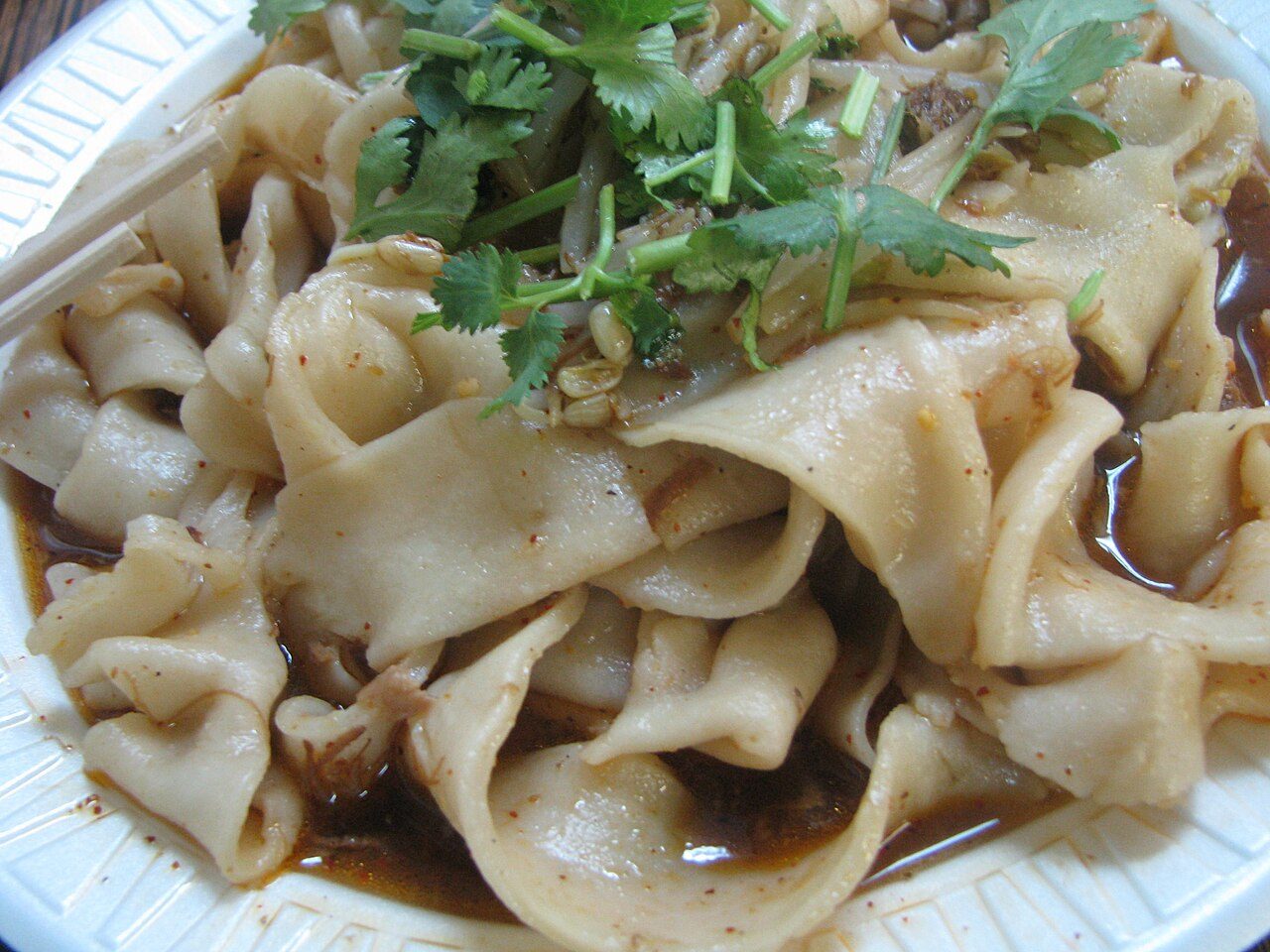
4 min read · 2 sourcesBiangbiang noodles (simplified Chinese: 𰻝𰻝面; traditional Chinese: 𰻞𰻞麵; pinyin: Biángbiángmiàn), alternatively known as yóupō chěmiàn (油泼扯面; 油潑扯麵) in Chinese, are a type of Chinese noodle originating from Shaanxi cuisine. The noodles, touted as one of the "Eight Curiosities of Shaanxi" (陕西八大怪; 陝西八大怪; Shǎnxī bā dà guài), are described as being like a belt, owing to their thickness and length. Biangbiang noodles are renowned for being written using a unique character. The character is unusually complex, with the standard variant of its traditional form containing 58 strokes. 1
Noodles
The noodles are thick and belt-like, and are usually hand-made. For most of their existence, they have been an obscure dish local to Xi'an, eaten by workers lacking the time to make thinner noodles. More recently, the noodles have become more widely known across China, in a rise driven to some extent by social media interest in the esoteric character used to write biáng. The word biáng is an Onomatopoeia being said to resemble the sound of the thick noodle dough hitting a work surface. 1
Chinese character for biáng
There are many variations of the character for biáng, but the most widely accepted version is made up of 58 strokes in its traditional form (42 in simplified Chinese). It is one of the most complex Chinese characters in modern usage, although it is not found in modern dictionaries or even in the Kangxi dictionary. The character is composed of 言 (speak; 7 strokes) in the middle flanked by 幺 (tiny; 2 × 3 strokes) on both sides. Below it, 馬 (horse; 10 strokes) is similarly flanked by 長 (grow; 2 × 8 strokes). This central block itself is surrounded by 月 (moon; 4 strokes) to the left, 心 (heart; 4 strokes) below, and刂 (knife; 2 strokes) to the right. These in turn are surrounded by a second layer of characters, namely 穴 (cave; 5 strokes) on the top and 辶 (walk; 4 strokes) curving around the left and bottom. 1
Computer entry and phonetic substitution
Both the traditional and simplified Chinese characters for biáng were encoded in Unicode, on 20 March 2020, for Unicode 13.0.0. The code point is U+30EDE for the traditional form (𰻞) and U+30EDD for the simplified form (𰻝). Until that point, there were no standardized ways of entering or representing them on computers. Both traditional and simplified forms had been submitted to the Ideographic Rapporteur Group for inclusion in CJK Unified Ideographs Extension G. As the characters are not widely available on computers (and not supported by many fonts), images of the characters, phonetic substitutes like 彪彪面 (biāobiāomiàn) or 冰冰面 (bīngbīng miàn), as well as the pinyin, are often used instead. The character is described by the following ideographic description sequences (IDSs): ⿺辶⿱穴⿱⿲月⿱⿲幺言幺⿲長馬長刂心 (traditional) ⿺辶⿱穴⿱⿲月⿱⿲幺言幺⿲長马長刂心 (cantonese) ⿺辶⿱穴⿱⿲月⿱⿲幺言幺⿲长马长刂心 (simplified) In Adobe's Source Han Sans (prior to 2.002) and Source Han Serif font these IDS sequences do not display as IDS sequences, but display the actual glyphs for the character. 1
Unicode
After an email discussion with Lee Collins, John Jenkins submitted an application of "" in 2006. However, its IDS was longer than the length permissible under Unicode's IDS specifications and "radical 心 (heart)" was missing from the character shape. Ming Fan (范銘) submitted an application to the Unicode Consortium. In WS2015, the traditional character had a code of UTC-00791 and the simplified character had a code of UTC-01312. However, the evidence for this character does not fully match the character shape. For UTC-00791, "radical 刂 (knife)" has disappeared from the dictionary (which is used as evidence). For UTC-01312, "radical 刂 (knife)" has become "radical 戈 (dagger-axe)" in the academic paper used as evidence. Members of the Unicode Consortium supported the character shape. In a proposal submitted on April 1st, Toshiya Suzuki suggested creating a new block ("CJK Complex Ideographic Symbols") and encoding "" as a generic character covering all possible variations, including the theoretical "". The character's traditional and simplified forms were added to Unicode version 13.0 in March 2020 in the CJK Unified Ideographs Extension G block of the newly allocated Tertiary Ideographic Plane, the finalized form of WS2015. The corresponding Unicode characters are: 1
Traditional: U+30EDE 𰻞 Simplified: U+30EDD 𰻝 1
Mnemonics
There are a number of mnemonics used by Shaanxi residents to aid recall of how the character is written. One version runs as follows: 1
The text above is adapted from the Wikipedia article “Biangbiang noodles”, available under the Creative Commons Attribution-ShareAlike 4.0 licence. 1
biangbiang noodles is Shaanxi dish of thick, broad, hand-made noodles, according to the structured record cited below. This entry was generated automatically from that record and has not yet been reviewed by a person familiar with the tradition. 2
The source record links this tradition to 5 external registers, which can be verified through the citation. 2