The tradition & historical record
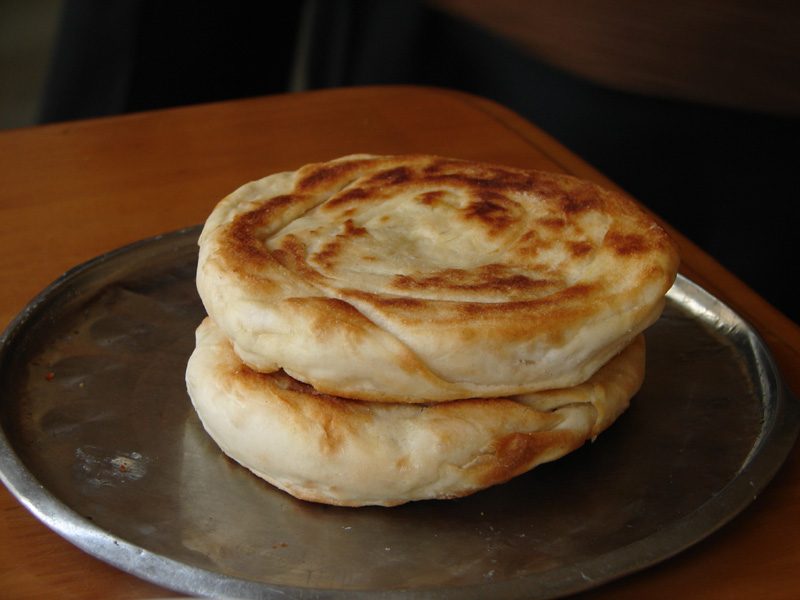
4 min read · 2 sourcesBing (Chinese: 餠) is a wheat flour-based Chinese bread with a flattened or disk-like shape. These foods may resemble the flatbreads, pancakes, pies and unleavened dough foods of non-Chinese cuisines. Many are similar to a roti or crêpe; others are more similar to cakes and cookies. The term is Chinese but may also refer to flatbreads or cakes of other cultures. The crêpe and the pizza, for instance, are referred to as keli bing (可麗餅) and pisa bing (披薩餅) respectively, based on the sound of their Latin names, and the flour tortilla is known as Mexican thin bing (墨西哥薄餅), based on its country of origin. 1
Types
Bing are usually a casual food and generally eaten for lunch, but they can also be incorporated into formal meals. Both Peking duck and moo shu pork are rolled up in thin wheat flour bo bing with scallions and sweet bean sauce or hoisin sauce. Bing may also have a filling such as ground meat. Bing are commonly cooked on a skillet or griddle although some are baked. Some common types include: 1
Cong you bing (蔥油餅; scallions and oil bing) Fa mian bing (發麵餅; yeast-risen bing) Laobing (烙餅; pan fried bing) Chun bing (春餅; spring pancake), a thin, Northern bing traditionally eaten to celebrate the beginning of spring. Usually eaten with a variety of fillings. Shaobing (燒餅; baked bing) Donkey burgers, a type of shaobing stuffed with meat Jianbing (煎餅; fried egg pancake, similar to crepes), a popular breakfast streetfood in China. Popiah (薄餅; literally "thin pancakes"), a thin circular crepe-like wrapper or "skin" (薄餅皮) wrapping various fillings. This is sometimes called "Mandarin pancake" or "moo shu pancake" (木須餅, mù xū bǐng) in American Chinese food contexts. 1
Luóbo si bing (蘿蔔絲餅, shredded radish bing), a type of panfried bing consisting of a wheat dough skin filled with shredded radish Rou jia bing (肉夾餅), also called rou jia mo refers to a bing that is sliced open and filled with meat, typically stewed pork or lamb meat. Some variants, such as niu rou jia bing (臘牛肉夾饃) use sesame bread and are filled with beef meat and pickled carrots and daikon, similar to a banh mi. Hé yè bǐng (荷葉餅; a foldable bing made to represent a lotus leaf), used to accompany many rich meat stuffings and popularized by the gua bao, a variation with red-cooked pork belly. Jin bing (筋餅) is a layered bing that is made with high-gluten flour (jin (筋) meaning gluten) popular in Northern China. 1
History
The earliest record of the word bing is in Mozi, written c. 400 BCE – c. 300 BCE, where it describes a food. In the Han dynasty, the dictionary Shuowen Jiezi (c. 100) defined bing as pastries made of wheat flour, while the dictionary Shiming (c. 200) defined bing as doughy foods including noodles, fried dough, and steamed or baked bread that food historians consider to be equivalent to pasta. During the Western Jin Dynasty (266–316), Shu Xi wrote about bing in more detail. He described various types of bing, some with origins in villages or foreign lands. He recommended stuffed buns for spring, what may be a flatbread for summer, what may be a leavened bread for autumn, and boiled noodles for winter. The first recipes for bing appeared in the sixth century agricultural text Qimin Yaoshu. 1
By the end of the Tang dynasty (618–907), when many more varieties of doughy foods were available, bing came to mainly refer to steamed or baked flatbreads while noodles became called mian. Wheaten foods including bing were a staple in northern China and also became popular in southern China. 1
The text above is adapted from the Wikipedia article “Bing (bread)”, available under the Creative Commons Attribution-ShareAlike 4.0 licence. 1
bing is flour-based food classification that is either baked (such as a flatbread) or not (such as a jianbing, a paratha), according to the structured record cited below. This entry was generated automatically from that record and has not yet been reviewed by a person familiar with the tradition. 2
The source record links this tradition to 1 external register, which can be verified through the citation. 2