The tradition & historical record
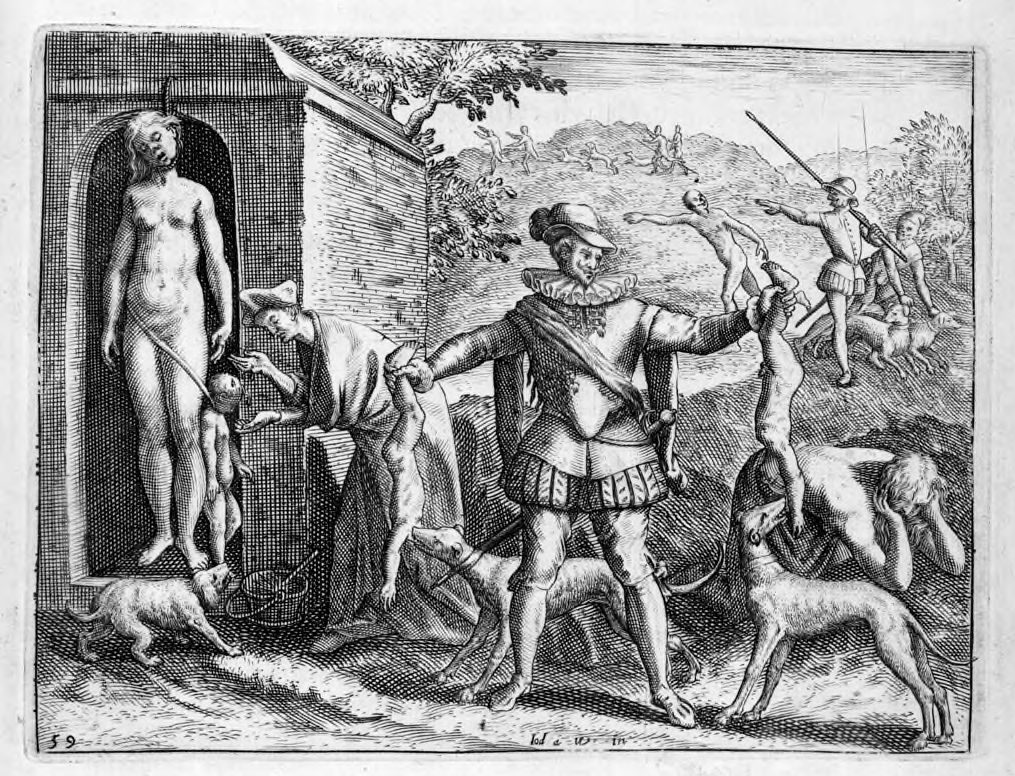
6 min read · 2 sourcesThe Black Legend (Spanish: leyenda negra) or the Spanish Black Legend (Spanish: leyenda negra española) is a purported historiographical tendency which consists of anti-Spanish and anti-Catholic propaganda. Its proponents argue that its roots date back to the 16th century, when Spain's European rivals were seeking, by political and psychological means, to demonize the Spanish Empire, its people, and its culture, minimize Spanish discoveries and achievements, and counter its influence and power in world affairs. According to the theory, Protestant propaganda published during the Hispano-Dutch War and the Anglo-Spanish War against the Catholic monarchs of the 16th century fostered an anti-Hispanic bias among subsequent historians. Along with a distorted view of the history of Spain and the history of Latin America, other parts of the world in the Portuguese Empire were also affected as a result of the Iberian Union and the Luso-Dutch Wars. Although some 17th-century propaganda was based in real events from the Spanish colonization of the Americas, some of which involved atrocities, the mainstream academia around the Leyenda Negra suggests that it often employed lurid and exaggerated depictions of violence, and ignored similar behavior by other powers. Although most scholars agree that the term Black Legend might be useful to describe 17th- and 18th-century anti-Spanish propaganda, there is no consensus on whether the phenomenon persists in the present day. 1
Historiography and definitions of the Spanish Black Legend
The term "black legend" was first used by Arthur Lévy in reference to biographies of Napoleon, and he primarily used it in the context of two opposing legends, a "golden legend" and a "black legend": two extreme, simplistic, one-dimensional approaches to a character which portrayed him as a god or a demon. "Golden" and "black legends" had been used by Spanish historians and intellectuals with the same meaning in reference to aspects of Spanish history; Antonio Soler used both terms about the portrayal of Castilian and Aragonese monarchs. The use of the term leyenda negra to refer specifically to a biased, anti-Spanish depiction of history gained currency in the first two decades of the 20th century, and is most associated with Julián Juderías. Throughout the 20th and into the 21st century, scholars have offered divergent interpretations of the Black Legend and debated its usefulness as a historical concept. 1
Origins of the concept of a Spanish Black Legend
At an 18 April 1899 Paris conference, Emilia Pardo Bazán used the term "Black Legend" for the first time to refer to a general view of modern Spanish history: 1
Abroad, our miseries are known and often exaggerated without balance; take as an example the book by M. Yves Guyot, which we can consider as the perfect model of a black legend, the opposite of a golden legend. The Spanish black legend is a strawman for those who seek convenient examples to support certain political theses ... The black legend replaces our contemporary history with a novel in the Ponson du Terrail style, with mines and countermines, which doesn't even deserve the honor of analysis. The conference had a great impact in Spain, particularly on Julián Juderías. Juderías, who worked at the Spanish Embassy in Russia, had noticed (and denounced) the spread of anti-Russian propaganda in Germany, France, and the United Kingdom and was interested in its possible long-term consequences. Juderías was the first historian to describe the "black legend" phenomenon, although he did not yet name it as such, in a book regarding the construction of an anti-Russian black legend. His work, initially concerned with the intentional deformation of Russia's image in Europe, led him to identify the same patterns of narration he detected in the construction of anti-Russian discourse in the dominant historical narrative regarding Spain. Juderías investigated the original sources supporting centuries old claims of Spanish atrocities and other misdeeds, tracing the origin or propagation of the majority to rival emerging powers. In his 1914 book, La leyenda negra y la verdad histórica (The Black Legend and Historical Truth), deconstructs aspects of Spain's image (including those in Foxe's Book of Martyrs). 1
Historiographic development of the term
Later writers supported and developed Juderías's critique. In Tree of Hate (1971), Historian Charles Gibson described it as "the accumulated tradition of propaganda and hispanophobia according to which the Spanish Empire is considered cruel, intolerant, degenerate, exploitative and sanctimonious above reality." Historian Philip Wayne Powell argued that the Black Legend was still active in modern history, and plays an active role in shaping Latin America–United States relations. His book provides examples of what he viewed as divergent treatment of Spain and other powers, and illustrates how this allows for a double narrative that taints Americans' view of Hispanic America as a whole: 1
Spaniards who came to the New World seeking opportunities beyond the prospects of their European environment, are contemptuously called cruel and greedy "goldseekers," or other opprobrious epithets virtually synonymous with "Devils"; but Englishmen who sought New World opportunities are more respectfully called "colonists," or "homebuilders," or "seekers after liberty." ... When Spaniards expelled or punished religious dissidents, this came to be known as "bigotry," "intolerance," "fanaticism," and a cause of their decline. 1
Historical basis
Despite having a vast empire stretching from Mexico to Peru across the Pacific to the Philippines and beyond, which required many Spaniards to travel overseas and deal with foreigners, eighteenth-century philosopher Immanuel Kant wrote, "The Spaniard's bad side is that he does not learn from foreigners; that he does not travel in order to get acquainted with other nations; that he is centuries behind in the sciences. He resists any reform; he is proud of not having to work; he is of a romantic quality of spirit, as the bullfight shows; he is cruel, as the former auto-da-fé shows; and he displays in his taste an origin that is partly non-European." Thus, semiotician Walter Mignolo argues that the Spanish black legend was closely tied to race in using Spain's Moorish (Arab and Berber) history to portray Spaniards as racially tainted and its treatment of Native Americans and enslaved sub-Saharan Africans during Spanish colonization to symbolize the country's moral character. That notwithstanding, there is general agreement that the wave of anti-Spanish propaganda of the 16th and 17th centuries was linked to undisputed events and phenomena which occurred at the apogee of Spanish power between 1492 and 1648. 1
Conquest of the Americas
During the three-century European colonization of the Americas, atrocities and crimes were committed by all European nations according to both contemporary opinion and modern moral standards. 1
The text above is adapted from the Wikipedia article “Black Legend”, available under the Creative Commons Attribution-ShareAlike 4.0 licence. 1
Black Legend is supposed tendency in historical writing demonising Spain and the Spanish Empire, according to the structured record cited below. This entry was generated automatically from that record and has not yet been reviewed by a person familiar with the tradition. 2
The source record links this tradition to 14 external registers, which can be verified through the citation. 2