The tradition & historical record
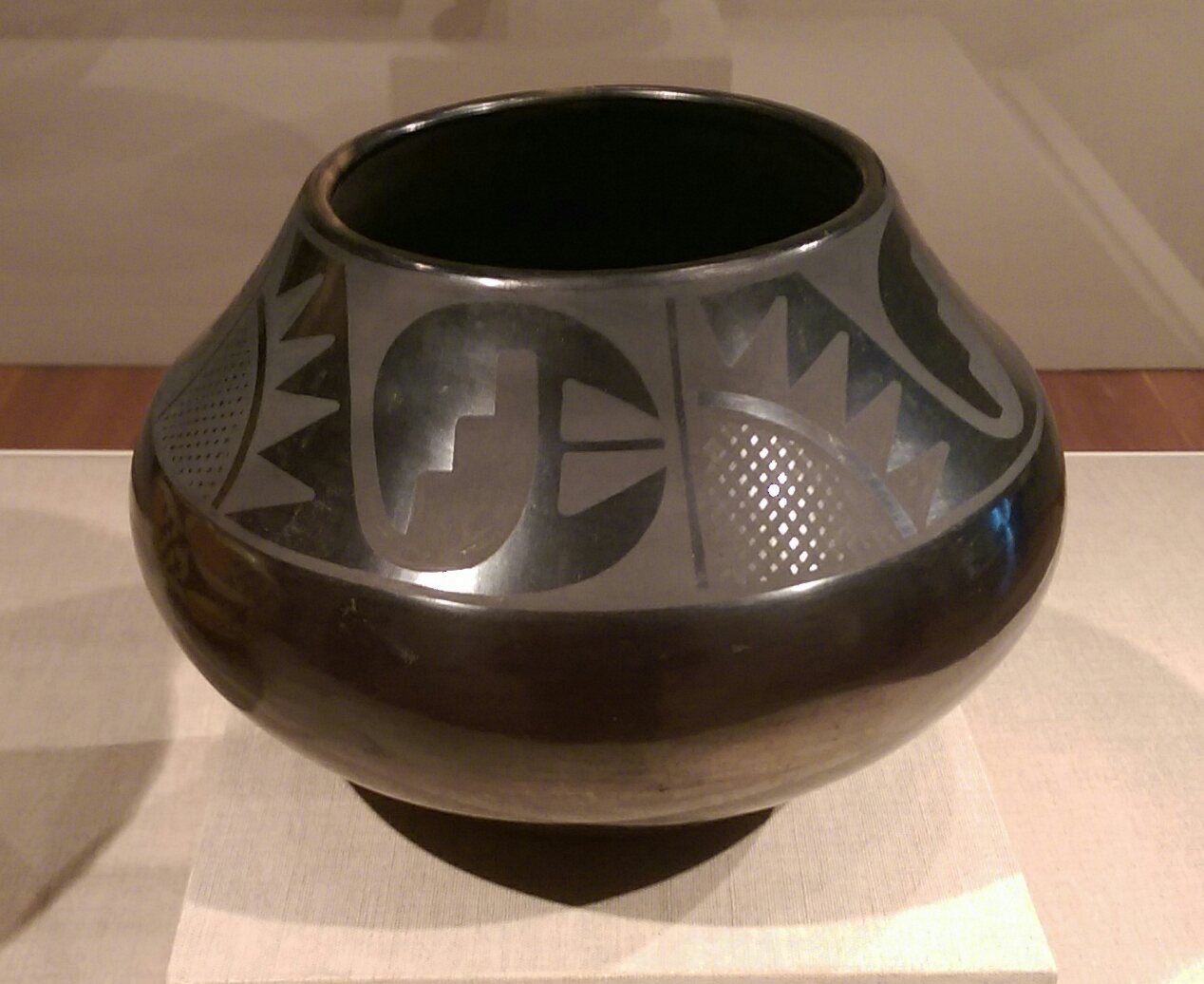
6 min read · 2 sourcesBlack-on-black ware is a 20th and 21st-century pottery tradition developed by Puebloan Native American ceramic artists in Northern New Mexico. Traditional reduction-fired blackware has been made for centuries by Pueblo artists and other artists around the world. Pueblo black-on-black ware of the past century is produced with a smooth surface, with the designs applied through selective burnishing or the application of refractory slip. Another style involves carving or incising designs and selectively polishing the raised areas. For generations several families from Kha'po Owingeh and P'ohwhóge Owingeh pueblos have been making black-on-black ware with the techniques passed down from matriarch potters. Artists from other pueblos have also produced black-on-black ware. Several contemporary artists have created works honoring the pottery of their ancestors. 1
Blackware and black-on-black ware
The artists of Kha'po Owingeh (Tewa: [xɑ̀ʔp’òː ʔówîŋgè]), also called Santa Clara Pueblo, and of P'ohwhóge Owingeh (Tewa: [p’òhxʷógè ʔówîŋgè]), also known as San Ildefonso Pueblo, have been making traditional blackware (reduction-fired earthenware) for many years using a coarse-grained clay body decorated with deeply incised or excised designs. During the firing process in an earthen pit, the fire is smothered with powdered dung which reduces the oxygen without diminishing the heat; this process blackens the clay. Another method of blackening the clay is by "smudging". The pots are surrounded with sheets of metal to reduce the amount of oxygen, and then smothered with damp manure. The smoke impregnates the clay with carbon to produce the blackened finish. Black-on-black ware is produced with a smooth surface, with the designs applied through selective burnishing or the application of refractory slip. The clay body used in this type of pottery has a very fine grain structure. Both types are typically made using traditional methods of hand-coiling local clay and firing it in a pit. Black-on-black ware pottery can be found in many museums and private collections. The rapid shift in the early 20th century from traditional blackware made for centuries to the black-on-black style that broke with tradition was triggered by the innovations of María Martinez of P'ohwhóge Owingeh. 1
Work by P'ohwhóge Owingeh (San Ildefonso Pueblo) artists
In 1910, María Poveka Martinez and her husband Julián of P'ohwhóge Owingeh are credited with originating a non-incised, smooth-surfaced polished-black on matte-black technique. Their technique involves making blackware using a fine-grained clay body fired in a cow-dung fire. By 1918 they had perfected the technique producing black-on-black surface ornamentation, created by selectively burnishing and polishing specific areas of the pot. The polishing gives the clay a silver-black lustrous light-reflecting quality. At times the matte areas are painted with an iron-bearing slip. By 1925, Martinez' pots were in demand, and selling for prices that benefited the pueblo by enabling new houses to be built and farming equipment to be purchased. Between 1956 and 1970 Martinez collaborated with her son, Popovi Da (1921–1971). Popovi Da was known for his experimentation, precision of design and for reviving and transforming traditional techniques. He perfected gunmetal-black finishes by knowing exactly when to "cut the oxidation" during the firing process. His son, Tony Da (1940–2008) produced work that used sgraffito etching, and initiated a technique to selective black-on-black and sienna coloration on the same vessel. He was able to achieve a "shimmering" mirror-like gunmetal-black finish on his work. A member of María Martinez' extended family, Santana Roybal Martinez (1909-2002) whose parents were also potters, learned from Maria and Julian Martinez and would sign her pots "Marie and Santana". She was married to Maria and Julian's eldest son Adam Martinez. In 1943, when Julian died, Santana took over the task of polishing and decorating Maria's work. When Maria became too old to fire her pots herself, Santana took on that process. 1
Work by Kha'po Owingeh (Santa Clara Pueblo) artists
Five generations of potters of the Tafoya family of Kha'po Owingeh have been producing incised blackware and later, smooth-surfaced black-on-black ware, notably the matriarch potter Sara Fina Tafoya 1863–1949). Both Sara Fina (Autumn Flower) and her husband Geronimo (White Flower) produced polished blackware, however it was Sara Fina who expected nothing but "perfection from her children in their ceramic endeavors", while Geronimo was primarily concerned with cultivating food for the family. She was considered the "outstanding Tewa potter of her time" in relation to the beauty, size, and variety of her ceramic work. Some of her work was produced in micaceous clay, but it was making polished blackware, and later carved black-on-black ware where she excelled. 1
Sara Fina's daughter Margaret Tafoya (Corn Blossom), born 1904, and her granddaughter LuAnn Tafoya (born 1938) also create black-on-black work. LuAnn learned polishing techniques from her mother starting at age twelve, before she learned to make her own pots. Once she began making her own pots, she challenged her abilities by working at a large scale; her first storage pot was 23 inches tall. She learned from her family the importance of keeping true to tradition working with specific designs and their meanings, digging local clay and open-flame firing techniques. Another daughter of Sara Fina Tafoya, Christina (Tafoya) Naranjo (1891–1980) is also well known for her blackware, as is her granddaughter Mary Cain (1915–2010), great-granddaughter Linda Cain (born 1949) and her great-great-granddaughter Tammy Garcia (born 1969). 1
Work by artists of other pueblos
In the 1920s the San Ildefonso (Pueblo P'ohwhóge Owingeh) black-on-black style began to flourish due to the work of Maria and Julian Martinez, and several artists were inspired by Nampeyo (1959–1942), of Hano, a Tewan pueblo on the East Mesa of Hopiland. Although her work looked very different from that of the artists working in the pueblos of the Rio Grande Valley, the depth of her knowledge influenced the artists working at P'ohwhóge Owingeh. Hopi–Tewa potter Helen Naha (Feather Woman, 1922–1993) of the village of Polacca, south of First Mesa (Hopi: Wàlpi), produced black-on-black ware in addition to other styles. Artists from Kewa Pueblo (Eastern Keres: [kʰewɑ], Navajo: Tó Hájiiloh, formerly known as Santo Domingo Pueblo), Ohkay Owingeh (Tewa: [ʔòhkèː ʔówĩ̂ŋgè], formerly known as San Juan Pueblo), and Picuris Pueblo (Tiwa: P'įwweltha [p’ī̃wːēltʰà]) also produce black-on-black ware, but in lesser quantities, as their primary ceramic work is mostly produced in other styles. Harrison Begay Jr. (born 1961), a Navajo artist who is part Hopi, Jemez and Zuni learned black-on-black techniques from his wife and her family who are from Santa Clara Pueblo. His pots are produced with traditional polished and matte black surfaces, and are deeply carved revealing traces of the red clay underneath the oxidized surface. 1
Contemporary art interpretations
Several contemporary artists have created works honoring th… 1
The text above is adapted from the Wikipedia article “Black-on-black ware”, available under the Creative Commons Attribution-ShareAlike 4.0 licence. 1
Black-on-black ware is Type of Native American pottery, according to the structured record cited below. This entry was generated automatically from that record and has not yet been reviewed by a person familiar with the tradition. 2
The source record links this tradition to 1 external register, which can be verified through the citation. 2