The tradition & historical record
7 min read · 2 sourcesThe parable of the blind men and an elephant is a story of a group of blind men who have never come across an elephant before and who learn and imagine what the elephant is like by touching it. Each blind man feels a different part of the animal's body, but only one part, such as the side or the tusk. They then describe the animal based on their limited experience and their descriptions of the elephant are different from each other. In some versions, they come to suspect that the other person is dishonest and they come to blows. Only in a handful of versions do the men find out the truth. Regardless, the moral of the parable is that humans have a tendency to claim absolute truth based on their limited, subjective experience as they ignore other people's limited, subjective experiences which may be equally true. The parable originated in the ancient Indian subcontinent, from where it has been widely disseminated. This parable is found in the most ancient Jain agams before 5th century BCE. The Buddhist text Tittha Sutta, Udāna 6.4, Khuddaka Nikaya, contains one of the versions of the story. The Tittha Sutta is dated to around c. 500 BCE, during the lifetime of the Buddha. 1
The parable
The earliest versions of the parable of blind men and the elephant are found in Buddhist, Hindu and Jain texts, as they discuss the limits of perception and the importance of complete context. The parable has several Indian variations, but broadly goes as follows: 1
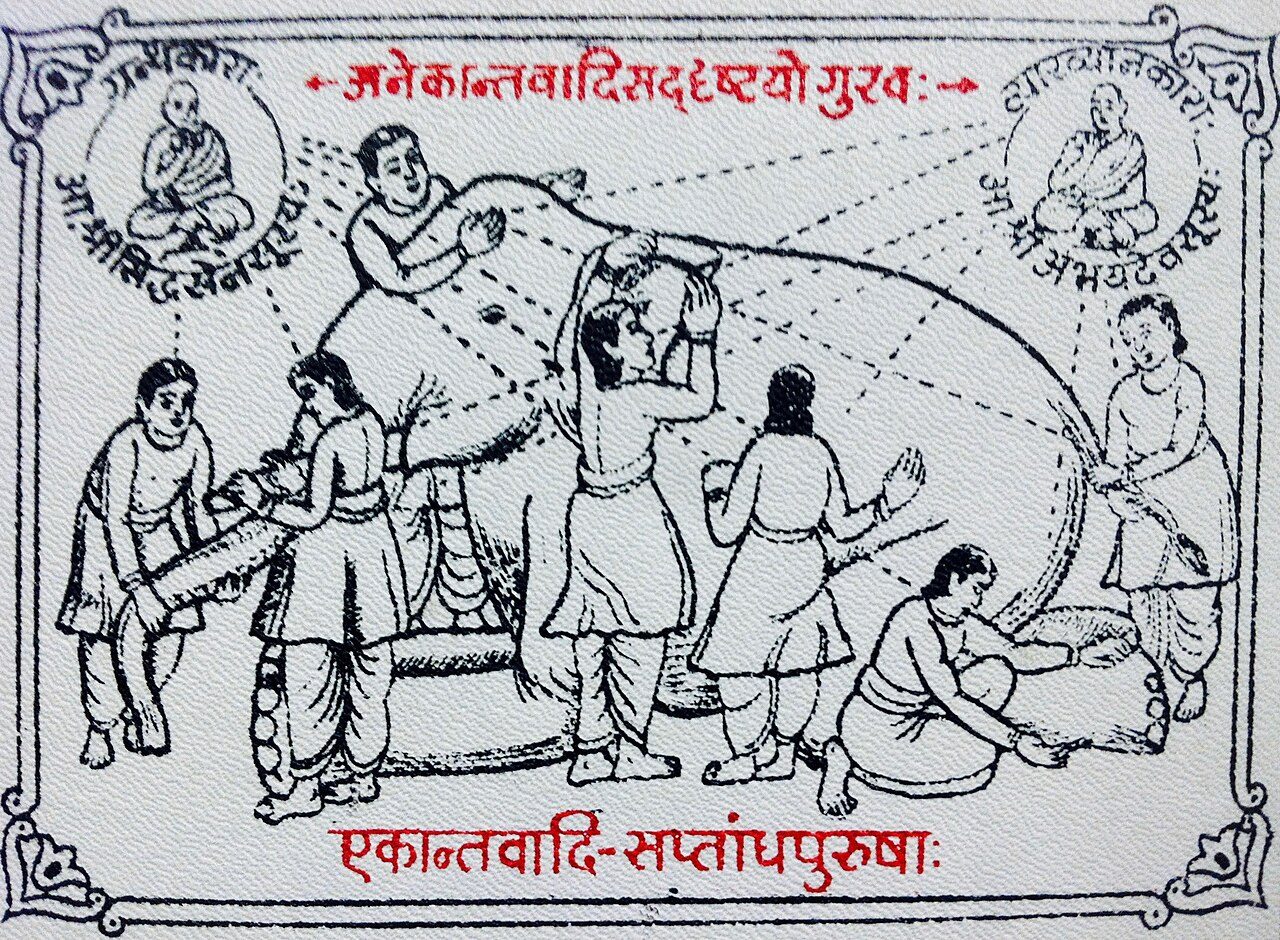
A group of blind men heard that a strange animal, called an elephant, had been brought to the town, but none of them were aware of its shape and form. Out of curiosity, they said: "We must inspect and know it by touch, of which we are capable". So, they sought it out, and when they found it they groped about it. The first person, whose hand landed on the trunk, said, "This being is like a thick snake". For another one whose hand reached its ear, it seemed like a kind of fan. As for another person, whose hand was upon its leg, said, the elephant is a pillar like a tree-trunk. The blind man who placed his hand upon its side said the elephant, "is a wall". Another who felt its tail, described it as a rope. The last felt its tusk, stating the elephant is that which is hard, smooth and like a spear. In some versions, the blind men then discover their disagreements, suspect the others to be not telling the truth and come to blows. The stories also differ primarily in how the elephant's body parts are described, how violent the conflict becomes and how (or if) the conflict among the men and their perspectives is resolved. In some versions, they stop talking, start listening and collaborate to "see" the full elephant. In another, a sighted man enters the parable and describes the entire elephant from various perspectives, the blind men then learn that they were all partially correct and partially wrong. 1
Hinduism
The Rigveda, dated to have been written down (from earlier oral traditions) between 1500 and 1200 BCE, states "Reality is one, though wise men speak of it variously." According to Paul J. Griffiths, this premise is the foundation of universalist perspective behind the parable of the blind men and an elephant. The hymn asserts that the same reality is subject to interpretations and described in various ways by the wise. In the oldest version, four blind men walk into a forest where they meet an elephant. In this version, they do not fight with each other, but conclude that they each must have perceived a different beast although they experienced the same elephant. The expanded version of the parable occurs in various ancient and Hindu texts. Many scholars refer to it as a Hindu parable. The parable or references appear in bhasya (commentaries, secondary literature) in the Hindu traditions. For example, Adi Shankara mentions it in his bhasya on verse 5.18.1 of the Chandogya Upanishad as follows: 1
etaddhasti darshana iva jatyandhah Translation: That is like people blind by birth in/when viewing an elephant. 1
Jainism
The medieval era Jain texts explain the concepts of anekāntavāda (or "many-sidedness") and syādvāda ("conditioned viewpoints") with the parable of the blind men and an elephant (Andhgajanyāyah), which addresses the manifold nature of truth. This parable is found in the most ancient Jain agams before 5th century BCE. Its popularity remained till late. For example, this parable is found in Tattvarthaslokavatika of Vidyanandi (9th century) and Syādvādamanjari of Ācārya Mallisena (13th century). Mallisena uses the parable to argue that immature people deny various aspects of truth; deluded by the aspects they do understand, they deny the aspects they don't understand. "Due to extreme delusion produced on account of a partial viewpoint, the immature deny one aspect and try to establish another. This is the maxim of the blind (men) and the elephant." Mallisena also cites the parable when noting the importance of considering all viewpoints in obtaining a full picture of reality. "It is impossible to properly understand an entity consisting of infinite properties without the method of modal description consisting of all viewpoints, since it will otherwise lead to a situation of seizing mere sprouts (i.e., a superficial, inadequate cognition), on the maxim of the blind (men) and the elephant." 1
Buddhism
The Buddha twice uses the simile of blind men led astray. The earliest known version was recorded in the one of Buddhist scriptures, known as Tittha Sutta. In another scripture known as Canki Sutta, the Buddha describes a row of blind men holding on to each other as an example of those who follow an old text that has passed down from generation to generation. In the Udana (68–69) he uses the elephant parable to describe sectarian quarrels. A king invited a group of blind men in the capital to be brought to the palace, where an elephant is brought in and they are asked to describe it. 1
When the blind men had each felt a part of the elephant, the king went to each of them and said to each: "Well, blind man, have you seen the elephant? Tell me, what sort of thing is an elephant?" The men assert the elephant is either like a pot (the blind man who felt the elephant's head), a winnowing basket (ear), a plowshare (tusk), a plow (trunk), a granary (body), a pillar (foot), a mortar (back), a pestle (tail) or a brush (tip of the tail). The men cannot agree with one another and come to blows over the question of what it is like and their dispute delights the king. The Buddha ends the story by comparing the blind men to preachers and scholars who are blind and ignorant and hold to their own views: "Just so are these preachers and scholars holding various views blind and unseeing.... In their ignorance they are by nature quarrelsome, wrangling, and disputatious, each maintaining reality is thus and thus." The Buddha then speaks the following verse: 1
Sufism
The Persian Sufi poet Sanai (1080–1131/1141 CE) of Ghazni (currently, Afghanistan) presented this teaching story in his The Walled Garden of Trut… 1
The text above is adapted from the Wikipedia article “Blind men and an elephant”, available under the Creative Commons Attribution-ShareAlike 4.0 licence. 1
blind men and an elephant is parable from the ancient Indian subcontinent, in which several blind men feel and try to conceptualize an elephant, according to the structured record cited below. This entry was generated automatically from that record and has not yet been reviewed by a person familiar with the tradition. 2
The source record links this tradition to 1 external register, which can be verified through the citation. 2