The tradition & historical record
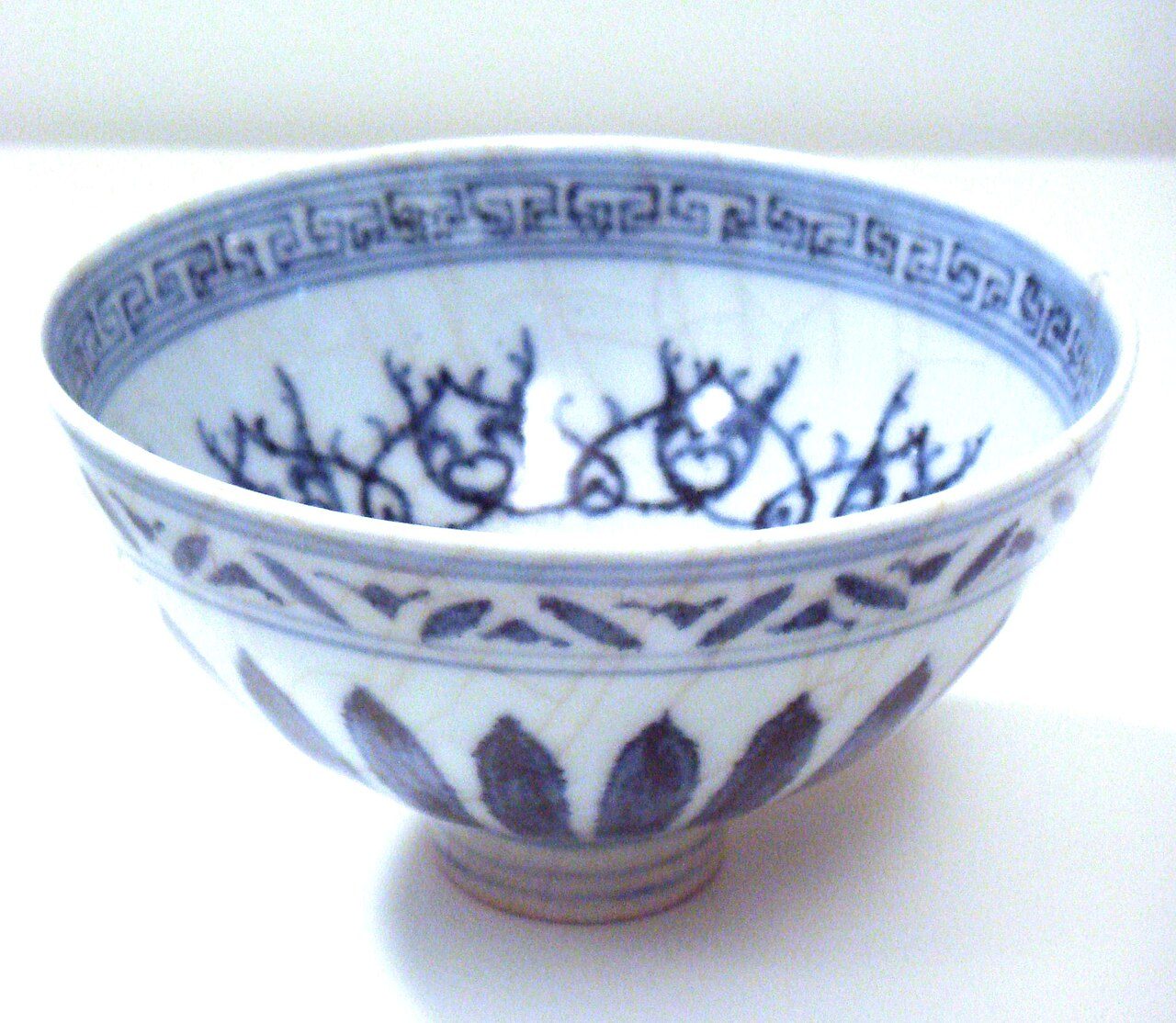
6 min read · 2 sources"Blue and white pottery" (Chinese: 青花瓷; pinyin: qīng-huā cí; lit. 'Blue flowers/patterns') covers a wide range of white pottery and porcelain decorated under the glaze with a blue pigment, generally cobalt oxide. The decoration was commonly applied by hand, originally by brush painting, but nowadays by stencilling or by transfer-printing, though other methods of application have also been used. The cobalt pigment is one of the very few that can withstand the highest firing temperatures that are required, in particular for porcelain, which partly accounts for its long-lasting popularity. Historically, many other colours required overglaze decoration and then a second firing at a lower temperature to fix that. The origin of the blue and white pottery is thought to lie in Iraq, when craftsmen in Basra sought to imitate imported white Chinese stoneware with their own tin-glazed, white pottery and added decorative motifs in blue glazes. Such Abbasid-era pieces have been found in present-day Iraq dating to the 9th century AD, decades after the opening of a direct sea route from Iraq to China. According to Jonathan Bloom, these 9th and 10th century Iraqi examples were the first blue-and-white wares. This technique was transmitted to Europe during the Arab conquest of Spain and North Africa and is also believed to have influenced Chinese ceramics through the activities of Muslim traders. 1
Origin and development
Cobalt blue glaze became popular in Islamic pottery during the Abbasid Caliphate, when the cobalt was mined near Kashan, Oman, and Northern Hejaz. Blue-and-white wares were first produced in the 9th century in Iraq. Following an analysis of the literature regarding blue-and-white ceramics, Edwards and Colomban (2025) characterized the decoration style as an Abbasid innovation. Early Chinese craftspeople used blue-and-white porcelain to replicate the styles of Islamic pottery and metalwork. Even earlier, during the eighth century, Chinese potters adopted motifs like lotus scrolls directly from Persian silverwork. 1
Tang and Song blue-and-white
The use of cobalt as an underglaze color was introduced to China from Iraq, where Abbasid potters had been using it on white glazed earthenware since the 9th century. In China, it was first applied to earthenware during the Tang dynasty (618–907 CE) and subsequently to porcelain. Shards of blue-and-white porcelain from the late Tang dynasty have been discovered at the Huangye and Baihe kiln sites in Gongyi, Henan Province. Tang period blue-and-white is more rare than Song blue-and-white and was unknown before 1985. The Tang pieces are not porcelain however, but rather earthenwares with greenish white slip, using cobalt blue pigments. The only three pieces of complete "Tang blue and white" in the world were recovered in 1998 from the Belitung shipwreck in Indonesia and later sold to Singapore. It appears that the technique was forgotten for some centuries. Textual and archaeological evidence suggests that blue-and-white wares may have been produced during the Song dynasty, although the identification of Song dynasty blue-and-white pieces remains the subject of disagreement among experts. 1
14th-century development
In the early 20th century, the development of the classic blue and white Jingdezhen ware porcelain was dated to the early Ming period, but consensus now agrees that these wares began to be made around 1300–1320, and were fully developed by the mid-century, as shown by the David Vases dated 1351, which are cornerstones for this chronology. There are still those arguing that early pieces are mis-dated, and in fact go back to the Southern Song. Still, most scholars continue to reject this view. In the early 14th century, mass production of fine, translucent, blue and white porcelain started at Jingdezhen, sometimes called the porcelain capital of China. This development was due to the combination of Chinese techniques and Islamic trade. The new ware was made possible by the export of cobalt from Persia (called Huihui qing, 回回青, "Islamic blue" or "Muslim blue"), combined with the translucent white quality of Chinese porcelain, derived from kaolin. Cobalt was so prized that manufacturers in Jingdezhen considered cobalt a precious commodity with about twice the value of gold. Motifs also draw inspiration from Islamic decorations. A large portion of these blue-and-white wares were then shipped to Southwest-Asian markets through the Muslim traders based in Guangzhou. Chinese blue and white porcelain was once-fired: after the porcelain body was dried, it was decorated with refined cobalt-blue pigment mixed with water and applied using a brush. It was then coated with a clear glaze and fired at a high temperature. From the 16th century, local sources of cobalt blue started to be developed, although Persian cobalt remained the most expensive. Production of blue and white wares has continued at Jingdezhen to this day. 1
14th century
The true development of Chinese blue and white ware started with the first half of the 14th century, when it progressively replaced the centuries-long tradition of (normally) unpainted bluish-white southern Chinese porcelain, or Qingbai, as well as Ding ware from the north. The best, and quickly the main production was in Jingdezhen porcelain from Jiangxi Province. There was already a considerable tradition of painted Chinese ceramics, mainly represented at that time by the popular stoneware Cizhou ware, but that was not used by the court. For the first time in centuries the new blue and white appealed to the taste of the Mongol rulers of China.The earlier blue-and-white decoration techniques could not withstand the firing process and hence tended to run in the kiln, until Jingdezhen potters developed glazes with sufficient viscosity to avoid diffusion during firing. Blue and white ware also began making its appearance in Japan, where it was known as sometsuke. Various forms and decorations were highly influenced by China, but later developed its own forms and styles. 1
15th century
With the advent of the Ming dynasty in 1368, blue and white ware was shunned for a time by the Court, especially under the Hongwu and Yongle Emperors, as being too foreign in inspiration. Blue and white ware did not accord with Chinese taste at that time, the early Ming work Gegu Yaolun (格古要論) in fact described blue as well as multi-coloured wares as "exceedingly vulgar". Blue and white porcelain however came back to prominence in the 15th century with the Xuande Emperor, and again developed from that time on. In this century a number of experiments were made combining underglaze blue and other colours, both underglaze and overglaze enamels. Initially copper and iron reds were the most common, but these were much more difficult to fire reliably than cobalt blue, and produced a very high rate of mis-fired wares, where a dull grey replaced the intended red. Such experiments continued over the following centuries, with the doucai and wucai techniques combining underglaze blue and other colours in overglaze. 1
The text above is adapted from the Wikipedia article “Blue and white pottery”, available under the Creative Commons Attribution-ShareAlike 4.0 licence. 1
blue and white ceramic is white pottery and porcelain decorated under the glaze with a blue pigment, generally cobalt oxide, according to the structured record cited below. This entry was generated automatically from that record and has not yet been reviewed by a person familiar with the tradition. 2
The source record links this tradition to 9 external registers, which can be verified through the citation. 2