The tradition & historical record
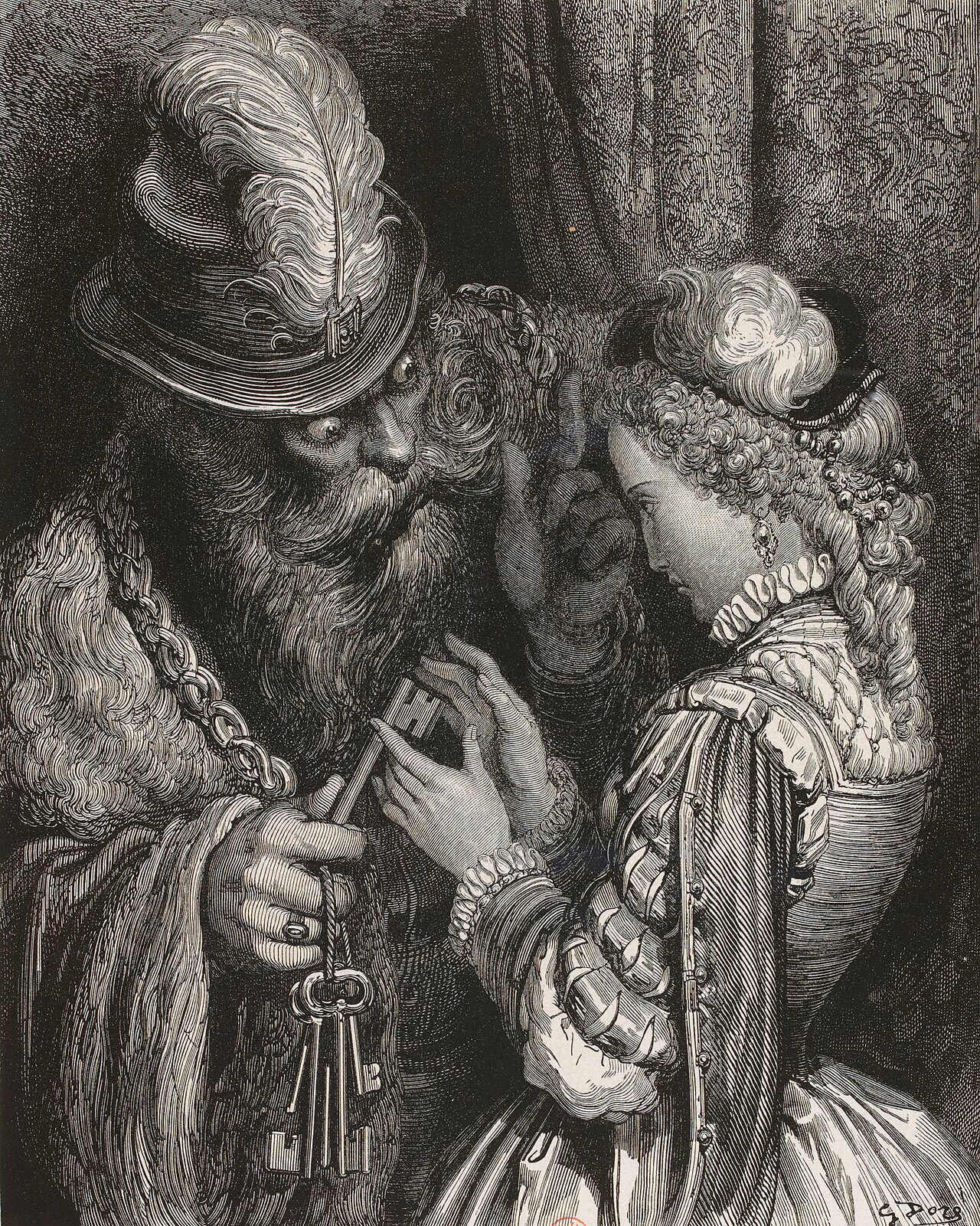
7 min read · 2 sources"Bluebeard" (French: Barbe bleue [baʁb(ə) blø]) is a French folktale, the most famous surviving version of which was written by Charles Perrault and first published by Claude Barbin in Paris in 1697 in Histoires ou contes du temps passé. The tale is about a wealthy man in the habit of murdering his wives and the attempts of the present one to avoid the fate of her predecessors. "The White Dove", "The Robber Bridegroom", and "Fitcher's Bird" (also called "Fowler's Fowl") are tales similar to "Bluebeard". The notoriety of the tale is such that Merriam-Webster gives the word Bluebeard the definition of "a man who marries and kills one wife after another". The verb bluebearding has even appeared as a way to describe the crime of either killing a series of women, or seducing and abandoning a series of women. 1
Plot
In one version of the story, Bluebeard is a wealthy and powerful nobleman who has been married six times to beautiful women who have all mysteriously vanished. When he visits his neighbor and asks to marry one of his daughters, they are terrified. After hosting a wonderful banquet, the youngest decides to be his wife and goes to live with him in his rich and luxurious palace in the countryside, away from her family. Bluebeard announces that he must leave for the country and gives the palace keys to his wife. She is able to open any room with them, each of which contain some of his riches, except for an underground chamber that he strictly forbids her to enter lest she suffer his wrath. He then goes away, leaving the palace and the keys in her hands. She invites her sister, Anne, and her friends and cousins over for a party. However, she is eventually overcome with the desire to see what the secret room holds, and she sneaks away from the party and ventures into it. She immediately discovers that the room is flooded with blood and the murdered corpses of Bluebeard's previous six wives hanging on hooks from the walls. Horrified, she drops the key in the blood and flees the room. She tries to wipe the blood stain off the key, but the key is magic and the stain cannot be removed from it. Bluebeard unexpectedly returns and finds the bloody key. In a blind rage, he threatens to kill his wife on the spot, but she asks for one last prayer with Anne. Then, as Bluebeard is about to deliver the fatal blow, Anne and her brothers arrive and kill him. The wife inherits his fortune and castle, and has his six dead wives laid to rest. She uses the fortune to have her siblings married then remarries herself, finally moving on from the horror of her time with Bluebeard. 1
Commentaries
The fatal effects of female curiosity have long been the subject of story and legend. Pandora and Psyche are examples of women in mythic stories whose curiosity has dire consequences. In giving his wife the keys to his castle, Bluebeard is acting the part of the Serpent of Eden, and therefore of the devil, and his wife the part of the victim held by the serpent's gaze. While some scholars interpret the Bluebeard story as a fable preaching obedience to wives (as Perrault's moral suggests), folklorist Maria Tatar has suggested that the tale encourages women not to unquestioningly follow patriarchal rules. Women breaking men's rules in the fairy-tale can be seen as a metaphor for women breaking society's rules and being punished for their transgression. The key can be seen as a sign of disobedience or transgression; it can also be seen as a sign that one should not trust their husband. Tatar, however, does go on to speak of Bluebeard as something of a "Beauty and the Beast" narrative. The original Beauty and the Beast tale by Jeanne-Marie Leprince de Beaumont is said to be a story created to condition young women into the possibility of not only marriage, but marrying young, and to placate their fears of the implications of an older husband. It shows the beast as secretly compassionate, and someone meant to curb the intense sexual fear that young women have of marriage. 1
Aarne–Thompson classification
According to the Aarne–Thompson system of classifying folktale plots, the tale of Bluebeard is type 312. Another such tale is The White Dove, an oral French variant. The type is closely related to Aarne–Thompson type 311 in which the heroine rescues herself and her sisters, in such tales as Fitcher's Bird, The Old Dame and Her Hen, and How the Devil Married Three Sisters. The tales where the youngest daughter rescues herself and the other sisters from the villain are in fact far more common in oral traditions than this type, where the heroine's brother rescues her. Other such tales do exist, however; the brother is sometimes aided in the rescue by marvelous dogs or wild animals. Some European variants of the ballad Lady Isabel and the Elf Knight, Child ballad 4, closely resemble this tale. This is particularly noteworthy among some German variants, where the heroine calls for help much like Sister Anne calls for help to her brothers in Perrault's Bluebeard. 1
Bluebeard's wives
It is not explained why Bluebeard murdered his first bride; she could not have entered the forbidden room and found a dead wife. Some scholars have theorized that he was testing his wife's obedience, and that she was killed not for what she discovered there, but because she disobeyed his orders. In the 1812 version published in Grimm's Fairy-Tales, Wilhelm Grimm, on p. XLI of the annotations, makes the following handwritten comment: "It seems in all Märchen [fairy-tales] of Bluebeard, wherein his Blutrunst [lust for blood] has not rightly explained, the idea to be the basis of himself through bathing in blood to cure of the blue beard; as the lepers. That is also why it is written that the blood is collected in basins." Maurice Maeterlinck wrote extensively on Bluebeard and his plays name at least six former wives: Sélysette from Aglavaine et Sélysette (1896), Alladine from Alladine et Palomides (1894), both Ygraine and Bellangère from La mort de Tintagiles (1894), Mélisande from Pelléas et Mélisande, and Ariane from Ariane et Barbe-bleue (1907). In Jacques Offenbach's opera Barbe-bleue (1866), the five previous wives are Héloïse, Eléonore, Isaure, Rosalinde and Blanche, with the sixth and final wife being a peasant girl, Boulotte, who finally reveals his secret when he attempts to have her killed so that he can marry Princess Hermia. Béla Bartók's opera Bluebeard's Castle (1911), with a libretto by Béla Balázs, names "Judith" as wife number four. Anatole France's short story "The Seven Wives of Bluebeard" names Jeanne de Lespoisse as the last wife before Bluebeard's death. 1
"Bluebeard" and Orientalism in illustration and text
Several scholars have noted the presence of Orientalism in illustrations of the tale, particularly those from the late 19th and early 20th centuries, although the trend has been dated as far back as 1805. 1
The text above is adapted from the Wikipedia article “Bluebeard”, available under the Creative Commons Attribution-ShareAlike 4.0 licence. 1
Bluebeard is French folktale version by Charles Perrault, according to the structured record cited below. This entry was generated automatically from that record and has not yet been reviewed by a person familiar with the tradition. 2
The source record links this tradition to 17 external registers, which can be verified through the citation. 2