The tradition & historical record
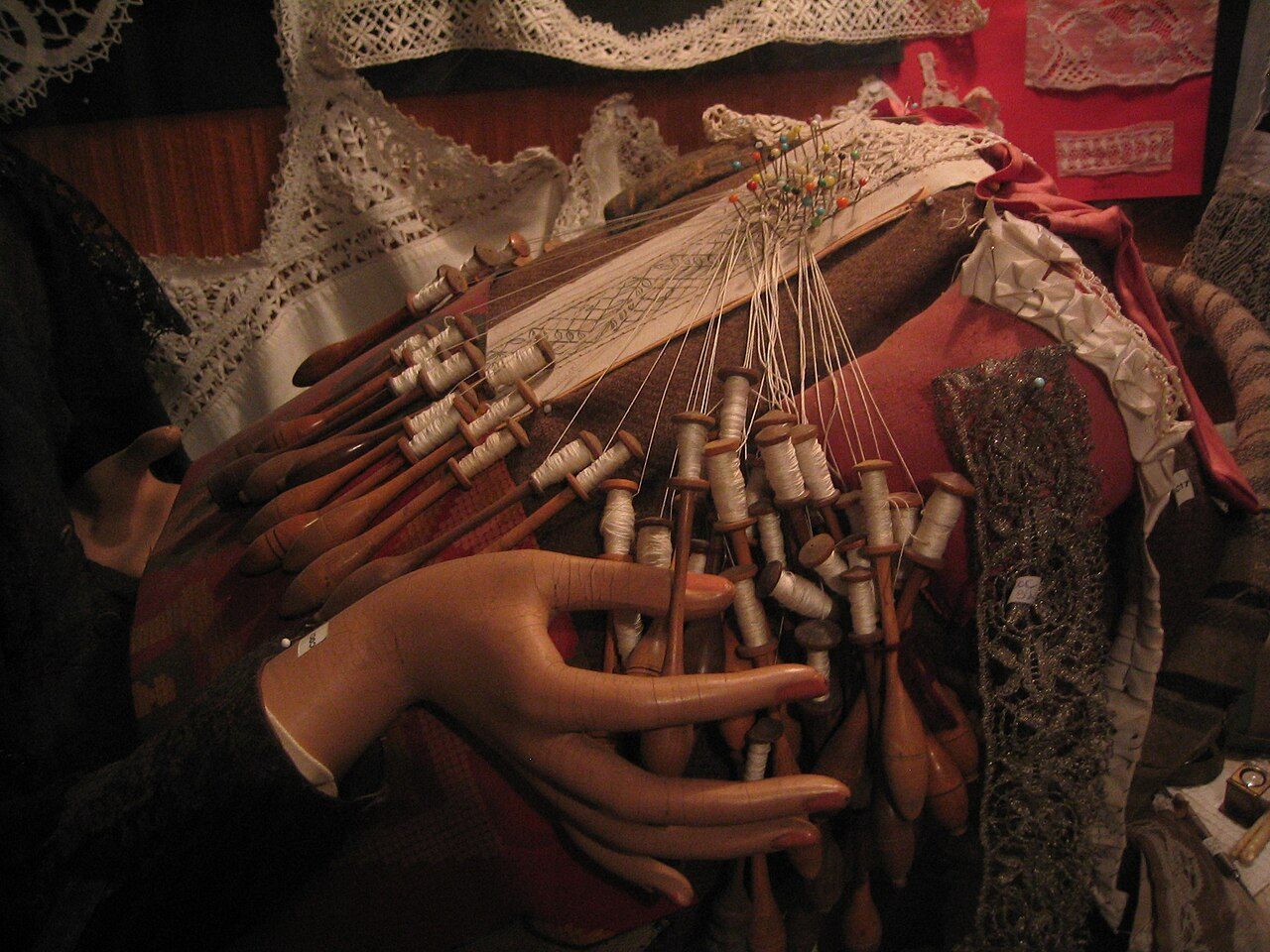
5 min read · 2 sourcesBobbin lace is a lace textile made by braiding and twisting lengths of thread, which are wound on bobbins to manage them. As the work progresses, the weaving is held in place with pins set in a lace pillow, the placement of the pins usually determined by a pattern or pricking pinned on the pillow. Bobbin lace is also known as pillow lace, because it was worked on a pillow, and bone lace, because early bobbins were made of bone or ivory. Bobbin lace is one of the two major categories of handmade laces, the other being needle lace, derived from earlier cutwork and reticella. 1
Origin
A will of 1493 by the Milanese Sforza family mentions lace created with twelve bobbins. There are two books that represent the earliest known pattern descriptions for bobbin lace, Le Pompe from Venice and Nüw Modelbuch from Zürich. Patterns from Nüw Modelbuch can be examined with commentary, working diagrams, and completed examples to understand the styles. Other popular lace pattern books were produced by Isabella Parasole, which included patterns for reticella, needle lace and bobbin lace designs. Other pattern books of this period include Cesare Vecellio and Bartolomeo Danieli. Bobbin lace evolved from passementerie or braid-making in 16th-century Italy. Genoa was famous for its braids, hence it is not surprising to find bobbin lace developed in the city. It traveled along with the Spanish troops through Europe. Coarse passements of gold and silver-wrapped threads or colored silks gradually became finer, and later bleached linen yarn was used to make both braids and edgings. The making of bobbin lace was easier to learn than the elaborate cutwork of the 16th century, and the tools and materials for making linen bobbin lace were inexpensive. There was a ready market for bobbin lace of all qualities, and women throughout Europe soon took up the craft which earned a better income than spinning, sewing, weaving or other home-based textile arts. 1
Structure
Sub-categories of bobbin lace based on structure include: mesh ground lace, guipure or braided lace, sectional lace, and tape lace. Mesh ground laces have a background of repeated, open stitches and motifs worked in more solid stitches. The mesh is called the ground or réseau. The solid sections are called the toilé. Sometimes a slightly thicker thread called a gimp or cordonnet is used to outline the toile. Guipure laces are made of intersecting plaits and often feature tallies and picots. Sectional lace is made up of motifs that are worked separately then joined into one piece. Tape lace is made up of thin woven strips that are shaped into a design then stitched in place with joining threads. 1
Traditional types
Many styles of lace were made in the heyday of lacemaking (approximately the 16th–18th centuries) before machine-made lace became available. Types of bobbin lace are usually named after the city they originated or were manufactured in. 1
Contemporary laces
The advent of machine-made lace at first pushed lace-makers into more complicated designs beyond the capabilities of early machines, then simpler designs so they could compete on price, and finally pushed them out of business almost entirely. The resurgence of lace-making is a recent phenomenon and is mostly done as a hobby. Lacemaking groups still meet in regions as varied as Devonshire, England and Orange County, California. In the European towns where lace was once a major industry or popular artisanry, especially in Belgium, England, Spain (Camariñas and Almagro), Portugal (Azores, Caminha, Lagos, Nisa, Olhão, Peniche, Póvoa de Varzim, Sesimbra, Setúbal, Silves, Viana do Castelo, Vila do Conde and Viseu (Farminhão), being known as Renda de Bilros), France and Slovenia lacemakers still demonstrate the craft and sell their wares, though their customer base has shifted from the wealthy nobility to the curious tourist. Still new types of lace are being developed such as the 3D Rosalibre and a colored version of Milanese lace by borrowing rolls from Duchesse lace to store various shades and colors. Other artists are giving grounds a major role by distorting and varying stitches, pin distances and thread sizes or colours. The variations are explored by experimentation and mathematics and algorithms. The lace maintaining its shape without stiffening is no longer a requirement. Inspiring journals, guilds and foundations show that old techniques with a new twist can challenge young people to create works that can definitely classify as art. A Dutch design graduate in 2006 discovered bobbin lace was a technique to make a fancy fence. The first fences became museum pieces. The fences are now produced in Bangalore by concrete rebar plaiters. 1
Tools
The major tools to make bobbin lace are a pillow, bobbins, pins and prickings. The part laces also require a crochet hook, very fine types of lace require very fine hooks. There are different types of pillows and bobbins linked to areas, eras and type of lace. 1
The text above is adapted from the Wikipedia article “Bobbin lace”, available under the Creative Commons Attribution-ShareAlike 4.0 licence. 1
bobbin lace making is craft of making lace using thread wound on bone or wooden bobbins, according to the structured record cited below. This entry was generated automatically from that record and has not yet been reviewed by a person familiar with the tradition. 2
The source record links this tradition to 9 external registers, which can be verified through the citation. 2