The tradition & historical record
5 min read · 2 sourcesBoitatá (from Tupi language), in Brazilian native folklore, refers to either a will-o'-the-wisp, a mythical fire snake which guards against humans setting fire to the fields or forests, or a bull-like creature. Snake-like will-o'-the-wisps also appear as "firedrake" in European folklore. 1
Nomenclature
Boitatá (var. baitatá, batatá) derives from Tupi-Guaraní: mba'e 'thing' or 'agent, cause' + taʼta/tatá 'fire', influenced by mbói 'snake, serpent'. It is called baitatá or batatá in South-Central Brazil; biatatá in Bahia; batatal in Minas Gerais; and biatatá in São Paulo state and batatão in the Northeast. It is also called Jean de la foice or Jean Delafosse ("John of the sickle") in the states of Sergipe and Alagoas and João Galafuz on Itamaracá. Thus the term Boitatá, like "João Galafoice" could be a synonym for Fogo-fátuo (will-o'-the-wisp). However, it could also refer to a mythical fire-serpent, the defender of fields, or forests. Alternatively, it is a mythical bull that shoots fire out of its nostrils. The term Boitatá is also used as papão, i.e., the Portuguese and Brazilian bogeyman to frighten children into obedience. 1
16th century attestation
In a letter dated 31 May 1560, Father José de Anchieta described the apparition as the baetatá (meaning "thing of fire" or "that which is entirely of fire"), dwelling at most times near sea and rivers, encountered especially on beaches. What appears to be a glimmering beam of light coursing towards its victim will attack the Indians, burning and killing them. Such fatality is likened to the handiwork of the curupira. Biologist Hitoshi Nomura comments that: "As that living fire moved while leaving a luminous trail, a sparkling beam came running towards, which the Jesuit noted inspired the image of the serpent's undulating motion". 1
General Description
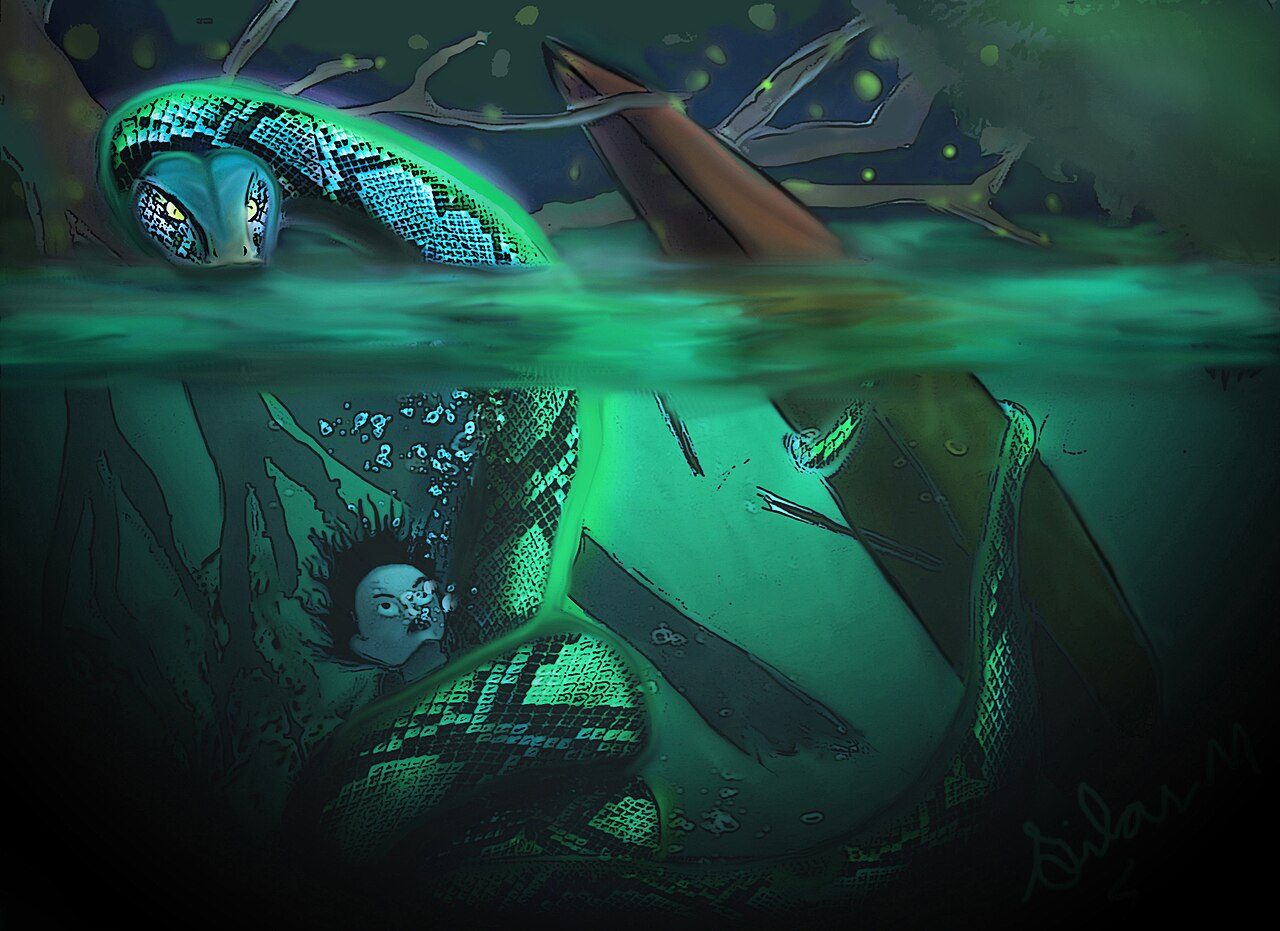
The fire snake Boitatá (Mboitatá), according to Magalhães (1876), is one of the being subjected under the moon goddess Jaci, the protectoress of all plants. Mboitátá is the spirit (genio) who guards the fields (campos) against those who sets them on fire (cf. controlled burn, slash-and-burn). The fire-snake sometimes transforms into a fiery log (called méuan) and burns the arsonist to death. The fire snake Boitatá is similar to the Cobra-Grande, both being terrifying serpents dwelling in or near water. It has been claimed that the legend of the fire-snake is actually localized in the state of Rio Grande do Sul, with its lore well-documented by writers such as Luiz Carlos Barbosa Lessa and João Simões Lopes Neto. In the Rio Grande do Sul, boitatá is regarded as the protectoress of the fields and forests, with many version introducing her as female a boitatá (where a is the feminine definite article). Lopes Neto in Lendas do Sul (first published 1913) describes the Boitatá as "sometimes like a black snake, sometimes like a big snake, with bright eyes like two beacons". From the Rio Grande do Sul region, an indigenous legend (given by Lopes Neto) tells of a period of endless nights in the forests. Not only did darkness fall, but torrential rains caused great floods. The frightened beasts sought higher elevation for safe haven. A mythological anaconda (boiguaçu) that lived in a dark cave was awakened by the flood, and with the advantage of seeing in the dark, prowled for food. It decided to feast solely on its favorite delicacy: the eyes of other animals. After gorging on the eyes, which lit up inside its body, it turned luminous in its entirety as its body became "clusters of sparkling pupils, a ball of flames, a bright flash, a boitatá, a fire snake". 1
Santa Catarina bull creature
The boitáta of Santa Catarina, described by journalist and writer Crispim Mira, inferred to be in the form of a bull, is "as large as a bull, with paws like those of giants and with an enormous eye right in the middle of his forehead, shining like a firebrand. No one knows its lair, or what it feeds on. In truth, it fares out to sea like a seahorse, or sometimes flies over trees like some fantastic infernal bird". As pointed out by Amadeu Amaral (d. 1929, published 1948), the Tupi stem mbói for "snake" was easily confused with Portuguese boi for "ox", hence the shift in the lore from the indigenous original. The artwork of local folklorist Franklin Cascaes has created some 30 pieces of iconography on the boitáta theme, with examples featuring a horned bovine head, body of a bull or cow, as well as wings and bipedalism (standing erect on two legs). 1
Modern retellings
In Manuel Filho's children's story Quem Tem Medo do Boitatá? ("Who's Afraid of the Boitatá?", 2007) the protagonist's grandfather Sandrinho is blinded by the Boitatá itself. José Santos's O casamento do Boitatá com a Mula-sem-cabeça ("The Wedding of the Boitatá with the Headless Mule", 2007) combines several beings from Brazilian folklore, like the Headless Mule (Mula sem cabeça). Marco Haurélio's A lenda do Batatão ("The Legend of Batatão", 2012) written in sextilha strophes, features a "Batatão" which preserves the fiery characteristic of the boitatá, but is similar to the tormented soul. In Alexandra Pericão's anthology Uaná and other legends (2011), the snake, also an eye-eater, is described in very contemporary fashion, with amusing quotes, such as "no one... has managed to put a photo of it on the internet. Despite its gigantic size, the snake is so discreet that only those it captures can see it". 1
The text above is adapted from the Wikipedia article “Boitatá”, available under the Creative Commons Attribution-ShareAlike 4.0 licence. 1
Boitatá is mythical beast from Brazil, according to the structured record cited below. This entry was generated automatically from that record and has not yet been reviewed by a person familiar with the tradition. 2
The source record links this tradition to 1 external register, which can be verified through the citation. 2