The tradition & historical record
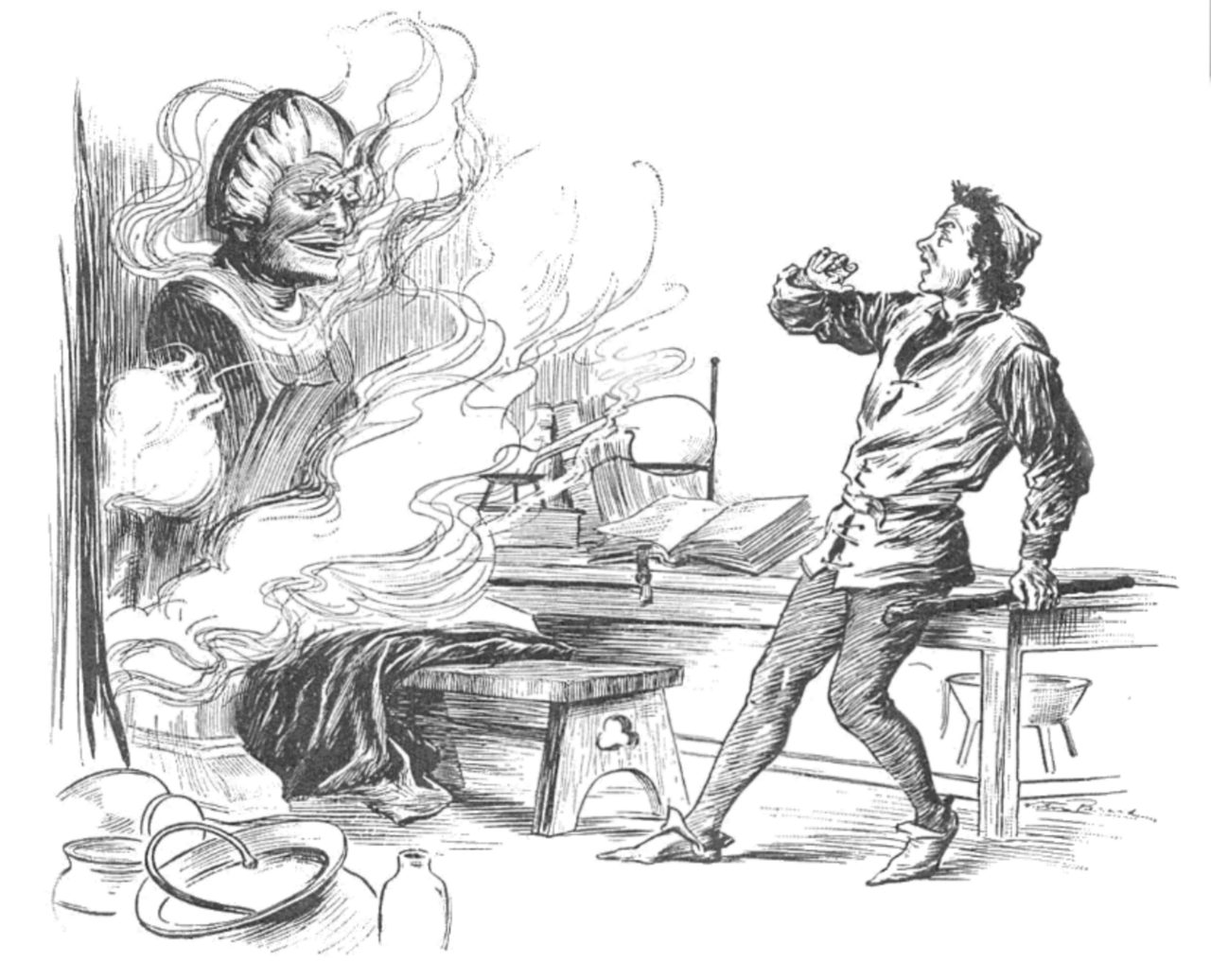
5 min read · 2 sourcesA brazen head, brass, or bronze head was a legendary automaton in the Middle Ages to the early modern period whose ownership was ascribed to late medieval scholars, such as Roger Bacon, who had developed a reputation as wizards. Made of brass or bronze, the male head was variously mechanical or magical. Like Odin's head of Mimir in Norse paganism, it was reputed to be able to correctly answer any question put to it, although it was sometimes restricted to "yes" or "no" answers. In the seventeenth century, Thomas Browne considered them to be misunderstanding of the scholars' alchemical work, while in modern times, Borlik argues that they came to serve as "a metonymy for the hubris of Renaissance intellectuals and artists". Idries Shah devotes a chapter of his book The Sufis to providing an interpretation of this "head of wisdom" as well as the phrase making a head, stating that at its source the head "is none other than the symbol of the [Sufic] completed man." 1
Legend
Chaucer's "The Squire's Tale" depicts a moving brazen horse among the gifts from an Arab and an Indian king to Cambuscan, and compares it to the Trojan horse. It is likely that these accounts had their origin in allegorical treatments of alchemy and in early machines whose owners pretended to have given them life or speech. They may also have found inspiration in the Greek legends concerning Talos, the brass guardian of Minoan Crete. The first account of a talking head used to give its owner answers to his questions appears in William of Malmesbury's c. 1125 History of the English Kings, in a passage where he collects various rumors surrounding the polymath Pope Sylvester II, who was said to have traveled to al-Andalus and stolen a tome of secret knowledge, whose owner he was only able to escape through demonic assistance. He was said to have cast the head of a statue using his knowledge of astrology. It would not speak until spoken to, but then answered any yes/no question put to it. The Roman poet Virgil, in his medieval role as a sorcerer, was credited with creating his own oracular head in Gautier de Metz's c. 1245 Image of the World (French: Image du Monde). The 1319 Reynard the Fox (Renard le Contrefait) retold the story and may have been the first to specify that the head was made of brass. The heads were then ascribed to several of the major figures of the 12th- and 13th-century Renaissance, who introduced Europe to Arabian editions of Aristotelian logic and science, as well as the Muslims' own work on mathematics, optics, and astronomy. These included Robert Grosseteste, Albertus Magnus, and—most famously—Roger Bacon. Grosseteste was said to have constructed "an hed of bras to... 1
History
Hero of Alexandria wrote two books, the Pneumatica and Automata, about devices powered by steam, water, or air. These books were known to medieval Islamic science, and reappeared in Europe during the 12th- and 13th-century Renaissance. The talking "Skull of Balsamo" was a mechanical illusion of the Viennese magician Joseffy. The skull was made of painted copper inset with real human teeth, answering questions by turning or clicking its lower jaw. 1
Literature
Robert Greene's c. 1590 treatment of Bacon's brazen head, the play Friar Bacon and Friar Bungay, was one of the most successful Elizabethan comedies. Miguel de Cervantes's 1605 Don Quixote lampoons the idea with Don Antonio Moreno's brazen head, created for him by a Polish pupil of "Escotillo"; it is later revealed to be fake. Daniel Defoe's 1722 Journal of the Plague Year, set in London's 1665 plague, states that Bacon's brazen head was the usual sign over the establishments of fortune tellers. Lord Byron references Bacon's brazen head in Don Juan Canto I, stanza CCXVII (1818). Nathaniel Hawthorne referenced both Bacon's brazen head and Albertus Magnus's man of brass in his 1843 "The Birth-Mark" and 1844 "The Artist of the Beautiful". William Douglas O'Connor's 1891 "The Brazen Android" features Bacon attempting to use a steam-powered brazen head to terrify King Henry into meeting Simon de Montfort's demands for greater democracy, although he repents after his prototype explodes. James Baldwin's 1905 Thirty More Famous Stories Retold reset the story of "Friar Bacon and the Brazen Head" as a children's story. John Masefield's 1935 The Box of Delights includes a bronze head among its characters. In C.S. Lewis's 1945 novel That Hideous Strength, the preserved head of a guillotined murderer is used by the villains as a medium of communication with demons. John Cowper Powys's 1956 The Brazen Head centres around Bacon and his eponymous head. Philip K. 1
Television
In Da Vinci's Demons, Leonardo discovers a brazen head in the Andes which functions as an ornate phonograph. 1
Video games
In The Savage Empire, the first Worlds of Ultima game, a brass head can be found and eventually reunited with its bejeweled body, creating a golem-like automaton that joins the player's party. A metal head, referred to as "the Hidden Knowledge", appears in Atlantis: The Lost Tales, described as being able to answer all questions. This head, however, appears to be made of steel or silver, rather than brass. 1
The text above is adapted from the Wikipedia article “Brazen head”, available under the Creative Commons Attribution-ShareAlike 4.0 licence. 1
Brazen Head is legendary automaton in the early modern period, according to the structured record cited below. This entry was generated automatically from that record and has not yet been reviewed by a person familiar with the tradition. 2
The source record links this tradition to 1 external register, which can be verified through the citation. 2