The tradition & historical record
4 min read · 2 sourcesBunbuku Chagama (分福茶釜 or 文福茶釜) , literally "Bunbuku tea-kettle", is a Japanese folktale or fairy tale about a tanuki (raccoon dog), that uses its shapeshifting powers to reward its rescuer for his kindness. 1
Overview
The fairy tale version has been translated into English as "The Accomplished and Lucky Teakettle" (1871) by Mitford and as "The Wonderful Tea Kettle" (1886) in the crepe-paper book series published by T. Hasegawa. The raccoon dog is ill-treated as a tea-kettle at a temple and sold off; it later performs a dance and tightrope walking routine, and the subsequent owner turned showman acquires great wealth. In most folk tale versions, the raccoon dog or fox transforms into a kettle so that its human friend or benefactor can make profit by selling the fake kettle, typically to a priest. In legend, Bunbuku chagama is the name of a tea kettle owned by priest Shukaku who turned out to be an ancient raccoon dog or mujina, the supposed kettle still on view at Morin-ji temple which Shukaku served. 1
Etymology
One suggested hypothesis is that bunbuku is an onomatopeic word mimicking the sound of boiling water, while the character buku (fuku) in the name denotes "good luck" or "good fortune". A second explanation is that bunbuku when written as 分福 means "sharing (bun) the wealth/fortune/luck (fuku)". This is according to the origin tale (engi) surrounding Morin-ji, and the essay Kasshi yawa. Yet another theory claims that the correct name is Bunbuka (文武火), with bunka signifying a mild flame and buka signifying an intense flame. This explanation is given, for example, by Toriyama Sekien. 1
Fairy tale
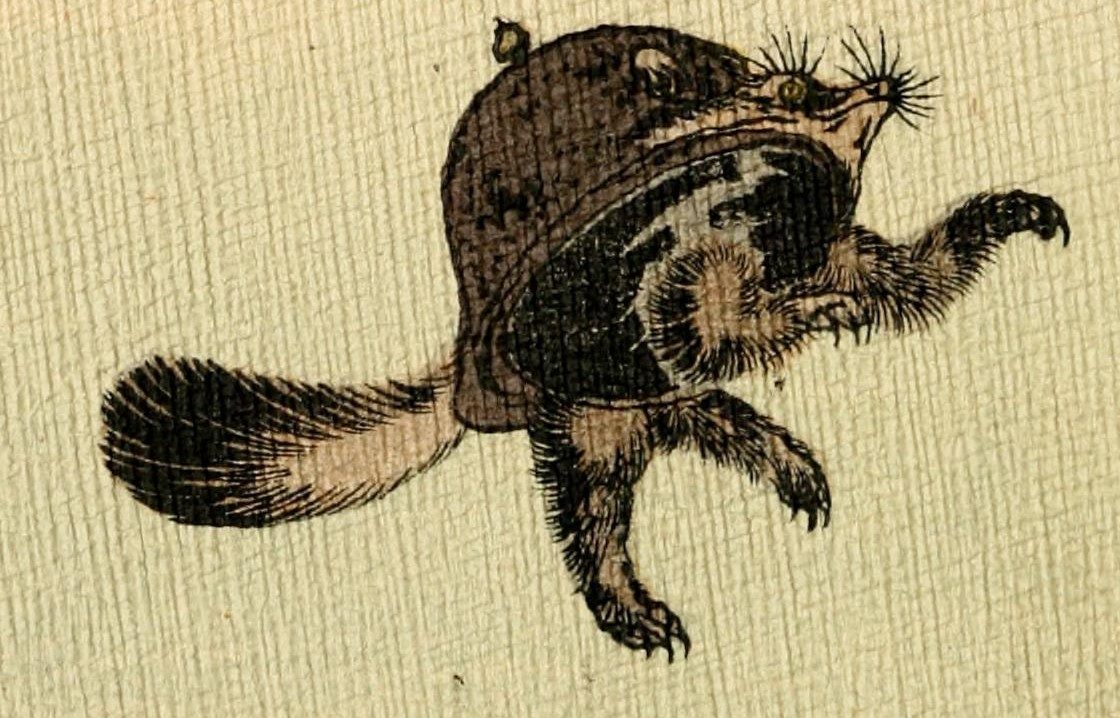
The following summary is based on three early English translations of the fairy tale version. At a temple called Morin-ji in Kōzuke Province (now Gunma Prefecture), the master priest (abbot) owns a chagama (tea kettle). When the priest sets the kettle on a hearth, the kettle sprouts a head and a tail (or legs as well), and turns into a half-badger, half tea-kettle creature. What is loosely translated as a "badger" here is strictly speaking a tanuki or raccoon dog. The priest and his novices subdue it, and since it reverts to the form of an ordinary kettle, they sell it to a traveling tinker or rag-peddler. The kettle reveals its half-tanuki form to the peddler, and the merchant acts on a friend's advice to command the beast to perform tricks, or, is persuaded by the tanuki itself, which bargains to perform acrobatics in exchange for being well-treated. The peddler agrees to neither put it over hot flame nor stow it away in a stuffy box, and share what food he has. The man sets up a circus-like roadside attraction and charges admission for people to see the tea-kettle badger walking a tightrope to the tune of music. The man becomes wealthy, and returns the kettle to Morin-ji temple. 1
Translations
A. B. Mitford published a version of it entitled "The Accomplished and Lucky Teakettle" in Tales of Old Japan (1871), illustrated by woodcuts from drawings by the artist "Ôdaké". A similar (slightly more elaborate) plot is found in "The Wonderful Tea Kettle" (June 1886), the retelling by Mrs. T. H. James (Kate James), published by Hasegawa Takejirō as Japanese Fairy Tale Series No. 16 (these books are classed in the chirimen-bon or "crepe-paper books" genre). The artist, who was not credited in print, has been identified as Yoshimune Arai (新井芳宗) from the signature on the cover art. Also of similar plot is the Japanese version retold by Iwaya Sazanami, also published in English as "The Tea-Kettle of Good-Luck" in the anthology Iwaya's Fairy Tales of Old Japan (1903) translated by Hannah Riddell. Iwaya's version that appeared in Nihon Otogibanashi is said to have established enduring recognition of the tale in Japan. The tale has also been referred to as "The Lucky Tea-Kettle" by Basil Hall Chamberlain, under a handbook entry for "Fairy tales". 1
Folktale
The tale group "Bunbuku chagama (Bunbuku Tea-kettle)" has been categorized as Types of Japanese Folktales No. 130 by Keigo Seki. Seki here treats the tale group as one involving the fox, and summarizes as follows: 1
The dancing raccoon dog, which is a familiar motif in the fairy tale, is comparatively rare among folk tales. 1
The text above is adapted from the Wikipedia article “Bunbuku Chagama”, available under the Creative Commons Attribution-ShareAlike 4.0 licence. 1
Bunbuku Chagama is Japanese folk tale, according to the structured record cited below. This entry was generated automatically from that record and has not yet been reviewed by a person familiar with the tradition. 2
The source record links this tradition to 3 external registers, which can be verified through the citation. 2