The tradition & historical record
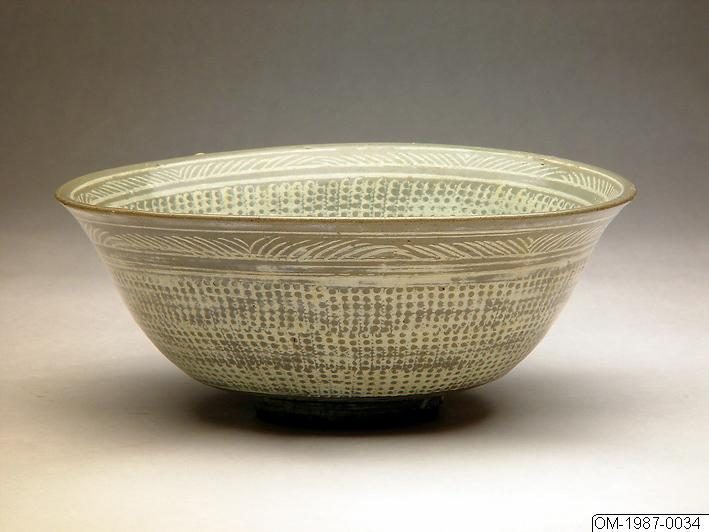
4 min read · 2 sourcesBuncheong (Korean: 분청), or punch'ong, ware is a traditional form of Korean stoneware, with a blue-green tone. Pieces are coated with white slip (ceramics), and decorative designs are added using a variety of techniques. This style originated in the 15th century and continues in a revived form today. 1
History
Buncheong is a contemporary term for a specific type of traditional Korean stoneware that developed in the 15th century, during the Joseon period, as Goryeo celadon techniques and subject matter evolved. Buncheong ware developed from the earlier Goryeo celadon inlay technique called sanggam and rapidly distinguished itself. In contrast to the refined elegance of Goryeo celadon, buncheong is designed to be natural, unassuming, and practical. This style is characterized by its pale blue-green color and decorative techniques, which involved shaping the clay and then covering it in white slip (ceramics) and decorating it by carving, stamping, and brushwork. Buncheong style initially lasted for a little over a century in Korea. In its heyday, buncheong ware pieces were exported to Japan by practitioners of the Japanese tea ceremony. The Japanese invasions in the 1590s caused extensive economic devastation to Joseon-era Korea, including the development of the ceramic industry. Hundreds of Korean ceramic artisans were killed or abducted, and taught the Japanese to produce their own porcelain, causing the simplification and decline of native Korean ceramics. It all but disappeared from Korea after the 16th century, partially due to the popularity of Joseon white porcelain. While the production of buncheong ware in Korea declined and was outpaced by porcelain, stoneware featuring buncheong-derived aesthetic elements continued to be produced in Japan, where it became known as Mishima pottery, simultaneously with porcelain. In Japan the two were seen as separate forms of expression, neither substituting for the other. Buncheong style continued to be used in Japan as tea ceremony ware, but only experienced a revival in Korea in the 20th century. 1
Characteristics
Buncheong is characterized by the use of dark, iron-bearing clay covered in white slip and a clear glaze. Various methods can be used to apply decoration and pigment on the slip or draw through the slip to reveal the dark clay beneath it. Buncheong is distinct from other forms of Korean ceramic ware, such as Goryeo celadon and Joseon white porcelain, in various ways which are more related to aesthetics and underlying sentimentality than to technique. Its unconventional beauty is easily distinguished from the elegance of its celadon precursor and the simplicity of white porcelain, setting it apart as a uniquely Korean style. Korean ceramics generally featured only one primary pigment and favored more subtle expression than those found in China and Japan, and the subject matter and composition of buncheong was more whimsical and lyrical, reminiscent of modern abstract works, with free-spirited decorative motifs. These motifs were originally derived from Goryeo era celadon but changed dramatically as buncheong ware developed throughout the 15th and 16th centuries. Flowers, such as peonies, chrysanthemums, and lotuses, as well as animals, both real and imagined, were important design elements and motifs in buncheong ware, as they were important symbols related to belief systems such as Confucianism. Buncheong incorporated carving and stamping as decorative elements, slip inlay, sgraffito, brushwork, iron painting, and later brushing and sipping pieces in white slip. 1
Gallery by techniques
There are six main techniques in buncheong ware: guiyal, inhwa, bakji, eumgak, cheolhwa and damgeum. 1
The text above is adapted from the Wikipedia article “Buncheong”, available under the Creative Commons Attribution-ShareAlike 4.0 licence. 1
Buncheong is Korean ceramics from the Joseon dynasty, according to the structured record cited below. This entry was generated automatically from that record and has not yet been reviewed by a person familiar with the tradition. 2
The source record links this tradition to 3 external registers, which can be verified through the citation. 2