The tradition & historical record
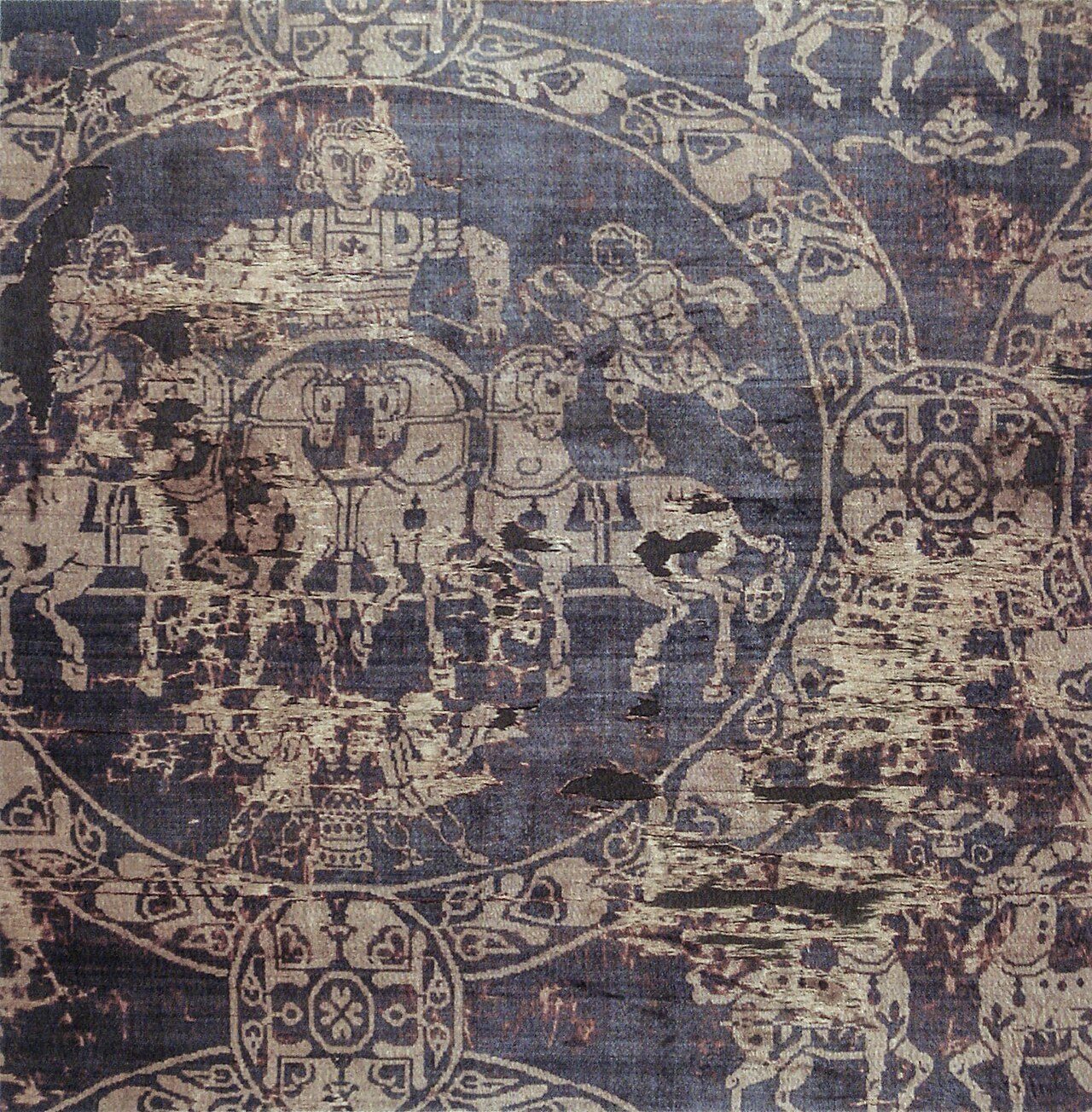
6 min read · 2 sourcesByzantine silk is silk woven in the Byzantine Empire (Byzantium) from about the fourth century until the Fall of Constantinople in 1453. The Byzantine capital of Constantinople was the first significant silk-weaving center in Europe. Silk was one of the most important commodities in the Byzantine economy, used by the state both as a means of payment and of diplomacy. Raw silk was bought from China and made up into fine fabrics that commanded high prices throughout the world. Later, silkworms were smuggled into the Empire and the overland silk trade gradually became less important. After the reign of Justinian I, the manufacture and sale of silk became an imperial monopoly, only processed in imperial factories, and sold to authorized buyers. Byzantine silks are significant for their brilliant colours, use of gold thread, and intricate designs that approach the pictorial complexity of embroidery in loom-woven fabric. Byzantium dominated silk production in Europe throughout the Early Middle Ages, until the establishment of the Italian silk-weaving industry in the 12th century and the conquest and break-up of the Byzantine Empire in the Fourth Crusade (1204). 1
Development
In the time of the Roman Empire, silk textiles reached the West overland via the Silk Road across Asia from Han China, passing through the Parthian Empire and later Sassanid Empire to trading centers in Syria. Imports of raw silk, silk yarn, and finished fabrics are all recorded, but the techniques of producing these textiles from the silkworm Bombyx mori remained a closely guarded secret of the Chinese until the Emperor of the East Justinian I (482–565) arranged to have silkworm eggs smuggled out of Central Asia in 553–54, setting the stage for the flowering of the Byzantine silk-weaving industry. The trade of the silk caterpillars and cocoons started off with households having an industry within their homes for silk making. The households tended to be on the outskirts of a town or in rural areas. The capital is where the main production of silk goods was done, and so the silk materials would have to be transported via land or sea and given from merchant to merchant in order to make it to the capital to be made into goods. However, this method was risky economically, as there were many factors that people had to consider in order to proceed. The mode of transportation, capacity utilization, the distance needing to be traveled, charges for carrying silk cocoons, and the quality expectations were all variables in the economic feasibility of silk and its production. New types of looms and weaving techniques also played a part. Plain-woven or tabby silks had circulated in the Roman world, and patterned damask silks in increasingly complex geometric designs appear from the mid-3rd century. Weft-faced compound twills were developed not later than 600, and polychrome (multicolored) compound twills became the standard weave for Byzantine silks for the next several centuries. 1
Political alliances
Silk diplomacy was also utilized to maintain political and trade diplomatic relationships with other nations, especially in Southern and Eastern Europe. Regions in the Latin West like Venice, Genoa, Pisa, and Amalfi would have silk utilized as a diplomatic gift and reward. In one particular instance, Venice protected the Byzantines from the Normans and the Crusaders and were rewarded with gold and silk for their efforts. Marriages would also be used to create political alliances, and silk was used to help arrange marriages. These were done by promising silk dispensaries as well, and were done with the Latin West a lot. One famous case was Emperor Constantine V marrying his eldest son Leo to Gisela, the daughter of the Latin ruler Pepin. This was done to help with negotiations with the betrothal in 765, and mosaic hunter silk was thrown in to improve the deal. A lot of information on the exchange of silk prior to the eleventh century was found in the Vita Basilii, which written during the reign of Constantine VII. Silk producers would send gifts on behalf of their governments as a sign of peace. One silk producer was a slave named Danelina, who sent gifts to Emperor Basil I in 880. Among these gifts were 100 female weavers and precious textiles. 1
China
Shortly after the smuggling of silkworm eggs from China by Nestorian Christian monks, the 6th-century Byzantine historian Menander Protector writes of how the Sogdians attempted to establish a direct trade of Chinese silk with the Byzantine Empire. After forming an alliance with the Sasanian ruler Khosrow I to defeat the Hephthalite Empire, Istämi, the Göktürk ruler of the Turkic Khaganate, was approached by Sogdian merchants requesting permission to seek an audience with the Sassanid king of kings for the privilege of traveling through Persian territories in order to trade with the Byzantines. Istämi refused the first request, but when he sanctioned the second one and had the Sogdian embassy sent to the Sassanid king, the latter had the members of the embassy poisoned to death. Maniah, a Sogdian diplomat, convinced Istämi to send an embassy directly to Constantinople, which arrived in 568 and offered not only silk as a gift to Byzantine ruler Justin II, but also proposed an alliance against Sassanid Persia. Justin II agreed and sent an embassy to the Turkic Khaganate, ensuring the direct silk trade desired by the Sogdians. However, even with the Byzantine production of silk starting in the 6th century, Chinese varieties were still considered of better quality, a fact that is perhaps underscored by the discovery of a Byzantine solidus coin minted during the reign of Justin II found in a Sui dynasty (581–618 AD) Chinese tomb of Shaanxi province in 1953, among other Byzantine coins found at various sites. According to Chinese histories, the Byzantines (i.e. 1
Constantinople
Being the capital for the Byzantine Empire meant that much diplomacy was done and centered around Constantinople. Foreign dignitaries would stay within the city, and silk would be used to show gratitude towards other nations. For instance, when Emperor Manuel I was victorious over the Hungarians and Serbs in battle, he had numerous silk items on display in Constantinople and to be adorned by high ranking officials. This was shown off to the captured Hungarians and Serbs, who were also made to feel the silk. This was done to showcase the Byzantine's superiority over the defeated nations in the Byzantine's eyes. 1
Arab regions
Silk was used to perform trade and military treaties with Arabic regions and started at some point before the eleventh century. The Byzantines admired Arab silk textures and patterns greatly, and would try to have silk producers replicate them within the empire. Silk allowed for a cross-cultural exchange between Arabic Regions and the Byzantine Empire. Silk has also been mentioned in military treaties, such as in a peace treaty in 968 between Muslim governor of Aleppo, Qarghawaih (modern day Syria), and Emperor Nikephoros II. 1
The text above is adapted from the Wikipedia article “Byzantine silk”, available under the Creative Commons Attribution-ShareAlike 4.0 licence. 1
Byzantine silk is silk woven in or distributed via the Byzantine Empire, according to the structured record cited below. This entry was generated automatically from that record and has not yet been reviewed by a person familiar with the tradition. 2
The source record links this tradition to 1 external register, which can be verified through the citation. 2