The tradition & historical record
6 min read · 2 sourcesThe history of Cambodian art (Khmer: សិល្បៈខ្មែរ) stretches back centuries to ancient times, with the most widely recognized period being the art of the Khmer Empire (802–1431), especially in the area around Angkor and the 12th-century temple-complex of Angkor Wat, initially Hindu and subsequently Buddhist. After the collapse of the empire, these and other sites were abandoned and overgrown, allowing much of the era's stone carving and architecture to survive to the present day. Traditional Cambodian arts and crafts include textiles, non-textile weaving, silversmithing, stone carving, lacquerware, ceramics, wat murals, and kite-making. Beginning in the mid-20th century, a tradition of modern art began in Cambodia, though in the later 20th century both traditional and modern arts declined for several reasons, including the killing of artists by the Khmer Rouge. The country has experienced a recent artistic revival due to increased support from governments, NGOs, and foreign tourists. In pre-colonial Cambodia, art and crafts were generally produced either by rural non-specialists for practical use or by skilled artists producing works for the Royal Palace. In modern Cambodia, many artistic traditions entered a period of decline or even ceased to be practiced, but the country has experienced a recent artistic revival as the tourist market has increased and governments and NGOs have contributed to the preservation of Cambodian culture. 1
Stone carving
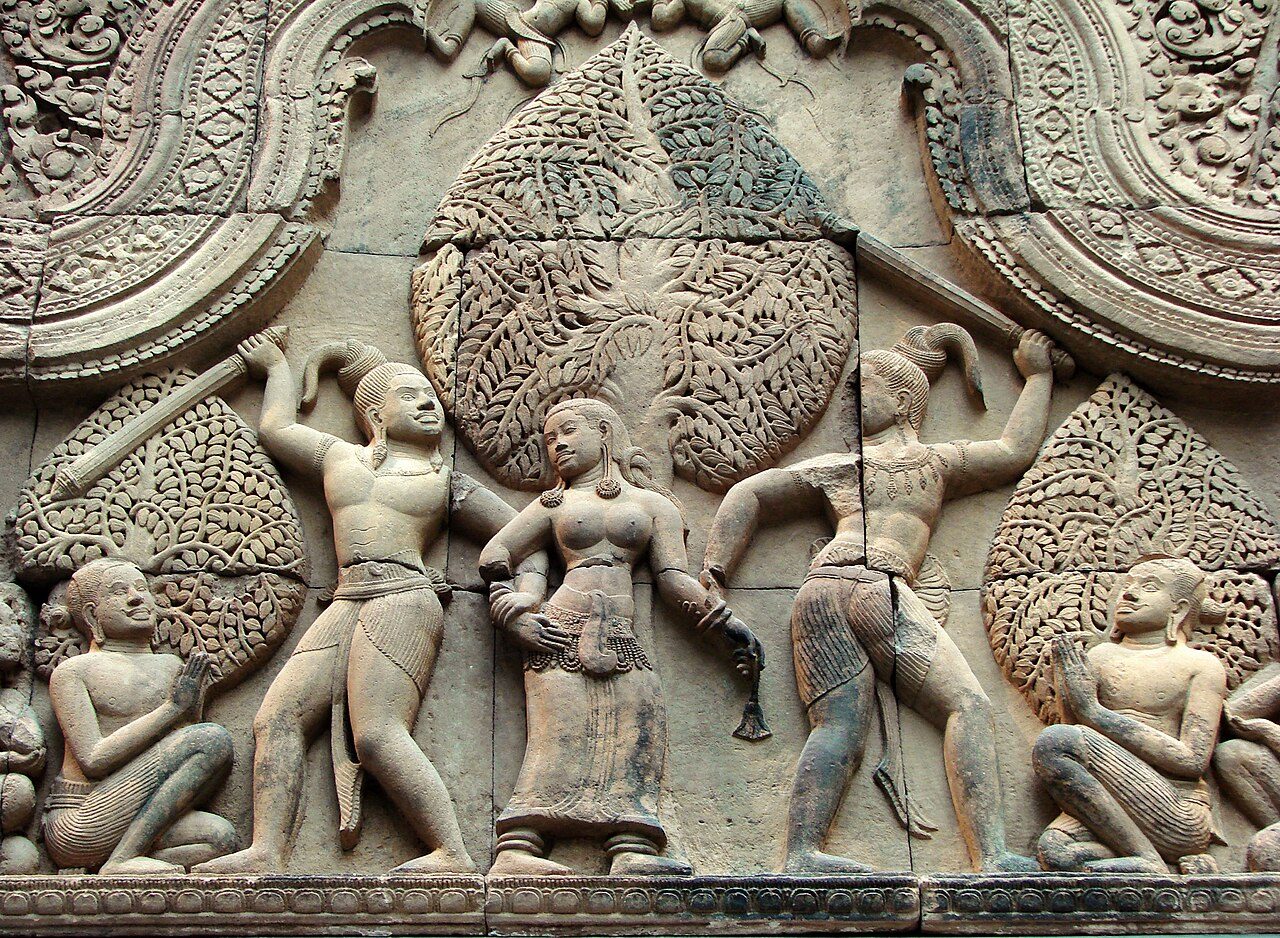
Cambodia's best-known stone carving adorns the temples of Angkor, which are "renowned for the scale, richness and detail of their sculpture". In modern times, however, the art of stone carving became rare, largely because older sculptures survived undamaged for centuries (eliminating the need for replacements) and because of the use of cement molds for modern temple architecture. By the 1970s and 1980s, the craft of stone carving was nearly lost. During the late 20th century, however, efforts to restore Angkor resulted in a new demand for skilled stone carvers to replace missing or damaged pieces, and a new tradition of stone carving is arising to meet this need. Most modern carving is traditional-style, but some carvers are experimenting with contemporary designs. Interest is also renewing for using stone carving in modern wats. Modern carvings are typically made from Banteay Meanchey sandstone, though stone from Pursat and Kompong Thom is also used. 1
Metal sculpture
Burial sites in Cambodia have uncovered metallic items such as bells and jewelry, and excavations have revealed not only weapons, bowls, and jewelry but tools for metalworking, like crucibles and molds. The Old Khmer word for bronze is samrit and experts believe there was significant metal production in historic Cambodia. The skill of metalworking was seen as a divine gift by ancient Khmers. Both Hindu and Buddhist Khmer bronzes, the oldest bearing Indian styles, appear in the 600sAD Chenla period, before Angkor. During the Angkorian period of the Khmer Empire (800s-1400s CE), the "sacred" skill of metalworking was tied to Khmer rulers who viewed themselves as god kings. Inscriptions tell us Khmer royals and elites commissioned bronze sculptures from skilled artists. A royal foundry for bronze art and item creations, and whose activity peaked in the 11th century, was unearthed at Angkor Thom by archaeologists in 2012, north of where the capital's Royal Palace would have been. Larger bronze sculpture were associated with the kings and their power and housed in temples for worshippers, whereas mid-size bronzes were created for rituals and processions. Small figures in the homes of believers could be offered to temples. Bronzes bore intricate, careful details regardless of size. The Buddha sheltered by a naga became a popular image during the Angkor era as it's associated with the divine and protection. Lists uncovered from this period revealed the weight, material, and features of items belonging to temples, including those of copper, gold, and silver. Representations of Lokeshvara and Prajnaparamita, as well as the Buddha seated on a naga, were popular with Khmer artists. Shiva in multiple forms was represented by bronze sculptors during the Angkor era as well. 1
Wood carving
As wood is a perishable material, few wooden sculptures survived the Angkor era and those that did were crafted in Angkor’s latest years. As Theravada Buddhism became the dominant religion, the practice of stone-carving faded and wood became the material of choice for Khmer sculpture. Historically, Cambodians have crafted from wood apsaras, Buddha sculptures, religious stories, and more to decorate temples, pagodas, and even houses. In the post-Angkorian era, artists would apply lacquer to wooden sculpture for decorative and protective purposes, as well as inlay mother of pearl, ivory, and vitrified lead as ornamental features for wooden sculpture. Post-Angkor Khmer wood-carving is usually styled in the elemental themes of earth, air, wind, and water. The meaningful, valuable practice of Khmer wood working survives in the living, breathing intricate wood work of Khmer artists today. 1
Murals
The most ancient mural paintings of any kind in Cambodia attributed to the 10th-11th century, are those of Prasat Neang Khmau, located south of Kor Ker, depicting scenes with Hindu themes. However, little remains of them today. The earliest epigraphic evidence of painted scrolls appears inscription K. 285 dated to 1593 in Phnom Bakeng. The oldest documented Buddhist paintings are dated to 1877, consist of 14 small paintings (1 x 1.20 m), on cloth, illustrating episodes of the Vessantara Jataka. As in most Buddhist societies, stories from the lives of the Buddha are a common source of inspiration for the majority of paintings. Because of destruction during recent war, few historic wat murals remain in Cambodia. In the 1960s, art historians Guy and Jacqueline Nafilyan photographed 19th-century murals, providing a record of this lost cultural heritage. The best known surviving murals are at the Silver Pagoda in Phnom Penh, Wat Rajabo in Siem Reap province, and Wat Kompong Tralach Leu in Kompong Chhnang Province. In the last decade, wat murals have seen a resurgence. 1
Banners / Scrolls
Preah Bot (Khmer: ព្រះបត), often called painted banners or scrolls, are paintings of Buddhist images on cloth incorporating a sewn tube at the top and base for inserting a wooden pole to hang the painting the keep it flat. The making of a preah bot is imbedded in the concept of merit-making through the production of a modest representation of devotion and the spreading of Buddhism. In 1899, Adhémard Leclère, a French scholar-administrator, wrote that painted scrolls were hung in monasteries and terraces to share the Dharma. They are usually painted on cotton or silk. However, some old preah bot can also be found painted on roughly woven cloth. The centers of their production have historically been Phnom Penh and Battambang, followed by Siem Reap. 1
The text above is adapted from the Wikipedia article “Cambodian art”, available under the Creative Commons Attribution-ShareAlike 4.0 licence. 1
Cambodian art is art from Cambodia, according to the structured record cited below. This entry was generated automatically from that record and has not yet been reviewed by a person familiar with the tradition. 2
The source record links this tradition to 4 external registers, which can be verified through the citation. 2