The tradition & historical record
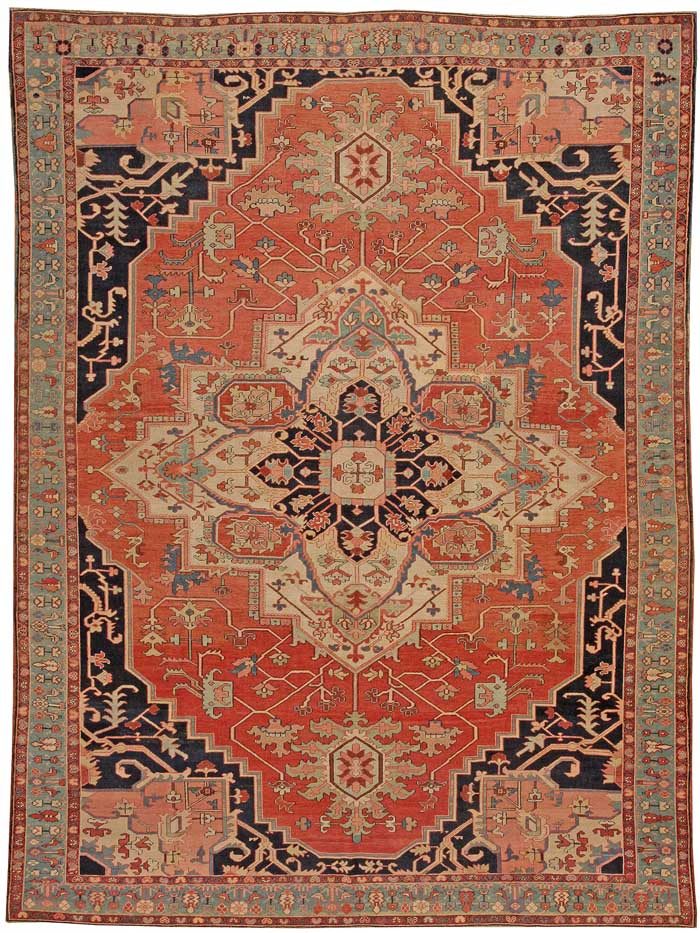
6 min read · 2 sourcesA carpet or rug is a floor covering made with textile that typically consists of an upper layer of pile attached to a backing. In Europe, the pile was traditionally made of wool, but since the 20th century, synthetic fibres such as polypropylene, nylon, and polyester have been used as less expensive alternatives. The pile often consists of twisted tufts that are heat-treated to maintain their structure. The terms carpet and rug are often used interchangeably, although rugs are generally smaller and loose-laid. Since the 19th century, there has been a trend toward the production of fitted carpets, including wall-to-wall carpeting that is fixed in place. Carpet flooring provides cushioning for sitting and kneeling. Carpets also provide better sound and heat insulation than tile or stone flooring. They are versatile and are often decorated with patterns and motifs. Due to technological developments, inexpensive mass-produced synthetic carpets are widely available, alongside more costly hand-knotted wool rugs. Carpets can be produced through various methods, including weaving, needle felting, hand-knotting (as seen in oriental rugs), tufting (where pile is inserted into a backing material), flat weaving, hooking (by pulling wool or cotton through the meshes of a sturdy fabric), and embroidery. Carpets are commonly manufactured in widths of 12 or 15 feet (3.7 or 4.6 m) in the United States and 4 or 5 m (13 or 16 ft) in Europe. 1
Etymology and usage
According to the Online Etymology Dictionary the term carpet was first used in English in the late 13th century, with the meaning 'coarse cloth', and by the mid-14th century, "tablecloth, or bedspread". The word comes from Old French carpite 'heavy decorated cloth, carpet', from Medieval Latin or Old Italian carpita 'thick woolen cloth', which may derive from Latin carpere, meaning 'to card, pluck'. The Latin word "carpet" was introduced in the 13th century by the Florentines from the Middle Armenian word կարպետ (carpet). The meaning of the term carpet shifted in the 15th century to refer to floor coverings. The terms carpet and rug are often interchangeable. Carpet more often refers to wall-to-wall carpet that is fastened to the floor and cut to fit a specific room, or smaller than an entire room, but of high quality with finished ends. Rugs or mats are usually loose-laid and free-floating floor coverings smaller than an entire room, and may be of lower quality and smaller size. Historically, the term carpet was also applied to table and wall coverings, as carpets were not commonly used on the floor in European interiors until the 15th century. The term rug was first used in English in the 1550s, with the meaning 'coarse fabric'. The term is of Scandinavian origin, comparable to Norwegian rugga 'coarse coverlet', from Old Norse rogg 'shaggy tuft', from Proto-Germanic rawwa. The meaning of rug "evolved to 'coverlet, wrap' (1590s), then 'mat for the floor' (1808)". 1
Woven
A woven carpet is produced on a loom quite similar to woven fabric. The pile can be plush or Berber. Plush carpet is a cut pile and Berber carpet is a loop pile. There are new styles of carpet combining the two styles, called cut and loop carpeting. Normally, many coloured yarns are used, and this process is capable of producing intricate patterns from predetermined designs. Some limitations apply to certain weaving methods with regard to the accuracy of the pattern within the carpet. These carpets are usually the most expensive due to the relatively slow speed of the manufacturing process. Countries such as Turkey, Iran, India, and Pakistan as well as the Middle East in general are well known for their woven carpets. 1
Flatweave
A flatweave carpet is created by interlocking warp (vertical) and weft (horizontal) threads. Types of oriental flat woven carpets include kilim, soumak, plain weave, and tapestry weave. Types of European flat woven carpets include Venetian, Dutch, damask, list, haircloth, and ingrain (aka double cloth, two-ply, triple cloth, or three-ply). 1
Knotted
Knotted pile carpet (formally, a "supplementary weft cut-loop pile" carpet) has the structural weft threads alternate with a supplementary weft, that rises at right angles to the surface of the weave. This supplementary weft is attached to the warp by one of three knot types (see below) to form the pile or nap of the carpet. The shag carpet, which was popular in the 1970s, is an example of knotted pile carpet. Knotting by hand is most prevalent in oriental rugs and carpets. Kashmir carpets are also hand-knotted. Pile carpets, like flat carpets, may be woven on a loom. Both vertical and horizontal looms have been used in the production of European and oriental carpets. The warp threads are set up on the frame of the loom before weaving begins. A number of weavers may work together on the same carpet. A row of knots is completed and cut. The knots are secured with (usually one to four) rows of weft. 1
There are several styles of knotting, but the two main types of knot are the symmetrical (also called Turkish or Ghiordes) and asymmetrical (also called Persian or Senna). Contemporary centres of knotted carpet production are: Lahore and Peshawar (Pakistan), Kashmir (India), Mirzapur and Bhadohi (India), Tabriz (Iran), Afghanistan, Armenia, Azerbaijan, Turkey, Northern Africa, Nepal, Spain, Turkmenistan, and Tibet. The importance of carpets in the culture of Turkmenistan is so that the national flag features a vertical red stripe near the hoist side, containing five carpet guls (designs used in producing rugs). Kashmir and bhadohi are known for hand knotted carpets of silk or wool. 1
Tufted
Tufted carpets have their pile injected with the help of tufting gun into a backing material. The first backing is itself then bonded to a secondary backing made of a woven hessian weave, or a man-made alternative to provide stability. The pile is often sheared in order to achieve different textures. This is the most common method of manufacturing of domestic carpets for floor covering purposes in the world. 1
The text above is adapted from the Wikipedia article “Carpet”, available under the Creative Commons Attribution-ShareAlike 4.0 licence. 1
carpet is textile floor covering, according to the structured record cited below. This entry was generated automatically from that record and has not yet been reviewed by a person familiar with the tradition. 2
The source record links this tradition to 54 external registers, which can be verified through the citation. 2