The tradition & historical record
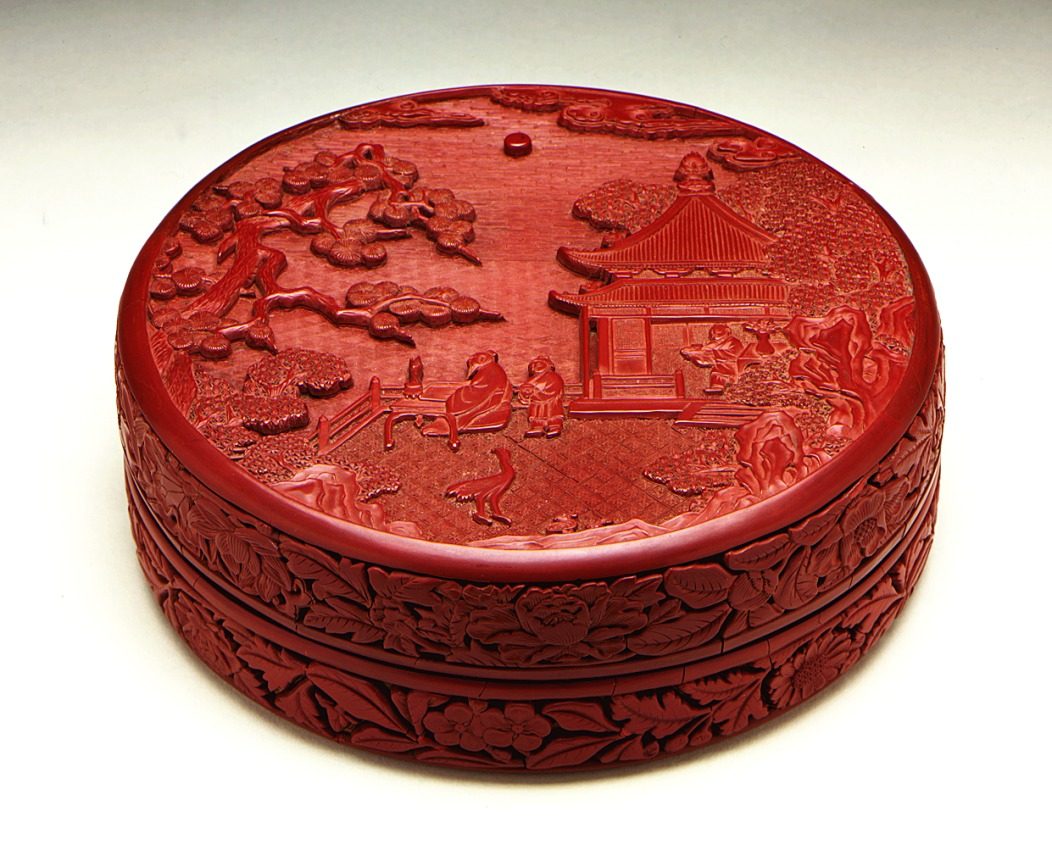
6 min read · 2 sourcesCarved lacquer or Qidiao (Chinese: 漆雕) is a distinctive Chinese form of decorated lacquerware. While lacquer has been used in China for at least 3,000 years, the technique of carving into very thick coatings of it appears to have been developed in the 12th century CE. It is extremely time-consuming to produce, and has always been a luxury product, essentially restricted to China, though imitated in Japanese lacquer in somewhat different styles. The producing process is called Diaoqi (雕漆, carving lacquer). Though most surviving examples are from the Ming and Qing dynasties, the main types of subject matter for the carvings were all begun under the Song dynasty, and the development of both these and the technique of carving were essentially over by the early Ming. These types were the abstract guri or Sword-Pommel pattern, figures in a landscape, and birds and plants. To these some designs with religious symbols, animals, auspicious characters (right) and imperial dragons can be added. 1
The objects made in the technique are a wide range of small types, but are mostly practical vessels or containers such as boxes, plates and trays. Some screens and pieces of Chinese furniture were made. Carved lacquer is only rarely combined with painting in lacquer and other lacquer techniques. 1
History
Later Chinese writers dated the introduction of carved lacquer to the Tang dynasty (618–906), and many modern writers have pointed to some late Tang pieces of armour found on the Silk Road by Aurel Stein and now in the British Museum. These are red and black lacquer on camel hide, but the lacquer is very thin, "less than one millimeter in thickness", and the effect very different, with simple abstract shapes on a plain field and almost no impression of relief. 1
Song dynasty, and the main types of subject matter
The style of carving into thick lacquer used later is first seen in the Southern Song (1127–1279), following the development of techniques for making very thick lacquer. There is some evidence from literary sources that it had existed in the late Tang. At first the style of decoration used is known as guri (屈輪) from the Japanese word for the ring-pommel of a sword, where the same motifs were used in metal, and is often called the "Sword-Pommel pattern" in English. This style uses a family of repeated two-branched scrolling shapes cut with a rounded profile at the surface, but below that a "V" section through layers of lacquer in different colours (black, red and yellow, and later green), giving a "marbled" effect from the contrasted colours; this technique is called tìxī (剔犀) in Chinese. This style continued to be used up to the Ming dynasty, especially on small boxes and jars with covers, though after the Song only red was often used, and the motifs were often carved with wider flat spaces at the bottom level to be exposed. Most Song carved lacquer to survive is in the guri and tixi style and technique, but the period also saw the development of a pictorial style, and the beginning of the two other main streams of iconography that were to dominate the rest of the history of carved lacquer, though surviving examples from the Song are rare. Both relate to Chinese art in other media, and use the existing vocabulary of Chinese ornament for borders. The first type of subject is scenes of people in a landscape, derived mainly from Chinese painting and woodcut book illustrations; such scenes were only later to be found in Chinese ceramics. 1
Yuan
In the Yuan dynasty the development of Song styles continued, especially from about 1320, after something of a hiatus (as also seen in other arts). Pieces in the Sword-Pommel pattern have more rounded tops to the ridges, and more narrow bottoms. The artistic quality of carving was perhaps never higher, in all the main streams of iconography: Sword-Pommel pattern, birds, flowers and foliage, and figures in landscapes. In the crowded, "exuberant and complex" designs with birds and plants, the forms overlap and curl in a more sculptural fashion, allowed by slightly thicker lacquer. By the late Yuan the reputation of individual masters has come down to us, although few pieces are signed and even these cannot be very confidently assigned to an artist, as the signatures may not be genuine. Yang Mao and Zhang Cheng were the most famous masters, both from Jiaxing in the southern province of Zhejiang. 1
Ming
Chinese diplomatic gifts to the Japanese government in the early Ming are especially well-documented on the Japanese side, at a time when the Ashikaga shogunate was enjoying a period of improved relations with China. In 1403 a consignment of luxury goods, also including Chinese silks and lacquered Chinese furniture, had 58 pieces of carved red lacquerware in a range of shapes. Lists with descriptions and measurements that allow some surviving pieces to be identified also survive from 1406, 1407, 1433 and 1434. These confirm that carved red lacquer was already "the favored type of lacquer for court use" by this point. Most early production of lacquer had been in the more suitable hot and moist climate of the south, but from the early Ming onwards the finest work was often from official workshops in Beijing, and the best early Ming work is "technically ... as near perfection as has ever been possible". The "Orchard Factory" was founded around 1416 in Lingjing hutong in Beijing, near the Forbidden City. It used imported workers from the south, the masters from Jiaxing in Zhejiang province, and other workers from Yunnan and Sichuan. As part of the internal tax or tribute system, about 5,000 workers from the south were required to work in the imperial workshops for terms of four years. The raw lacquer was also imported from the south, as the Chinese lacquer tree will not grow as far north as Beijing. Beijing was an unpromising location for lacquer production, being very cold in winter, and with dry and dusty air; the opposite of what was best. The Orchard Factory closed in 1436, after only some 20 years of operations. 1
Qing
Another imperial factory was founded beside the Forbidden City in 1680 under the Qing dynasty by the Kangxi Emperor and was still producing under the Qianlong Emperor (1736–95), "one of the most prodigal spenders in Chinese history" and a great lover of carved lacquer. Referring to the traditional complaints, stretching back to the Han dynasty, about the cost to the imperial budget of "ordinary" lacquerware, he had a carved Ming piece in the imperial collection engraved with an inscription beginning "Lacquer is cause for ten officials to complain; what if it is also carved?". 1
By the Qing period the repertoire of subjects for carved lacquer was essentially complete, but one addition in the Qianlong reign was a few pieces showing foreigners, mostly Central Asians bearing tribute though landscapes. 1
The text above is adapted from the Wikipedia article “Carved lacquer”, available under the Creative Commons Attribution-ShareAlike 4.0 licence. 1
carved lacquer is Chinese form of lacquerware, according to the structured record cited below. This entry was generated automatically from that record and has not yet been reviewed by a person familiar with the tradition. 2
The source record links this tradition to 2 external registers, which can be verified through the citation. 2