The tradition & historical record
4 min read · 2 sourcesIn knitting, casting on is a family of techniques for adding new stitches that do not depend on earlier stitches, i.e., having an independent lower edge. In principle, it is the opposite of binding off, but the techniques involved are generally unrelated. The cast-on can also be decorated with various stitch patterns, especially picots. The cast-on stitches can also be twisted clockwise or counterclockwise as they are added to the needle; this is commonly done for the single cast-on described below to give it a neater, more uniform look. Casting on is sometimes done with doubled-up needles or a needle of larger size than for the main pattern; the extra bit of yarn in each stitch makes the edge less tight and gives it more flexibility. When casting on at the beginning, one end of the yarn is usually secured to the knitting needle by knotting it, typically with a slip knot. This knot is unnecessary when casting on in the middle of the fabric (e.g., when making the upper edge of a buttonhole) since the yarn is already secured to the fabric. The original slip knot can be pulled out after a few rows have been knitted without damaging the knitted fabric. It is also possible to cast on using a simple twisted loop. Once one loop has been secured around the needle, or if it is already secured to the fabric, there are several different methods for adding others. 1
Methods for casting on in handknitting
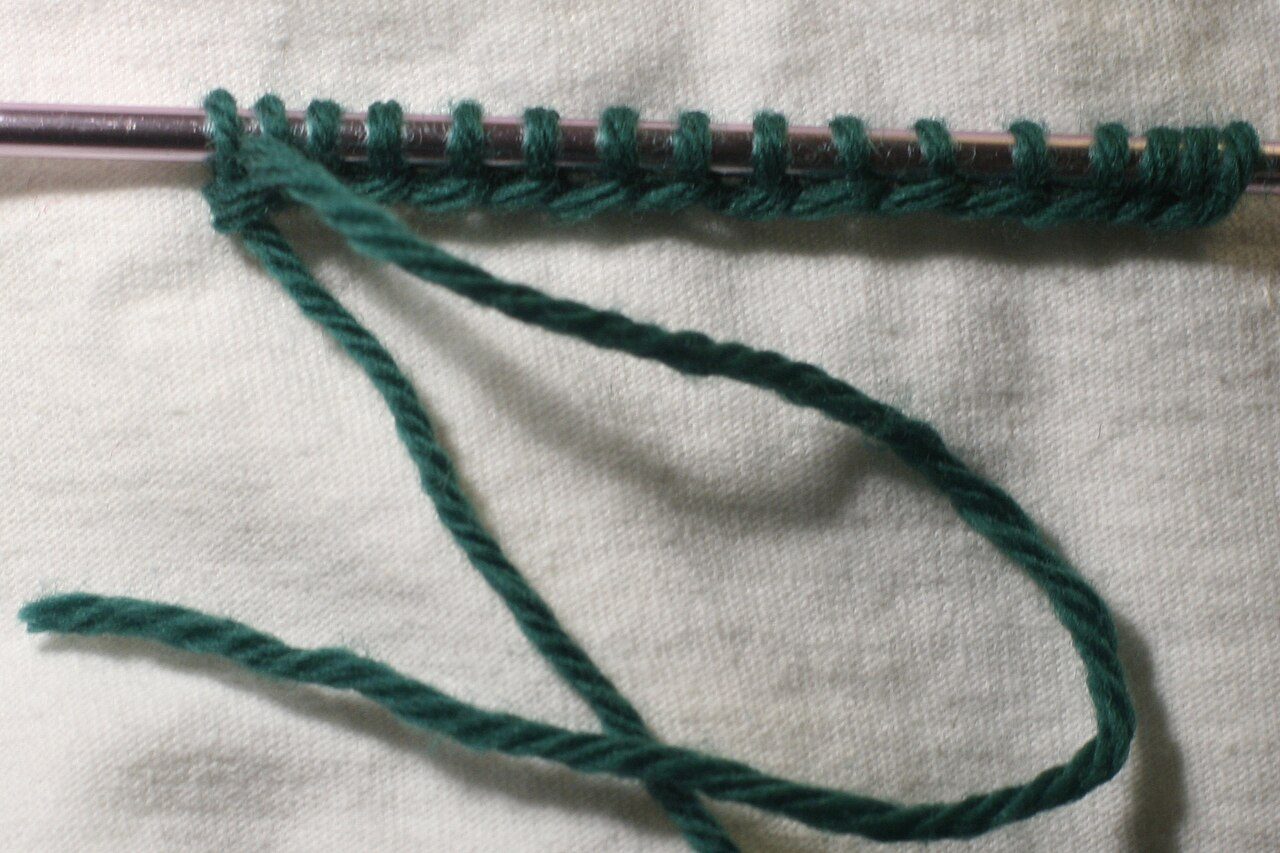
Knit-on cast-on Perhaps the most straightforward method, in which a new loop is drawn through the previous loop and then added to the needle. However, this method is deprecated for giving an untidy edge. It can also be done in a purl version or even a rib version. Cable cast-on A closely related technique, in which a new loop is drawn through the space between the two previous loops and then added to the needle. This edge is firm and has a neat, corded look; although it may be too bulky with thick yarns. Single cast-on An even simpler method, also called the "simple cast-on" or "backward loop cast-on," which involves adding a series of half hitches to the needle. This creates a very stretchy, flexible edge. It is a common approach for adding several stitches to the edge in the middle of a knitted fabric, but it is difficult to knit from and make even. A variation is the twisted simple cast on, where one twists the new loop around the thumb, with the yarn going around the back of the thumb to the front as in the simple cast-on, but picking up the new loop from the backside of the loop. This is tighter and neater but has less elasticity. Long tail cast-on A common method, in which all the loops are made with one yarn, while the other end (the dangling end from the original slip knot) is used to secure the base of each loop. The loops will appear like knit stitches. This method is also called the "knit half-hitch cast on". Although popular, this method requires that the knitter estimate the length of the dangling yarn before the stitches are cast on; if the dangling yarn is too short, the knitter will run out of yarn with which to secure the stitches before the full number of stitches have been cast on. 1
The text above is adapted from the Wikipedia article “Casting on (knitting)”, available under the Creative Commons Attribution-ShareAlike 4.0 licence. 1
casting on is in hand knitting, any of various techniques for adding new stitches that do not depend on earlier stitches, according to the structured record cited below. This entry was generated automatically from that record and has not yet been reviewed by a person familiar with the tradition. 2
The source record links this tradition to 1 external register, which can be verified through the citation. 2