The tradition & historical record
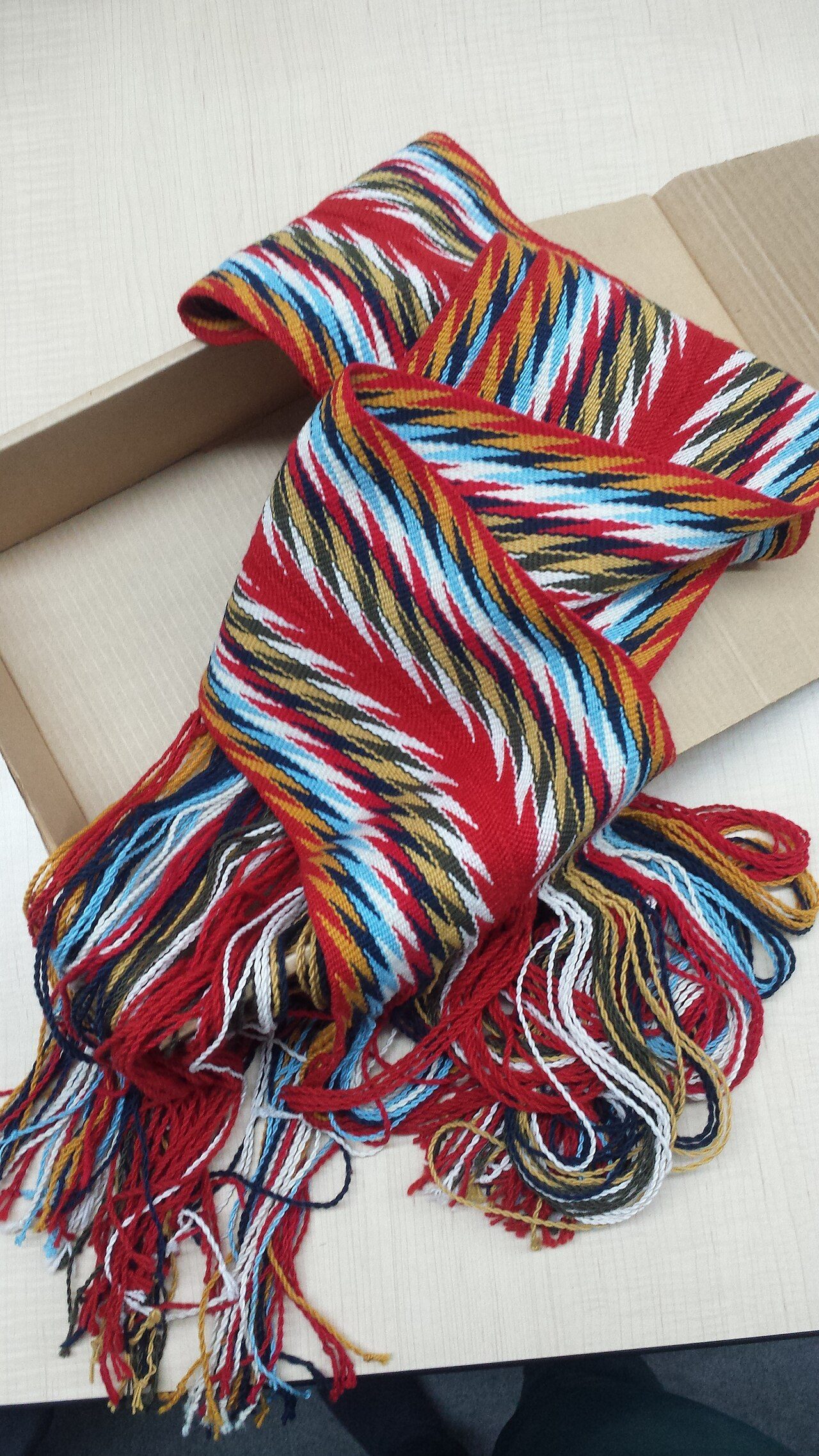
6 min read · 2 sourcesThe ceinture fléchée [sɛ̃tyʁ fleʃe] (French, 'arrowed sash') or ('arrow sash') is a type of colourful sash, a traditional piece of Québécois clothing linked to at least the 17th century (of the Lower Canada, Canada East and early confederation eras). The Métis also adopted and made ceintures fléchées (French-Canadian and later Metis or Michif translation: "Sayncheur Flayshii" or "Saenche(i)ur Flechey") and use them as part of their national regalia. Québécois and Métis communities share the sash as an important part of their distinct cultural heritages, nationalities, attires, histories and resistances. While the traditional view is that the ceinture fléchée is a Québécois invention, other origins have been suggested as well including the traditional fingerwoven Gaelic crios. According to Dorothy K. Burnham who prepared an exhibit on textiles at the National Gallery of Canada in 1981, and published an accompanying catalogue raisonné, this type of finger weaving was learned by residents of New France from Indigenous peoples. With European wool-materials, the syncretism and unification of Northern French and Indigenous finger-weaving techniques resulted in the making of Arrowed Sashes. The Arrow Sash pattern is the oldest known sash design; it was produced by Québécois artisans in 18th century. The Assomption pattern was produced after 1852. 1
History
In Quebec, the sash was worn by men in winter, tied around winter coats at the waist to keep out the cold. It had a utilitarian purpose and was considered fashionable and was worn by both the upper and habitant classes. The traditional width was 15 to 25 centimetres, and its length can easily be more than 2 metres. Fur traders also wore it to prevent back injuries and hernias. 1
It is adorned by an arrowed pattern and was worn around the winter coats of the time. It is also a symbol of the Lower Canada Rebellion and the Quebec Winter Carnival, as it is worn by the festival mascot, Bonhomme Carnaval. Imitations are sold and seen throughout the carnival. It is also an extremely important symbol of cultural pride for Québecois and Francophones in minority contexts across Canada outside of Québec. Franco-communities across Canada wear the sash during diverse and unique winter festivals. For example, the Festival du Voyageur in Manitoba, and Festival du Flying Canoë Volant in Alberta. During the Lower Canada Rebellion, Québécois people boycotted British products to resist English-Canada dominance. Because buttons and button-up coats were typically British-produced, the Québécois "rebels" commonly sewed their own clothes and wore the ceinture fléchée to keep their coats (capotes) closed. This was the main influence to the sash becoming an important part of the Lower Canada Rebellion uniform. The belt is represented in a number of artistic creations, such as the illustration Le Vieux de '37 by Henri Julien, the painting L'Assemblée des six-comtés by Charles Alexander Smith and the song Mon Pays, suivi du Reel des Aristocrates from néo-trad musical band Les Cowboys Fringants. The arrow sash was part of the traditional costume of the Lower Canada habitant at least from 1776 on. 1
Fabric-making process
Many steps are required in the creation of a ceinture fléchée. First, the weaver picks the wool threads that they need. The threads have to be long enough so that the person who will wear the sash can pass it twice around the waist. The weaver needs to add the length of the fringes at each end of the belt. The fringes are used to tie the arrow sash. After that, the weaver organizes the threads and weaves them to create designs of lightning bolts (zigzags), flames (lozenges) and arrow heads (usually in the middle of the sash). Finally, to make the fringes, the weaver finishes the belt by making twists or braids with the length of thread that remains. In the creation of a perfect ceinture fléchée or the intricate beadwork designs that would adorn various artifacts a hard callus develops on the tips of the finger. This is referred to as a "needle finger". It was considered a "rite of passage" for young girls and is acknowledged by the matriarchs in the family. 1
In English
Austin, Robert J. (2000). A Manual of Fingerweaving. A well ilustruted and colorful "How to do" sashes. Editor: Earl C. Fenner, published by Crazy Crow Trading Post Printed in Canada. ISBN 978-1-929572-00-7. Barbeau, Marius (1937). Assomption Sash, Ottawa: Dept. of Mines, National Museum of Canada. [Bulletin No. 93, Anthropological Series No. 24]. Beauvais, Michelle (2007). Braided Assomption Sash: so called "ceintured fléchée" or "arrowhead-design sash" pp. 37–42 in Space, Time and Braid published by Texte. Inc. Author Makiko Tada and Hiroyuki Hamada, printed in Japan (ISBN 978-4-925252-21-8). Bourdeau-Picard, Michelle (2004). An Alluring Symbol: The Arrow Sash in Canadian Art. Catalogue of an exhibition held at the Musée d'art de Joliette, Québec. May 21 to Aug. 22, 78 p. (ISBN 2-921801-28-0). Burnham, Dorothy K. (1976).Braided "Arrow" sash of Quebec. Irene Emery Roundtable at the Textile Museum Washington D.C.. [This was attended by Noemi Speiser.] Burnham, Dorothy K. (1981). The Comfortable Art: spinning and weaving in Canada. Chapter 2: Indian and French Braiding, published by National Museum of Canada. Burnham joined the staff of the Royal Ontario Museum in 1929 as a "second assistant draftsman" and became its first curator of textiles in 1939. Findley, Gerald Lee (2019). Fingerwoven Sashes: Basic Techniques. The book provides detailed instructions for three forms of fingerweaving that were developed by the people of the First Nations, and the settlers of North America. Amazon print on demand, Paperback : 193 pages ISBN 978-1070707488, ASIN 1070707481 Gottfred, J. "Ceinture Fléchée: Finger Weaving a Voyageur Sash", in Northwest Journal, Vol. VI, pp. 1–5. James, Carol (2008). Fingerweaving Untangled. 1
In French
Association des artisans de ceinture fléchées de Lanaudière inc. (1994). Histoire et origines de la ceinture fléchée traditionnelle dite de L'Assomption, collaboration avec le département d'ethnologie de l'université Laval à Québec. 125 p. Édition du Septentrion: Sillery, Québec. (ISBN 2-89448-002-4) (preview). Barbeau, Marius (1945). Ceinture fléchée, Montréal: Editions Paysana, 110 p. (ISBN 0885150341) Beauvais, Michelle (2007). Le tressage au-delà du trois brins avec révision (ressources électronique) Granby, M. Beauvais 167 pages (ISBN 978-2-9809125-1-1) Beauvais, Michelle (2006). Le tressage au-delà du trois brins, Granby: M. Beauvais, 137 p. (ISBN 2-9809125-0-6) Bourdeau-Picard, Michelle (2004). Un symbole de taille: la ceinture fléchée dans l'art canadien. Catalogue d'une exposition tenue du 21 mars au 22 août au Musée d'art de Joliette, Québec. 78p. (ISBN 2-921801-28-0). Bourret, Françoise, Lucie Lavigne (1973). Le fléché : l'art du tissage au doigt, Montréal: Éditions de l'Homme, 222 p. (ISBN 077590399X) Brousseau, Hélène Varin (1980). Le fléché traditionnel et contemporain, Montréal: La Presse, 133 p. 1
Specialized references in textiles
Burnh… 1
The text above is adapted from the Wikipedia article “Ceinture fléchée”, available under the Creative Commons Attribution-ShareAlike 4.0 licence. 1
ceinture fléchée is colorful sash of the 19th century associated with French-Canadians, Québécois, and Métis, according to the structured record cited below. This entry was generated automatically from that record and has not yet been reviewed by a person familiar with the tradition. 2
The source record links this tradition to 3 external registers, which can be verified through the citation. 2