The tradition & historical record
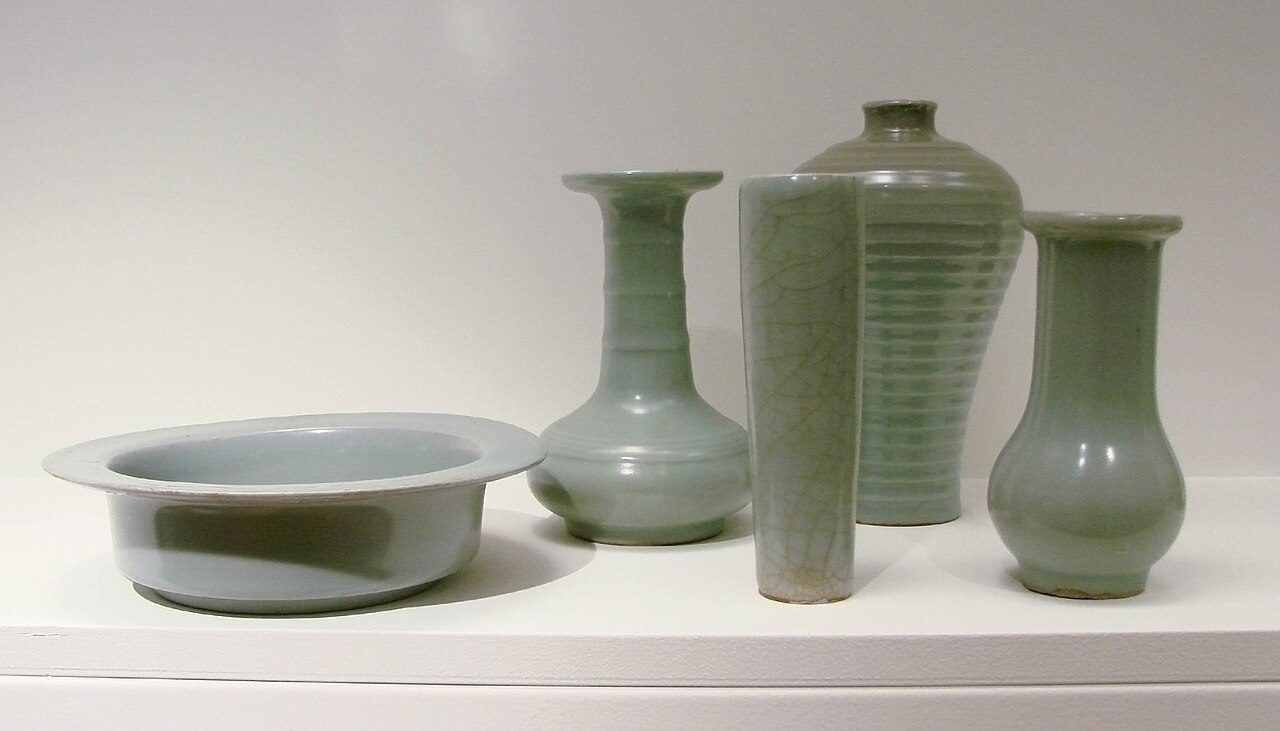
7 min read · 2 sourcesCeladon () is a term for pottery denoting both wares glazed in the jade green celadon color, also known as greenware or "green ware" (the term specialists now tend to use), and a type of transparent glaze, often with small cracks, that was first used on greenware, but later used on other porcelains. Celadon originated in China, though the term is purely European, and notable kilns such as the Longquan kiln in Zhejiang province are renowned for their celadon glazes. Celadon production later spread to other parts of East Asia, such as Japan and Korea, as well as Southeast Asian countries, such as Thailand and Vietnam. Eventually, European potteries produced some pieces, but it was never a major element there. Finer pieces are in porcelain, but both the color and the glaze can be produced in stoneware and earthenware. Most of the earlier Longquan celadon is on the border of stoneware and porcelain, meeting the Chinese but not the European definitions of porcelain. For many centuries, celadon wares were highly regarded by the Chinese imperial court, before being replaced in fashion by painted wares, especially the new blue and white porcelain under the Yuan dynasty. The similarity of the color to jade, traditionally the most highly valued material in China, was a large part of its attraction. Celadon continued to be produced in China at a lower level, often with a conscious sense of reviving older styles. 1
Etymology
The term "celadon" for the pottery's pale jade-green glaze was coined by European connoisseurs of the wares. The most commonly accepted theory is that the term first appeared in France in the 17th century as céladon, and that it is named after the shepherd Céladon in Honoré d'Urfé's pastoral romance L'Astrée (1627), who wore pale green ribbons. (D'Urfé, in turn, borrowed his character from Ovid's Metamorphoses V.144.) Another theory is that the term is a corruption of the name of Saladin (Salah ad-Din), the Ayyubid Sultan, who in 1171 sent forty pieces of the ceramic to Nur ad-Din Zengi, Sultan of Syria. 1
Production and characteristics
Celadon glaze refers to a family of usually partly transparent but colored glazes, many with pronounced (and sometimes accentuated) "crackle", or tiny cracks in the glaze produced in a wide variety of colors, generally used on stoneware or porcelain pottery bodies. So-called "true celadon", which requires a minimum 1,260 °C (2,300 °F) furnace temperature, a preferred range of 1,285 to 1,305 °C (2,340 to 2,380 °F), and firing in a reducing atmosphere, originated at the beginning of the Northern Song dynasty (960–1127), at least on one strict definition. The unique grey or green celadon glaze is a result of iron oxide's transformation from ferric to ferrous iron (Fe2O3 → FeO) during the firing process. Individual pieces in a single firing can have significantly different colors, from small variations in conditions in different parts of the kiln. Most of the time, green was the desired color, reminding the Chinese of jade, always the most valued material in Chinese culture. Celadon glazes can be produced in a variety of colors, including white, grey, blue and yellow, depending on several factors: 1
the thickness of the applied glaze, the type of clay to which it is applied, the exact chemical makeup of the glaze, the firing temperature the degree of reduction in the kiln atmosphere and the degree of opacity in the glaze. The most famous and desired shades range from a very pale green to deep intense green, often meaning to mimic the green shades of jade. The main color effect is produced by iron oxide in the glaze recipe or clay body. Celadons are almost exclusively fired in a reducing atmosphere kiln as the chemical changes in the iron oxide which accompany depriving it of free oxygen are what produce the desired colors. 1
Chinese celadons
Greenwares are found in earthenware from the Shang dynasty onwards. Archaeologist Wang Zhongshu states that shards with a celadon ceramic glaze have been recovered from Eastern Han dynasty (25–220 CE) tomb excavations in Zhejiang, and that this type of ceramic became well known during the Three Kingdoms (220–265). These are now often called proto-celadons, and tend to browns and yellows, without much green. The earliest major type of celadon was Yue ware, which was succeeded by a number of kilns in north China producing wares known as Northern Celadons, sometimes used by the imperial court. The best known of these is Yaozhou ware. All these types were already widely exported to the rest of East Asia and the Islamic world. 1
Longquan celadon wares were first made during the Northern Song, but flourished under the Southern Song, as the capital moved to the south and the northern kilns declined. This had bluish, blue-green, and olive green glazes and the bodies increasingly had high silica and alkali contents which resembled later porcelain wares made at Jingdezhen and Dehua rather than stonewares. All the wares mentioned above were mostly in, or aiming to be in, some shade of green. Other wares which can be classified as celadons, were more often in shades of pale blue, very highly valued by the Chinese, or various browns and off-whites. These were often the most highly regarded at the time and by later Chinese connoisseurs, and sometimes made more or less exclusively for the court. 1
Japanese celadons
The Japanese pronunciation of the Chinese characters for greenware is seiji (青磁). It was introduced during the Song dynasty (960–1270) from China and via Korea. Even though Japan has arguably the most diverse styles of ceramic art in the modern era, greenware was mostly avoided by potters because of the high loss rate of up to 80%. Kaolinite, the ceramic material usually used for the production of porcelain, also does not exist in large quantities like in China. One of the sources for kaolin in Japan is from Amakusa in Kyushu. Nevertheless, a number of artists emerged whose works received critical acclaim in regards to the quality and color of the glazes achieved, as well as later on in the innovation of modern design. Three pieces originally from China have been registered by the government as national treasures. They are two flower vases from the Longquan kiln dating to the southern Song dynasty in the 13th century, and a flower vase with iron brown spots also from Longquan kiln dating to the Yuan dynasty in the 13–14th century. Production in the style of Longquan was centered around Arita, Saga and in the Saga Domain under the lords of the Nabeshima clan. Greenware is also closed entwined with hakuji (白磁) white porcelain. The glaze with a mixed subtle color gradations of icy, bluish white is called seihakuji (青白磁) porcelain. In Chinese this type of glaze is known as Qingbai ware. Qingbai's history goes back to the Song dynasty. It is bisque-fired and painted with a glaze containing small amounts of iron. This turns a bluish color when fired again. 1
Korean celadons
Korean celadon has its own tradition of greenware production, dating back to the Three Kingdoms period. 1
The text above is adapted from the Wikipedia article “Celadon”, available under the Creative Commons Attribution-ShareAlike 4.0 licence. 1
celadon is ceramic ware with a jade-green to blue-green glaze, according to the structured record cited below. This entry was generated automatically from that record and has not yet been reviewed by a person familiar with the tradition. 2
The source record links this tradition to 8 external registers, which can be verified through the citation. 2