The tradition & historical record
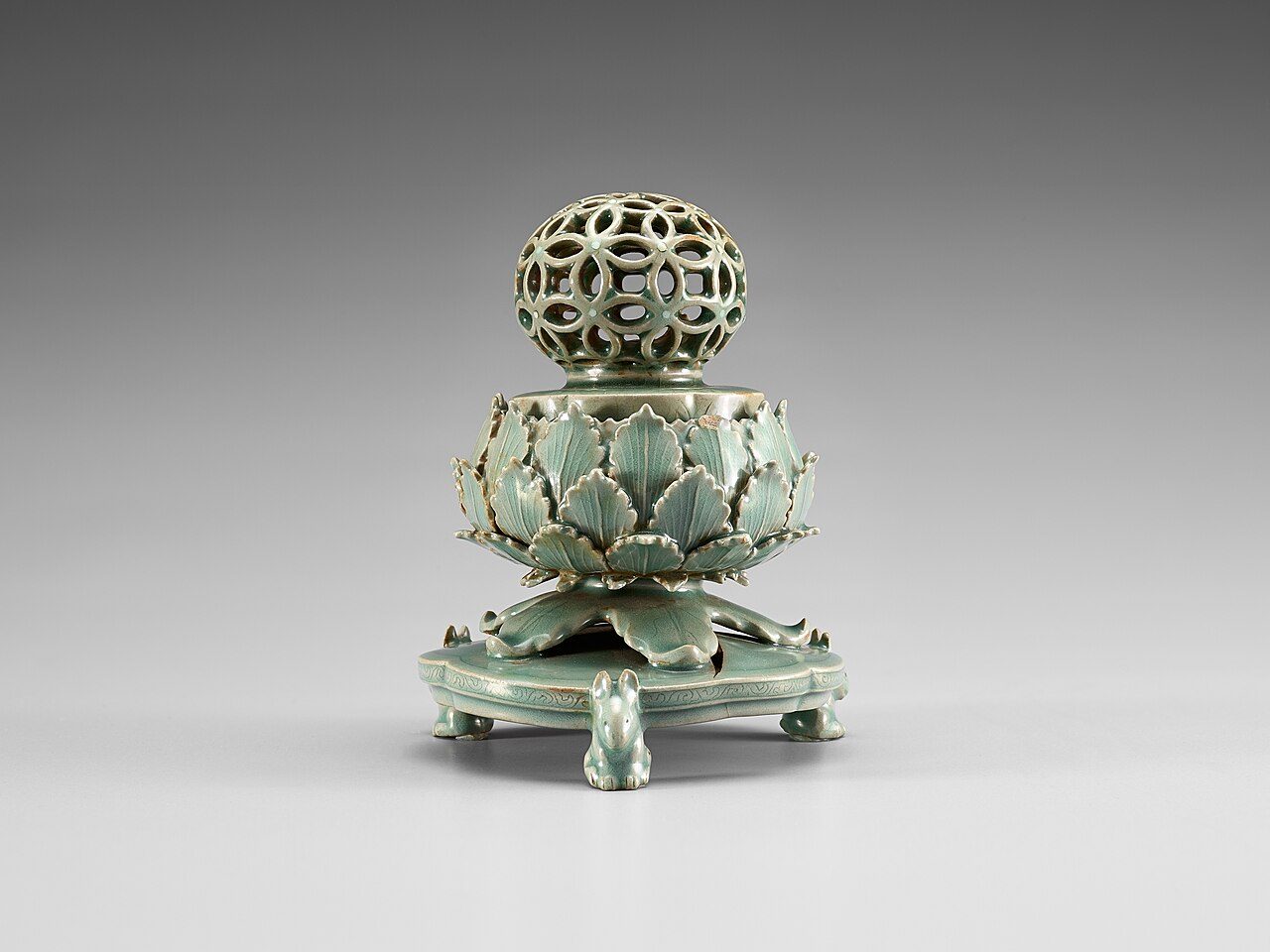
3 min read · 2 sourcesThe celadon incense burner with openwork auspicious-character design lid (Korean: 청자 투각칠보문뚜껑 향로) is a 12th-century Goryeo celadon incense burner, designated as the National Treasures of South Korea No. 95 on 20 December 1962. Standing 15.3 centimetres (6.0 in) in height with a base diameter of 11.2 centimetres (4.4 in), this exquisite ceremonial object dates to the golden age of Goryeo ceramic art under the reign of King Injong and King Uijong. The incense burner consists of three distinct structural sections: a spherical openwork lid, a central lotus-form body, and a pedestal base supported by three sculpted rabbits. It is preserved and displayed at the National Museum of Korea in Seoul. 1
Background
During the 12th century, Goryeo potters perfected the jade-colored translucent glaze known as bisaek (kingfisher green), achieving a level of refinement highly praised even by Song dynasty emissaries such as Xu Jing in his 1123 travelogue Goryeo Dogyeong, literally 'the journey to the capital of Goryeo'. While the exact circumstances of its original discovery remain unrecorded due to its acquisition during the early 20th century, archaeological excavations at the Sadang-ri kiln sites in Gangjin County, South Jeolla Province, yielded identical porcelain shards, structural fragments, and firing tools. These findings confirmed that this incense burner was crafted at the official royal kilns in Gangjin, which exclusively manufactured high-grade celadon for the Goryeo royal court, aristocratic rituals, and state Buddhist ceremonies. 1
Characteristics
The vessel exhibits a sophisticated composition that seamlessly integrates diverse decorative techniques including openwork carving (tugak), high-relief modeling, incising, and underglaze white-and-black slip dotting. The top cover is a hollow sphere decorated with a complex, openwork geometric pattern based on interlocking rings, traditionally called the "seven-treasure" (chilbomun) motif, which allowed incense smoke to billow gracefully through the openings. The middle receptacle that holds the burning incense is encircled by overlapping, sculpted lotus petals individual raised in relief, each tipped with a fine white slip dot for added dimensionality. The lower pedestal rests on three small, fully three-dimensional rabbits facing outward, whose eyes are highlighted with delicate black iron-pigment dots. 1
Significance
The incense burner synthesizes deep symbolic traditions from Buddhism and Taoist nature philosophy into a cohesive sacred vessel. Burning incense was a fundamental rite in Goryeo Buddhist rituals, serving to purify space, summon deities, and elevate prayers to heaven. The lotus flower represents transcendent spiritual purity emerging unstained from mud, while the openwork seven-treasure motif symbolizes royal nobility, cosmic harmony, and infinite good fortune. The three rabbits supporting the weight of the lotus pedestal reflect the ancient East Asian legend of the moon rabbit, symbolizing immortality, peace, and longevity. 1
The text above is adapted from the Wikipedia article “Celadon Incense Burner with Openwork Auspicious-character Design Lid”, available under the Creative Commons Attribution-ShareAlike 4.0 licence. 1
celadon incense burner with openwork auspicious-character design lid is Korean cultural heritage item, according to the structured record cited below. This entry was generated automatically from that record and has not yet been reviewed by a person familiar with the tradition. 2
The source record links this tradition to 1 external register, which can be verified through the citation. 2