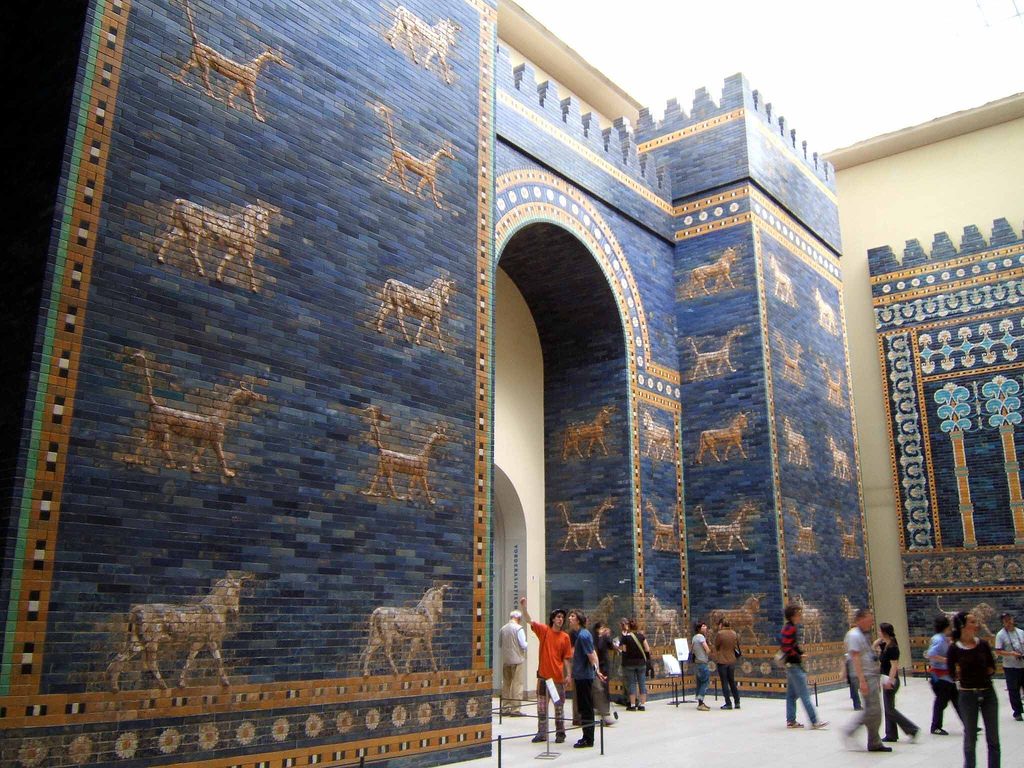
The tradition & historical record
6 min read · 2 sourcesA ceramic is any of the various hard, brittle, heat-resistant, and corrosion-resistant materials made by shaping and then firing an inorganic, nonmetallic material, such as clay, at a high temperature. Common examples are earthenware, porcelain, and brick. The earliest ceramics made by humans were fired clay bricks used for building house walls and other structures. Other pottery objects such as pots, vessels, vases and figurines were made from clay, either by itself or mixed with other materials like silica, hardened by sintering in fire. Later, ceramics were glazed and fired to create smooth, colored surfaces, decreasing porosity through the use of glassy, amorphous ceramic coatings on top of the crystalline ceramic substrates. Ceramics now include domestic, industrial, and building products, as well as a wide range of materials developed for use in advanced ceramic engineering, such as semiconductors. The word ceramic comes from the Ancient Greek word κεραμικός (keramikós), meaning "of or for pottery" (from κέραμος (kéramos) 'potter's clay, tile, pottery'). The earliest known mention of the root ceram- is the Mycenaean Greek ke-ra-me-we, workers of ceramic, written in Linear B syllabic script. The word ceramic can be used as an adjective to describe a material, product, or process, or it may be used as a noun, either singular or, more commonly, as the plural noun ceramics. 1
Materials
Ceramic material is an inorganic, metallic oxide, nitride, or carbide material. Some elements, such as carbon or silicon, may be considered ceramics. Ceramic materials are brittle, hard, strong in compression, and weak in shearing and tension. They withstand the chemical erosion that occurs in other materials subjected to acidic or caustic environments. Ceramics generally can withstand very high temperatures, ranging from 1,000 °C to 1,600 °C (1,800 °F to 3,000 °F). 1
The crystallinity of ceramic materials varies widely. Most often, fired ceramics are either vitrified or semi-vitrified, as is the case with earthenware, stoneware, and porcelain. Varying crystallinity and electron composition in the ionic and covalent bonds cause most ceramic materials to be good thermal and electrical insulators (researched in ceramic engineering). With such a large range of possible options for the composition/structure of a ceramic (nearly all of the elements, nearly all types of bonding, and all levels of crystallinity), the breadth of the subject is vast, and identifiable attributes (hardness, toughness, electrical conductivity) are difficult to specify for the group as a whole. General properties such as high melting temperature, high hardness, poor conductivity, high moduli of elasticity, chemical resistance, and low ductility are the norm, with known exceptions to each of these rules (piezoelectric ceramics, low glass transition temperature ceramics, superconductive ceramics). Composites such as fiberglass and carbon fiber, while containing ceramic materials, are not considered to be part of the ceramic family. Highly oriented crystalline ceramic materials are not amenable to a great range of processing. 1
History
Human beings appear to have been making their own ceramics for at least 26,000 years, subjecting clay and silica to intense heat to fuse and form ceramic materials. The earliest found so far were in southern central Europe and were sculpted figures, not dishes. The earliest known pottery was made by mixing animal products with clay and firing it at up to 800 °C (1,500 °F). While pottery fragments have been found up to 19,000 years old, it was not until about 10,000 years later that regular pottery became common. An early people that spread across much of Europe is named after its use of pottery: the Corded Ware culture. These early Indo-European peoples decorated their pottery by wrapping it with rope while it was still wet. When the ceramics were fired, the rope burned off but left a decorative pattern of complex grooves on the surface. 1
The invention of the wheel eventually led to the production of smoother, more even pottery using the wheel-forming (throwing) technique, like the pottery wheel. Early ceramics were porous, absorbing water easily. It became useful for more items with the discovery of glazing techniques, which involved coating pottery with silicon, bone ash, or other materials that could melt and reform into a glassy surface, making a vessel less pervious to water. 1
Archaeology
Ceramic artifacts have an important role in archaeology for understanding the culture, technology, and behavior of peoples of the past. They are among the most common artifacts to be found at an archaeological site, generally in the form of small fragments of broken pottery called sherds. The processing of collected sherds can be consistent with two main types of analysis: technical and traditional. The traditional analysis involves sorting ceramic artifacts, sherds, and larger fragments into specific types based on style, composition, manufacturing, and morphology. By creating these typologies, it is possible to distinguish between different cultural styles, the purpose of the ceramic, and the technological state of the people, among other conclusions. Besides, by looking at stylistic changes in ceramics over time, it is possible to separate (seriate) the ceramics into distinct diagnostic groups (assemblages). A comparison of ceramic artifacts with known dated assemblages allows for a chronological assignment of these pieces. The technical approach to ceramic analysis involves a finer examination of the composition of ceramic artifacts and sherds to determine the source of the material and, through this, the possible manufacturing site. Key criteria are the composition of the clay and the temper used in the manufacture of the article under study: the temper is a material added to the clay during the initial production stage and is used to aid the subsequent drying process. Types of temper include shell pieces, granite fragments, and ground sherd pieces called 'grog'. Temper is usually identified by microscopic examination of the tempered material. 1
Properties
The physical properties of any ceramic substance are a direct result of its crystalline structure and chemical composition. Solid-state chemistry reveals the fundamental connection between microstructure and properties, such as localized density variations, grain size distribution, type of porosity, and second-phase content, which can all be correlated with ceramic properties such as mechanical strength σ by the Hall-Petch equation, hardness, toughness, dielectric constant, and the optical properties exhibited by transparent materials. Ceramography is the art and science of preparation, examination, and evaluation of ceramic microstructures. Evaluation and characterization of ceramic microstructures are often implemented on similar spatial scales to that used commonly in the emerging field of nanotechnology: from nanometers to tens of micrometers (μm). 1
Mechanical properties
Mechanical properties are important in stru… 1
The text above is adapted from the Wikipedia article “Ceramic”, available under the Creative Commons Attribution-ShareAlike 4.0 licence. 1
ceramic is inorganic, nonmetallic solid prepared by the action of heat, according to the structured record cited below. This entry was generated automatically from that record and has not yet been reviewed by a person familiar with the tradition. 2
The source record links this tradition to 81 external registers, which can be verified through the citation. 2