The tradition & historical record
5 min read · 2 sourcesCeramic art, one of the plastic arts, is art made from ceramic materials, including clay. Ceramic art may take forms such as pottery, tiles, figurines, sculptures, and tableware. While some ceramic products are considered fine art, others are considered decorative, industrial, or applied art objects. Ceramics may also be considered artefacts in archaeology. People design, manufacture, and decorate pottery in pottery or ceramic factories. Some pottery is regarded as art pottery. In one-person pottery studios, ceramists or potters produce studio pottery. Ceramics exclude glass and mosaics made from glass tesserae. In Britain and the United States, modern ceramics as an art took its inspiration in the early twentieth century from the Arts and Crafts movement, leading to the revival of pottery considered as a specifically modern craft. Such crafts emphasized traditional non-industrial production techniques, faithfulness to the material, the skills of the individual maker, attention to utility, and an absence of excessive decoration that was typical to the Victorian era. The word "ceramics" comes from the Greek keramikos (κεραμεικός), meaning "pottery", which in turn comes from keramos (κέραμος) meaning "potter's clay". Most traditional ceramic products were made from clay (or clay mixed with other materials), shaped and subjected to heat, and tableware and decorative ceramics are generally still made this way. 1
Materials
Different types of clay, when used with different minerals and firing conditions, are used to produce different types of ceramic, including earthenware, stoneware, porcelain and bone china. 1
Earthenware
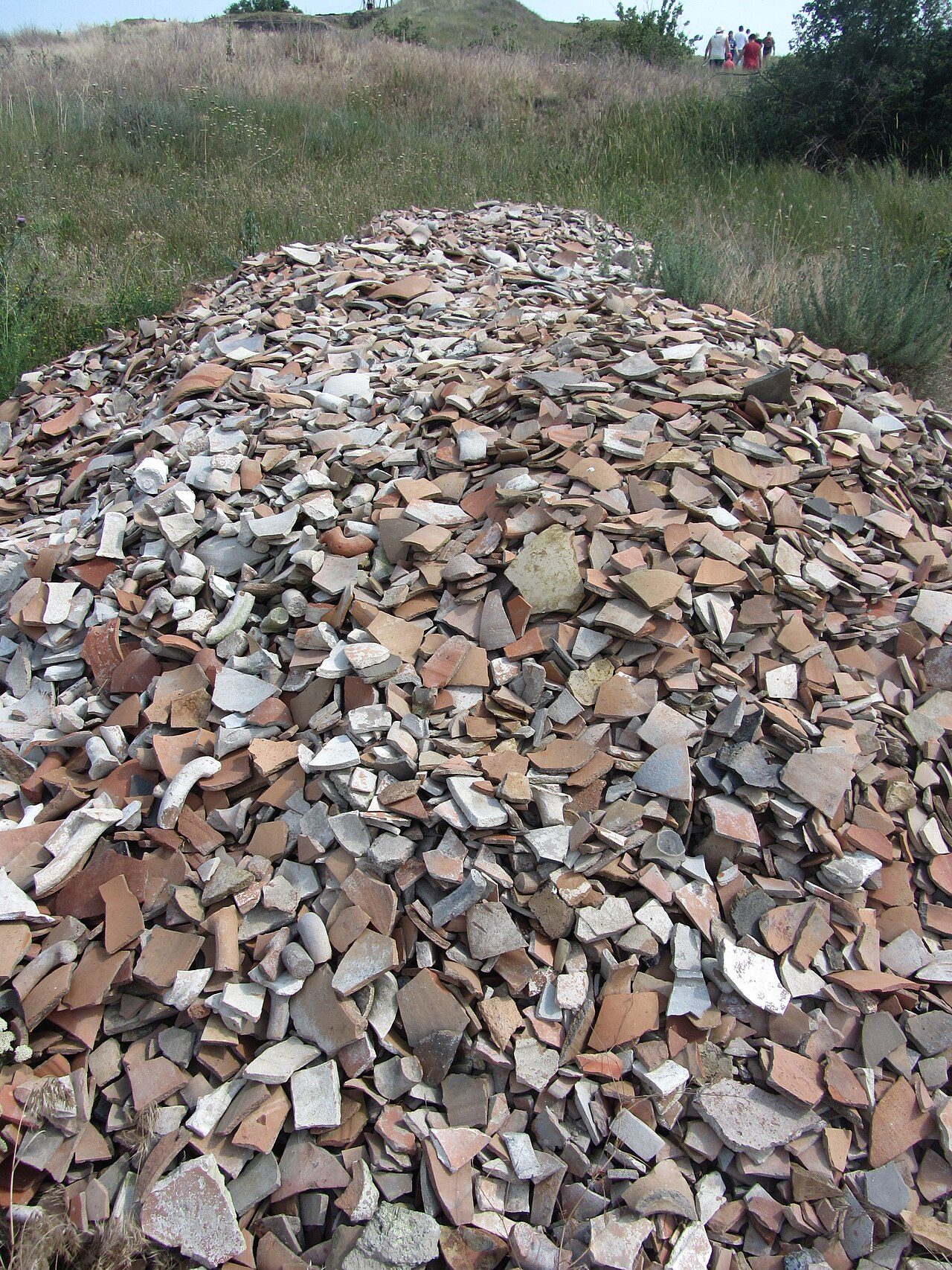
Earthenware is pottery that has not been fired to vitrification and is thus permeable to water. Many types of pottery have been made from it from the earliest times, and until the 18th century it was the most common type of pottery outside the far East. Earthenware is often made from clay, quartz and feldspar. Terracotta, a type of earthenware, is a clay-based unglazed or glazed ceramic, where the fired body is porous. Its uses include utilitarian vessels, flower pots, water and waste water pipes, bricks, and surface embellishment in building construction. Terracotta has been a common medium for ceramic art (see below). 1
Stoneware
Stoneware is a vitreous or semi-vitreous ceramic made primarily from stoneware clay or non-refractory fire clay. Stoneware is fired at high temperatures. Vitrified or not, it is nonporous; it may or may not be glazed. One widely recognised definition is from the Combined Nomenclature of the European Communities, a European industry standard states "Stoneware, which, though dense, impermeable and hard enough to resist scratching by a steel point, differs from porcelain because it is more opaque, and normally only partially vitrified. It may be vitreous or semi-vitreous. It is usually coloured grey or brownish because of impurities in the clay used for its manufacture, and is normally glazed." 1
Porcelain
Porcelain is a ceramic material made by heating materials, generally including kaolin, in a kiln to temperatures between 1,200 and 1,400 °C (2,200 and 2,600 °F). The toughness, strength and translucence of porcelain, relative to other types of pottery, arises mainly from vitrification and the formation of the mineral mullite within the body at these high temperatures. Properties associated with porcelain include low permeability and elasticity; considerable strength, hardness, toughness, whiteness, translucency and resonance; and a high resistance to chemical attack and thermal shock. Porcelain has been described as being "completely vitrified, hard, impermeable (even before glazing), white or artificially coloured, translucent (except when of considerable thickness), and resonant". However, the term porcelain lacks a universal definition and has "been applied in a very unsystematic fashion to substances of diverse kinds which have only certain surface-qualities in common". 1
Bone china
Bone china is a type of soft-paste porcelain that is composed of bone ash, feldspathic material, and kaolin. It has been defined as ware with a translucent body containing a minimum of 30% of phosphate derived from animal bone and calculated calcium phosphate. Developed by English potter Josiah Spode, bone china is known for its high levels of whiteness and translucency, and very high mechanical strength and chip resistance. Its high strength allows it to be produced in thinner cross-sections than other types of porcelain. Like stoneware it is vitrified, but is translucent due to differing mineral properties. From its initial development and up to the later part of the twentieth century, bone china was almost exclusively an English product, with production being effectively localised in Stoke-on-Trent. Most major English firms made or still make it, including Mintons, Coalport, Spode, Royal Crown Derby, Royal Doulton, Wedgwood and Worcester. In the UK, references to "china" or "porcelain" can refer to bone china, and "English porcelain" has been used as a term for it, both in the UK and around the world. Fine china is not necessarily bone china, and is a term used to refer to ware which does not contain bone ash. 1
The text above is adapted from the Wikipedia article “Ceramic art”, available under the Creative Commons Attribution-ShareAlike 4.0 licence. 1
ceramic art is art objects made from clay and other raw materials by the process of pottery, according to the structured record cited below. This entry was generated automatically from that record and has not yet been reviewed by a person familiar with the tradition. 2
The source record links this tradition to 20 external registers, which can be verified through the citation. 2